



From polymers to power, Barito Pacific widens reach
JAKARTA, thekabarnews.com—Barito Pacific has expanded from its petrochemical base into a regional industrial group. Now, it has businesses spanning chemicals, power generation, renewable energy and...

JAKARTA, thekabarnews.com—Barito Pacific has expanded from its petrochemical base into a regional industrial group. Now, it has businesses spanning chemicals, power generation, renewable energy and infrastructure across Indonesia and Singapore.
The group has pursued this expansion through its controlling interests in Chandra Asri Pacific and Barito Renewables Energy. In addition, it has formed partnerships and made acquisitions.
Its portfolio now includes petrochemical plants, geothermal and wind facilities, and a coal-fired power project. It also contains ports, storage facilities, shipping services and industrial utilities.
Barito Pacific reported unaudited consolidated revenue of US$5.69 billion for the first half of 2026. This is a 76.1 percent increase from the same period a year earlier.
The company explained much of the growth to Chandra Asri Group’s refinery performance and the integration of ExxonMobil’s Singapore retail assets.
Net profit after tax reached US$518 million, although it fell 70 percent year-on-year from an unusually high comparative base. Total debt stood at US$8.12 billion, while net debt reached US$4.94 billion.
The figures indicate that the group’s expansion has increased its operating scale. Additionally, it now requires substantial capital and financing, as reported by a Barito Pacific official.
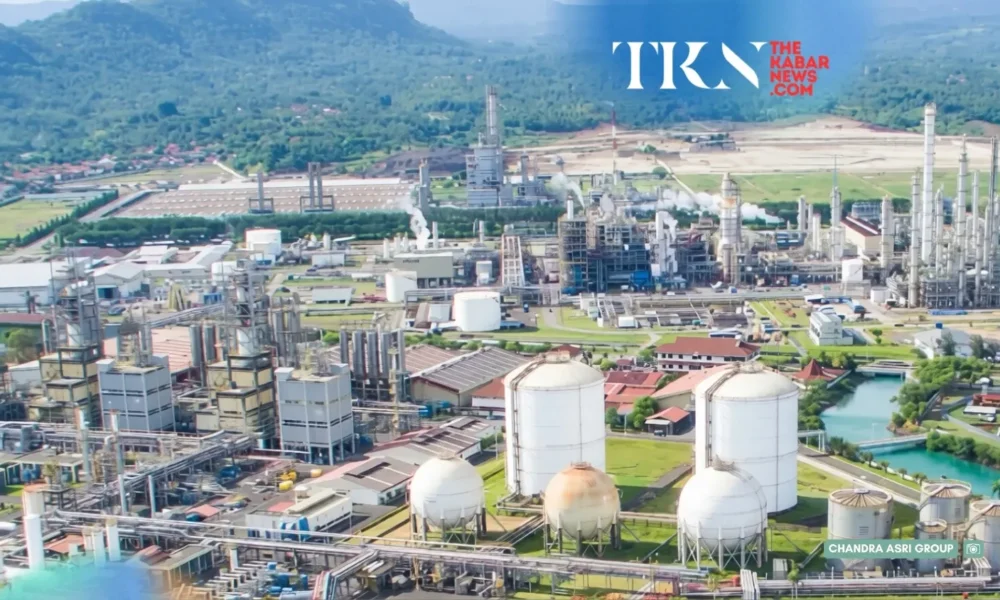
Chandra Asri remains central to Barito Pacific’s industrial portfolio. Beyond petrochemicals, the parent company has developed infrastructure businesses through Chandra Daya Investasi, covering electricity, water, ports, storage and maritime logistics.
Its international expansion accelerated in 2025. This occurred when Chandra Asri and Glencore acquired Shell’s Energy and Chemicals Park in Singapore through a joint venture.
The operation, now known as Aster Chemicals and Energy, includes a refinery capable of processing 237,000 barrels of crude oil per day. Moreover, it has an ethane cracker with an annual capacity of 1.1 million metric tons.
Chandra Asri also acquired ExxonMobil’s Esso-branded petrol-station network in Singapore. These transactions extended the group’s reach into refining and fuel retail. Consequently, its energy portfolio is not limited to low-carbon assets.
Renewable energy forms a separate growth pillar. Barito Renewables currently operates 926 megawatts of geothermal capacity through Star Energy Geothermal. It also owns the 79-MW Sidrap wind farm in South Sulawesi. Together, those assets provide 1,005 MW of installed renewable capacity.
Star Energy operates the Wayang Windu, Salak and Darajat geothermal complexes. Additional projects are intended to lift geothermal capacity to about 1 gigawatt by the end of 2026. However, that figure remains a corporate target rather than completed capacity.
Barito Pacific also participates in conventional power generation through Indo Raya Tenaga, its venture with PLN subsidiary Indonesia Power. The company operates the 2,000-MW Java 9 and 10 ultra-supercritical coal-fired power plants in Suralaya, Banten.
The expanded portfolio gives Barito Pacific several revenue sources and links its manufacturing operations with supporting infrastructure.
However, its combination of renewable assets, petrochemicals, refining and coal power also exposes the group to commodity cycles. It also brings financing risks and is subject to Indonesia’s evolving energy-transition policies.


No Comment! Be the first one.