



The business strategy behind Rocket Chicken’s 1,300-outlet expansion
Thekabarnews.com—Rocket Chicken has proven that success in the big business world does not always start with fancy locations, giant capital, or complicated corporate strategies. Nevertheless, it has...

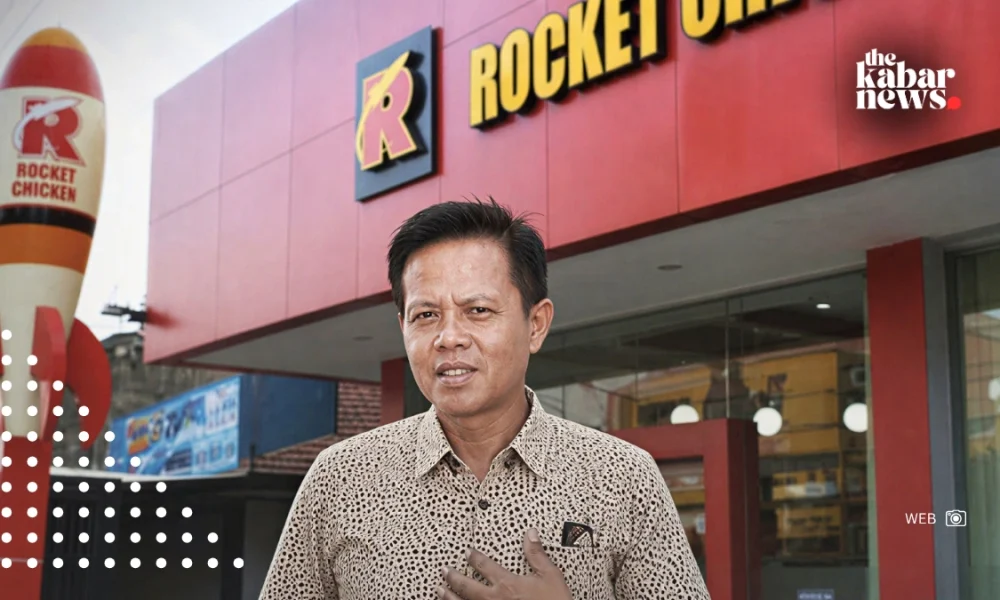
Thekabarnews.com—Rocket Chicken has proven that success in the big business world does not always start with fancy locations, giant capital, or complicated corporate strategies. Nevertheless, it has become one of Indonesia’s most popular local fried chicken brands.
Instead, the company grew by understanding one simple fact about Indonesian consumers: people want food that’s tasty, quick, affordable, and easy to reach.
That knowledge made Rocket Chicken grow from a small local business into one of the country’s biggest fried-chicken restaurant chains. Reportedly, it now boasts more than 1,300 outlets across Indonesia.
Thanks to the founder Nurul Atik, who often draws attention for his humble beginnings, the business has experienced rapid growth.
Nurul Atik is said to have worked as a cleaning service worker in the fried chicken industry before starting his own company. He learned restaurant operations through day-to-day field experience, not business theory.
Nurul Atik looked at how kitchens functioned. He watched how the cashiers took orders. He watched the handling of raw materials.
Nurul Atik observed how minor operational errors, such as incorrect ingredient quantities or improper adherence to food safety regulations, could accumulate significantly. Ultimately, that practical experience later became a powerful foundation for the firm.
Many food businesses fail because they only focus on taste and not on operational consistency. Good taste is simply not enough in the food and beverage industry.
You need consistency of quality, good prices, fast service, manageable inventory, and systems that allow your branches to run efficiently. Therefore, your restaurants should operate even without you having to be there all the time.
It seems that Rocket Chicken faced that challenge early on. The company’s strength is not just in its fried chicken products. Additionally, it shines in the operational systems that enable thousands of employees and outlets.
Rocket Chicken was founded in 2010 and grew aggressively using a partnership and franchise-based model.
Shopping malls and prime city locations are the primary focus of many major fast food brands. Rocket Chicken had specifically targeted shop houses along the roads, residential areas, schools, and commercial centers in the regions.
This strategy enabled the company to maintain affordable menu prices and to penetrate a broader middle- and lower-income market.
This is in line with consumer behavior in Indonesia, as many families, students, and workers tend to go for affordable food. They would rather do this than splurge on fine dining.
Rocket Chicken menus continue to offer a simple, familiar menu of local flavors: fried chicken, rice, sauces, drinks, and side dishes to complete the meal.
The simplicity makes the operations easier, and the customers also find it easier to decide on the purchase. The company also uses standard operating procedures (SOPs) to maintain consistency across outlets.
These SOPs for big restaurant chains include everything from measurements of seasonings, methods of frying, cleanliness of the kitchen, service of cashiers, and use of inventory to management of workflow.
The level of service provided across hundreds of branches is often much more difficult to achieve than opening new stores.
Rocket Chicken also has layered supervision systems in its outlets, with defined operational roles for supervisors, kitchen staff, cashiers, and crew members. Because of this system, the company can control operationally a vast network.
Its partnership model has also attracted many regional entrepreneurs to set up their outlets, contributing to the local economy. Rocket Chicken is relatively inexpensive for local partners compared to many of the other large franchise businesses.
Partnership packages reportedly include operational training, outlet standards, initial equipment, raw materials, and business assistance. Rocket Chicken’s greatest strength, may be its discipline about keeping things cheap and profitable.
It’s not about chasing luxury brand status, but about controlling operating expenses, streamlining menus, choosing the right sites, and creating repeatable systems. But to many bystanders, Rocket Chicken is more than just a successful fried chicken venture.
This is an example of how local brands can evolve into national players by leveraging consumers’ daily habits, maintaining operational discipline, and creating systems that support long-term sustainability.
Rocket Chicken proves that solid execution of simple ideas can still beat luxury concepts and flashy branding in Indonesia’s food industry. Remarkably, it has been able to attract a loyal customer base and maintain its profitability amid competition.

No Comment! Be the first one.