



Pontianak sends barges for freshwater as salinity rises
PONTIANAK, thekabarnews.com—The Pontianak city administration and municipal water company PDAM Tirta Khatulistiwa are preparing to transport raw freshwater by barge. This response comes in the wake...

PONTIANAK, thekabarnews.com—The Pontianak city administration and municipal water company PDAM Tirta Khatulistiwa are preparing to transport raw freshwater by barge. This response comes in the wake of seawater intrusion that has affected another source supplying the West Kalimantan capital.
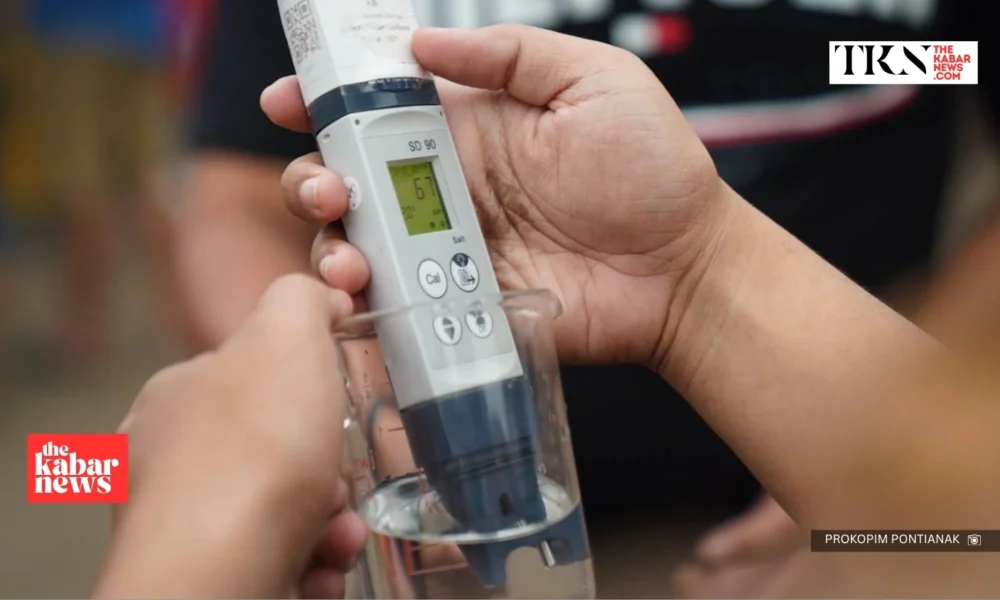
Pontianak Mayor Edi Rusdi Kamtono said on Sunday, September 13, that salt levels at the Penepat reservoir had risen above 1,000 milligrams per liter. Moreover, turbid water had created further difficulties for the treatment process.
“Based on developments through yesterday, seawater has already intruded into our raw-water source at Penepat,” Edi said, according to Pontianak.go.id.
“The salt level is above 1,000 milligrams per liter, and the water is turbid. We have no other choice but to locate an alternative source.”
The city plans to collect water from Radak village in Terentang district, Kubu Raya Regency. Officials measured the salt concentration at the location to be below 10 milligrams per liter.
Three barges will transport the raw water to Pontianak for treatment. The administration scheduled the first shipment for Monday but had not confirmed its arrival when this article was prepared.
“We will bring the water here for treatment. We will likely deliver it to the Parit Mayor water treatment plant to supply East Pontianak and to Nipah Kuning Dalam in the western area. Then supply the Selat Panjang plant,” Edi said.
The water remains raw during transportation. It must undergo treatment and quality testing before authorities can describe it as safe for consumption.
Pontianak is also increasing its reverse-osmosis capacity to process water during the emergency. The technology removes dissolved salts through a membrane, but its output remains limited compared with the city’s overall demand.
“We have requested additional reverse-osmosis equipment to increase capacity. This is an emergency, so we must strengthen our treatment capability,” Edi said.
The mayor said officials had identified another source with a salt concentration of approximately 47 milligrams per liter.
If the city can direct it into its third water treatment facility, the source could provide around 100 liters per second.
PDAM Tirta Khatulistiwa President Director Abdullah said the utility’s existing seawater reverse-osmosis system could not serve Pontianak at a citywide scale.
The company’s water treatment plants have a combined capacity of around 2,300 liters per second.
“Our SWRO capacity remains small, so we use it mainly as a solution under certain conditions,” Abdullah said.
“In the current situation, we need raw-water sources with lower salt levels that our existing system can process.”
Seawater intrusion has affected Pontianak during the prolonged dry season as saline water travels upstream into the Kapuas River system.
In late August, the salt concentration in the Kapuas exceeded 5,000 milligrams per liter. As a result, the city had to rely more heavily on Penepat as a reserve source.
PDAM Tirta Khatulistiwa continues to supply hospitals and community collection points with treated freshwater.
Abdullah said the company had distributed 1.3 million liters from an initial stock of 1.5 million liters at Perumnas III.
It also distributed approximately 350,000 of the 500,000 liters stored at Wonoyoso. Another 20,000 liters came from a 30,000-liter supply at the Kesehatan booster facility.
Residents can collect water using containers, while tanker trucks deliver supplies to neighborhoods and health facilities.
PDAM Tirta Khatulistiwa will provide the emergency water at no cost. However, owing to the barge’s limited capacity, it can’t be directly delivered to each household connection.
The barges and additional treatment equipment offer temporary relief. Pontianak will still need a stable raw-water source and sufficient treatment capacity to protect its public supply from future periods of severe saltwater intrusion.





No Comment! Be the first one.