



Kadin: Rp1,998.7 trillion in domestic investment
BOGOR, The Kabar News—President Prabowo Subianto met 250 Indonesian Chamber of Commerce and Industry (Kadin) members and about 400 participants in a national leadership program at his Hambalang...

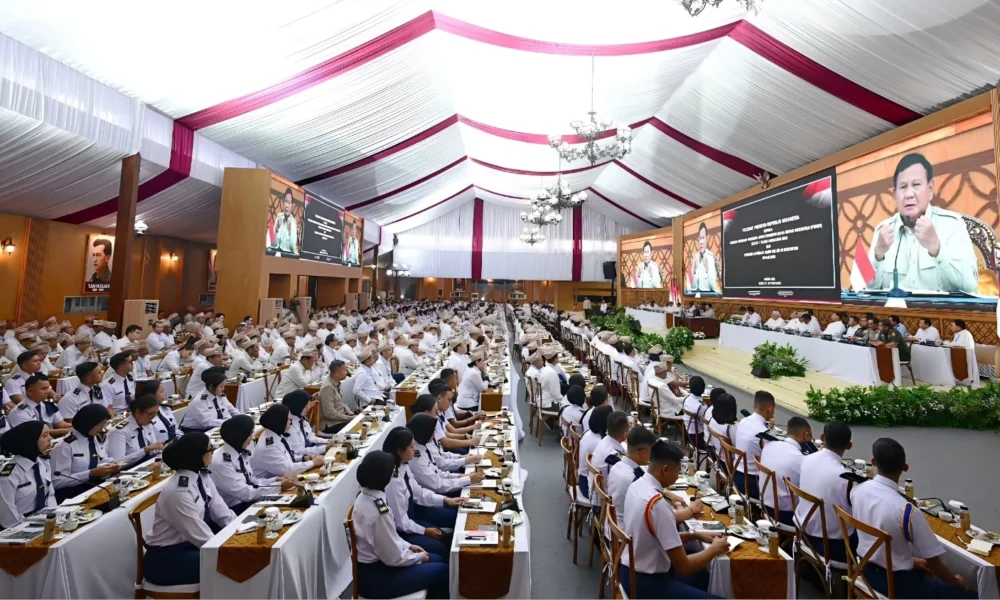
BOGOR, The Kabar News—President Prabowo Subianto met 250 Indonesian Chamber of Commerce and Industry (Kadin) members and about 400 participants in a national leadership program at his Hambalang residence on Saturday, Oct. 31, to discuss investment, emerging industries and leadership development.
The meeting brought together representatives from Kadin and the first cohort of the Presidential Program for Indonesia’s Future Leaders (P3MDI).
The President’s Office reported that President Prabowo delivered a briefing to the participants while receiving a report from Kadin chairman Anindya Bakrie on the organization’s 2026 National Leadership Meeting.
The discussion centered on domestic investment and opportunities for Indonesian businesses to participate in future industries.
Anindya reported that domestic direct investment (PMDN) had reached almost Rp2,000 trillion during the first two years of Prabowo’s administration.
Read also: 105,000 vehicle imports spark debate: KPK warns, Kadin opposes
More detailed data presented at Kadin’s national meeting placed PMDN at Rp1,998.7 trillion from the fourth quarter of 2024 through the third quarter of 2026. Foreign direct investment reached Rp1,924.5 trillion, bringing total realized investment to Rp3,923.2 trillion for the period.
The investment generated employment for 5.48 million workers, according to Investment Ministry data cited by Kadin.
Anindya interpreted the domestic investment figure as a sign of stronger confidence among Indonesian businesses. He said medium-sized companies also contributed to the result.
“Domestic investment also involves our businesspeople in the middle segment,” Anindya said. “We believe this trend can further strengthen our economic resilience.”
Read also: An Indonesian passport provides visa-free access to 88 countries
Domestic investment accounted for slightly more than half of total investment during the reporting period. However, continued confidence will depend on regulatory certainty and the ability of new projects to create productive employment.
Kadin told Prabowo that businesses wanted to expand beyond established sectors and support industries with stronger future demand. Anindya identified electric vehicles, renewable energy and data centers as areas with opportunities for locally produced components.
“We are looking not only at existing industries but also at future industries, such as electric vehicles, renewable energy and data centers, where the potential for local content is also substantial,” he said in a President’s Office statement.
The statement did not announce new investment commitments, project locations or implementation schedules. The discussion therefore reflected Kadin’s policy direction rather than confirmed projects.
Anindya also compared Indonesia’s approximately Rp25,000 trillion gross domestic product with the roughly Rp4,000 trillion state budget. He used the comparison to argue that private businesses have considerable room to support growth and help regional entrepreneurs expand.
Read also: URI reports leadership training progress to Prabowo
The two figures measure different economic concepts, but his remarks emphasized the private sector’s broader role in investment and job creation.
Prabowo also used the meeting to address P3MDI participants. The program prepares selected young professionals for future leadership roles through structured education and training.
Kadin representatives said cooperation between government and businesses could give participants exposure to economic decision-making and private-sector experience.
The meeting linked that leadership agenda with the government’s effort to attract investment and develop higher-value industries.
The Hambalang meeting highlighted the administration’s effort to bring business development and leadership training into the same policy conversation.
Its longer-term impact, however, will depend on whether the investment figures translate into competitive industries, sustainable jobs and measurable opportunities for domestic companies.






No Comment! Be the first one.