



Indonesia widens Bulog corn purchases to aid farmers
JAKARTA, thekabarnews.com—Indonesia has strengthened state logistics agency Perum Bulog’s role as a standby buyer of domestically grown corn, allowing it to purchase dry shelled corn with a moisture...

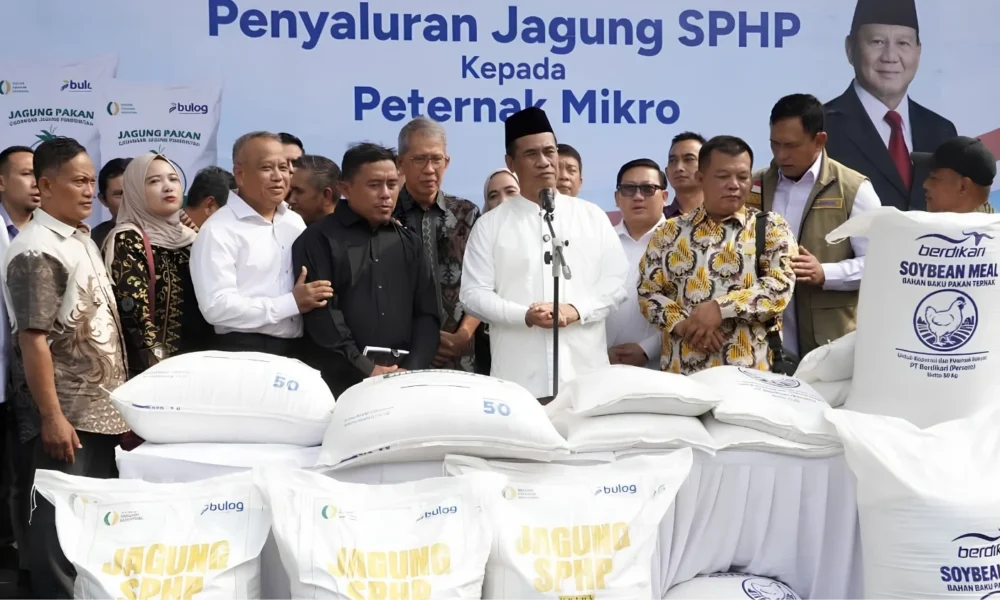
JAKARTA, thekabarnews.com—Indonesia has strengthened state logistics agency Perum Bulog’s role as a standby buyer of domestically grown corn, allowing it to purchase dry shelled corn with a moisture content of up to 20 percent under government procurement rules.
Agriculture Minister Andi Amran Sulaiman said the policy should prevent farmers from losing buyers when production exceeds local demand. Bulog will dry and process the corn until it meets the quality requirements for the Government Corn Reserve (CJP).
Amran, who also heads the National Food Agency (Bapanas), instructed Bulog’s regional offices to apply the moisture rules consistently.
“Corn with a moisture content of 20 percent must be accepted,” Amran said during a feed-corn partnership meeting in Jakarta on Tuesday, Oct. 27.
Read also: Prabowo operates Corn Harvest in Tuban, but most farmers still can’t afford one
Presidential Instruction No. 3/2026 sets a minimum domestic procurement target of 1 million tonnes for 2026. It establishes a government purchasing price of Rp5,500 (34 US cents) per kilogram for mature dry shelled corn containing 18 to 20 percent moisture at the farm level.
Under the instruction, Bulog must process higher-moisture corn into stock that satisfies the Government Corn Reserve standard. The policy is intended to provide farmers access to a buyer without requiring them to own industrial drying equipment.
A separate rule governs deliveries made directly to Bulog warehouses. Bapanas Decree Number 216/2025 sets the purchase price at Rp6,400 per kilogram for corn containing no more than 14 percent moisture and 50 parts per billion of aflatoxin.
Read also: Indonesia’s rice output hits 34.69 million tons in 2025
The government applies the two prices to different quality levels and delivery points. Bulog purchases corn containing 18–20 percent moisture at the farm level, while it pays the higher warehouse price for drier corn that meets additional quality standards. Presidential Instruction No. 3/2026 and a National Food Agency decree specify these provisions.
The government is also developing a “closed system” that connects corn farmers with poultry producers through cooperatives. Farmers would plan production according to feed demand, while Bulog would purchase any surplus.
“We are building a closed system and improving it first. Hopefully, within one or two years, these complaints will no longer occur,” Amran said.
Officials estimate that the proposed scheme will require 1.8 million tonnes of feed corn. The government plans to cultivate 300,000 hectares, assuming an average yield of seven tonnes per hectare. That calculation would produce 2.1 million tonnes, leaving a potential surplus of about 300,000 tonnes.
These figures remain planning assumptions rather than confirmed production. Actual output will depend on planted area, weather conditions and farm productivity.
Read also: Indonesia claims self-sufficiency in eight foods
When local poultry producers have enough corn, Bulog would purchase the remaining supply. Farmers or participating cooperatives could store the corn through a warehouse-receipt-like mechanism. Poultry farmers could later buy it through the government’s Food Supply and Price Stabilization (SPHP) program.
As of Oct. 27, Bulog had distributed 216,800 tonnes of subsidized feed corn to 11,646 poultry farmers through 151 cooperatives and associations in 29 provinces. The 2026 SPHP allocation reached 391,900 tonnes, nearly eight times the 51,200 tonnes allocated in 2025.
Bulog might be more actively involved in procurement to shield farmers during harvest surpluses and to stabilize the animal-feed supply. But its success will hinge on having sufficient drying capacity. Bulog must ensure the timeliness of payments and the uniform application of quality standards in all regional offices.






No Comment! Be the first one.