



Indonesia claims self-sufficiency in eight foods
JAKARTA, thekabarnews.com—President Prabowo Subianto has declared that Indonesia achieved self-sufficiency in eight food commodities during his administration’s first two years. The president cited...

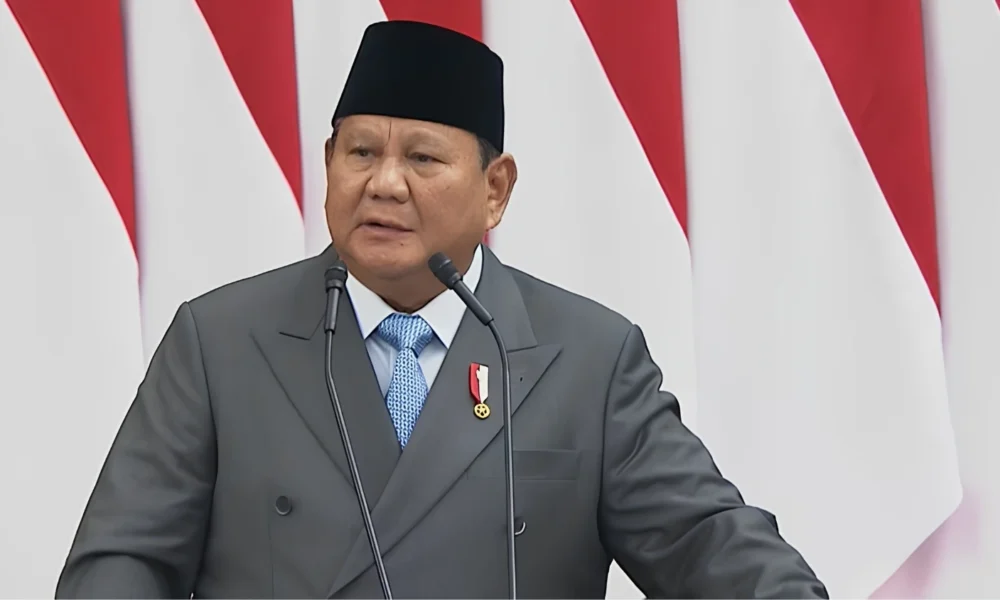
JAKARTA, thekabarnews.com—President Prabowo Subianto has declared that Indonesia achieved self-sufficiency in eight food commodities during his administration’s first two years. The president cited higher domestic production and large government rice reserves as evidence of stronger food security.
Prabowo presented the claim during the MPR Annual Session and the joint session of the House of Representatives and Regional Representatives Council at the parliamentary complex in Jakarta on Aug. 14, 2026.
“This year, we have achieved self-sufficiency in eight food commodities,” Prabowo said. “We are self-sufficient in rice, corn, consumer sugar, broiler chicken, chicken eggs, shallots, large chili peppers and bird’s eye chili peppers.”
The government uses self-sufficiency to describe a commodity for which domestic output supplies at least 90 percent of national demand, according to the Agriculture Ministry’s 2025 performance report. The designation, therefore, does not always mean that Indonesia has completely stopped importing the commodity.
Read also: Indonesia’s rice output hits 34.69 million tons in 2025
President Prabowo said Indonesia had not yet achieved self-sufficiency in beef. However, he expected the country to meet domestic demand within five to six years.
“At a time when the world is deeply concerned about mass hunger because of food shortages and unpredictable weather, thank God, our situation is secure,” Prabowo said.
Official statistics support the government’s claim of a sharp increase in rice production. Statistics Indonesia (BPS) recorded 34.69 million tonnes of rice for human consumption in 2025. This was up 4.07 million tonnes (13.29 percent) from 2024. The harvested area expanded by 12.69 percent to 11.32 million hectares.
“Production is the highest in the history of the Republic of Indonesia,” Prabowo said. “The reserves in government warehouses have exceeded their capacity, so we have had to rent additional storage. We now hold more than 5.3 million tonnes of rice reserves.”
Read also: Indonesia halts imports of key food commodities, strengthens food security in 2026
Bulog reported that the Government Rice Reserve reached 5.3 million tonnes on May 11, compared with a peak of 4.2 million tonnes in 2025. The state logistics agency has a storage capacity of approximately 3.1 million tonnes. Therefore, there is a need for additional warehouses.
The reserve later declined as Bulog distributed rice for food assistance and its market-stabilization program. Government-held stocks stood at approximately 4.61 million tonnes on Sept. 19.
The Agriculture Ministry estimated total national rice availability at 26.91 million tonnes in September. This amount is enough for about 310 days of consumption.
That figure is broader than Bulog’s physical stocks: it includes 4.61 million tonnes held by Bulog, an estimated 12.86 million tonnes held by households and businesses, and 9.44 million tonnes of expected production from crops still in the field.
Read also: Indonesia’s rice output rises as reserves strengthen
Indonesia did not authorize imports of ordinary consumption rice in 2025, according to the National Food Agency (BPN). However, BPS still recorded total rice imports of 450,734 tonnes for the year. These imports mainly covered specialty varieties and rice for industrial processing.
It will take more than a bumper crop to sustain self-sufficiency. Indonesia must protect farmland, improve irrigation and manage its reserves effectively. Meanwhile, the country must help farmers cope with increasingly unpredictable weather. These measures will show whether the recent gains in production can become a permanent basis for national food security.





No Comment! Be the first one.