



Prabowo launches Indonesia’s 100 GWp solar push
JEMBRANA, thekabarnews.com—President Prabowo Subianto launched Indonesia’s 100-gigawatt-peak solar power program in Gilimanuk, Jembrana Regency, Bali, on Tuesday, August 25. He also set an ambitious...

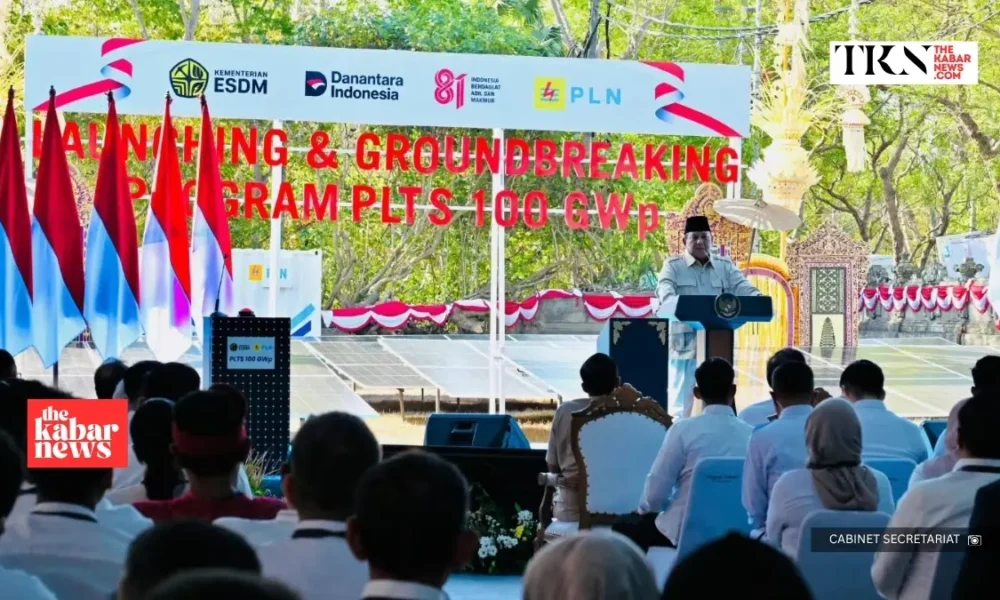
JEMBRANA, thekabarnews.com—President Prabowo Subianto launched Indonesia’s 100-gigawatt-peak solar power program in Gilimanuk, Jembrana Regency, Bali, on Tuesday, August 25. He also set an ambitious three-year target to expand clean electricity and reduce the country’s reliance on imported fuel.
The launch and groundbreaking ceremony at the Gilimanuk solar project connected virtually with the Gajah Mungkur floating solar project in Central Java. It also connected with the Sembur village project in the Riau Islands and the Pulau Rengit project in the Bangka Belitung Islands.
“We will build 100 gigawatts, and we are serious about it. Our target is 100 gigawatts within three years,” Prabowo said, according to the Cabinet Secretariat official.
The target would represent an unprecedented expansion of Indonesia’s generating capacity. Prabowo said the entire national electricity system currently has about 88 GW of installed capacity. This capacity comes from coal, gas, oil, geothermal and other sources.
The government’s initial portfolio covers 14 projects across six provinces with a combined planned capacity of approximately 5,216 MWp, or 5.2 GWp.
The projects are at different stages, including tender preparation, construction, and groundbreaking. They should not be interpreted as 5.2 GWp of capacity that is already operating.
The portfolio includes the Tembesi and Sembur projects in the Riau Islands; Pulau Rengit in the Bangka Belitung Islands; and Saguling, Purwakarta, Jatiluhur, Cirata and Jatigede in West Java. It also includes Gajah Mungkur in Central Java and Karangkates, Madura, Pasuruan and Banyuwangi in East Java. Gilimanuk in Bali completes the list.
A government fact sheet cited by Katadata valued these first projects at about US$7.7 billion, or Rp135 trillion.
At Gilimanuk, the government plans to combine solar generation with a battery energy storage system (BESS). Project data presented by PLN put the site’s planned capacity at 300 MWp with 1,000 MWh of battery storage. Other material issued during the event cited a smaller initial configuration. Authorities target commercial operation in 2028.
Energy and Mineral Resources Minister Bahlil Lahadalia estimated that implementing the full 100 GWp program would require about US$71.3 billion. This amount is equivalent to more than Rp1.14 quadrillion.
“From this overall program, we can achieve Rp73.9 trillion in subsidy savings every year. It can also create approximately 5.52 million jobs,” Bahlil said.
Bahlil also projected that the program could cut greenhouse gas emissions by about 140.16 million tonnes of carbon dioxide.
These estimates remain government projections and depend on the program securing investment, completing tenders and construction, expanding transmission networks, and deploying sufficient battery storage.
The government plans to involve independent power producers, state-owned enterprises, PLN and the sovereign wealth fund Danantara.
Beyond adding renewable capacity, the program aims to replace diesel generation, electrify remote communities and strengthen Indonesia’s domestic solar industry.




No Comment! Be the first one.