



Hashim cites Rp10,000 trillion in informal economic activity
JAKARTA, The Kabar News—Hashim Djojohadikusumo has put Indonesia’s vast informal economy under renewed scrutiny. He cited barbers, massage workers and small food stalls as examples of cash-based...

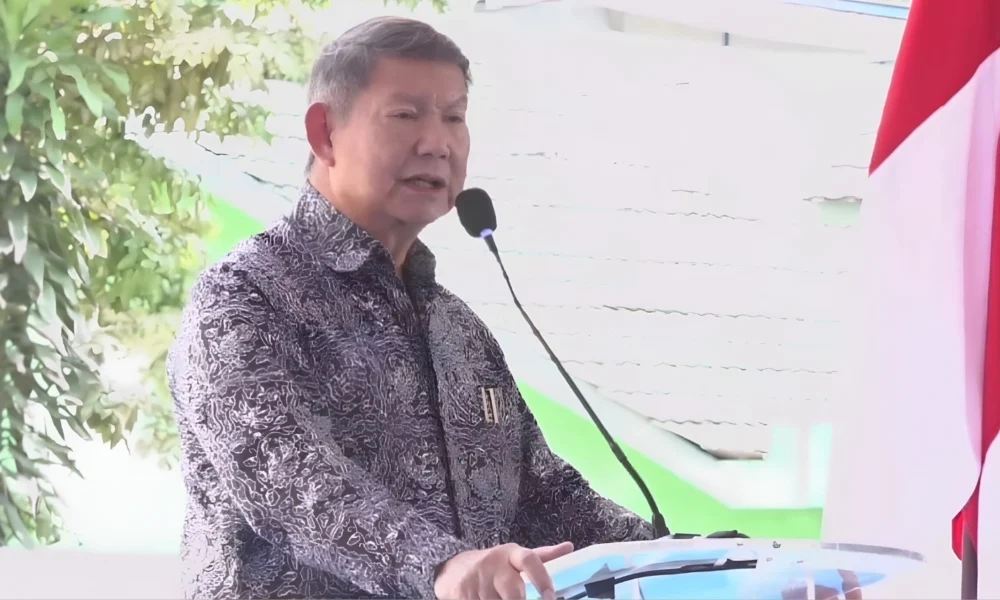
JAKARTA, The Kabar News—Hashim Djojohadikusumo has put Indonesia’s vast informal economy under renewed scrutiny. He cited barbers, massage workers and small food stalls as examples of cash-based businesses that often operate without formal records.
Hashim, chairman of the Indonesian Chamber of Commerce and Industry (Kadin) advisory council and the Special Presidential Envoy on Energy and Climate Change, made the remarks during Kadin’s national leadership meeting in Central Jakarta on Thursday, Oct. 29.
His speech prompted claims on social media that the government planned to impose new taxes on warteg food stalls and massage workers. However, Hashim did not announce such a policy. IInstead, he cited the businesses to illustrate how people conduct many daily cash transactions without invoices or formal reporting.
“According to the World Bank, approximately 35 to 40 percent of Indonesia’s economic activity is unrecorded,” Hashim said. “That means there is roughly Rp10,000 trillion in unrecorded activity.”
Read also: Indonesian govt approves UU PPRT, guaranteeing leave and social protection
He described the activity as part of a “grey economy.” This term refers to lawful economic transactions that remain partly or entirely outside administrative, regulatory or taxation systems.
Hashim recounted paying a barber who visits his home once a month. He also mentioned a massage therapist hired by his wife every two weeks.
“I usually have a barber come to my place once a month. He charges a fee, and I pay it without a receipt. Without a receipt, the 11 percent VAT is not collected,” Hashim said.
“My wife also has a massage therapist named Yanti who comes once every two weeks. She does not provide a receipt, and the 11 percent is not collected,” he added.
Hashim said millions of similar transactions involving small service providers, beauty salons and warteg stalls could create a substantial informal economy. When aggregated nationally, the scale becomes significant.
Read also: Indonesia’s VAT revenue faces consumer spending
The underlying scale of informality has support from international research. A World Bank study estimated that Indonesia’s informal output averaged about 35 percent of official gross domestic product in the decade before 2020.
However, the estimate does not mean that the entire amount is missing from Indonesia’s GDP. Statistical agencies use household consumption, employment surveys and other methods to estimate some economic activity even when businesses do not issue receipts. Therefore, adding the informal-output estimate directly to official GDP could result in double counting.
Hashim’s VAT examples also require legal context. A business that accepts cash or does not issue a receipt may still comply with VAT rules.
According to the Directorate General of Taxes (DJP), businesses generally must register as taxable enterprises and collect VAT when annual turnover exceeds Rp4.8 billion. However, a smaller business can register voluntarily. Many individual barbers and massage workers may operate below that threshold.
Read also: Online sellers as Indonesia begins marketplace VAT collection, starting July 2026
Individual microbusiness owners with annual turnover of no more than Rp4.8 billion can use Indonesia’s 0.5 percent final income-tax scheme. The first Rp500 million in annual turnover remains exempt under Government Regulation No. 20/2026.
Warteg transactions follow another rule. Food and beverages served by restaurants, food stalls and similar businesses are not subject to national VAT because local governments regulate them through the Specific Goods and Services Tax (PBJT). However, the applicable obligations depend on local regulations and business thresholds.
Hashim’s speech therefore highlighted weak documentation and tax visibility rather than announcing a new levy on small traders. Any effort to formalize the sector would need to distinguish deliberate tax evasion from lawful microbusiness activity. At the same time, it should avoid new burdens that could undermine low-income entrepreneurs.

No Comment! Be the first one.