



DEN briefs Prabowo on welfare, fuel and graft law
JAKARTA, thekabarnews.com—President Prabowo Subianto reviewed proposals on digital social assistance, school meals and industrial exports during a meeting with National Economic Council (DEN) head...

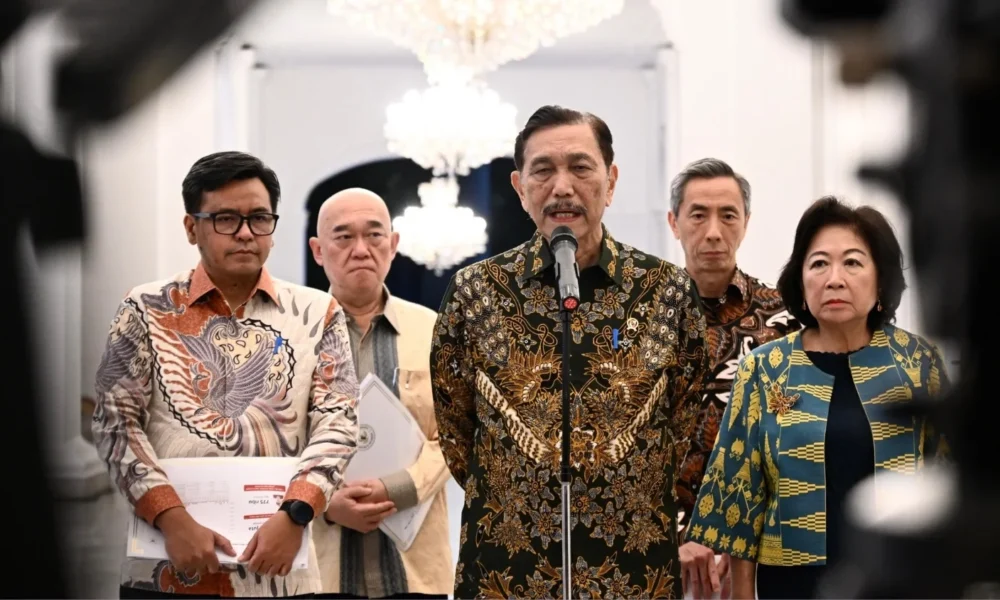
JAKARTA, thekabarnews.com—President Prabowo Subianto reviewed proposals on digital social assistance, school meals and industrial exports during a meeting with National Economic Council (DEN) head Luhut Binsar Pandjaitan at the Merdeka Palace in Jakarta on Tuesday, Oct. 20.
The meeting brought together DEN officials and relevant ministers to assess how global developments could affect Indonesia’s economy. The council also presented policy recommendations on subsidized fuel and climate-related risks, according to the Presidential Secretariat.
DEN reported that the government’s digital social protection trial had reached all 514 regencies and cities as of Oct. 20. About 11.5 million families had registered, supported by approximately 775,000 field agents.
A trial in Bali reduced the number of eligible residents excluded from assistance by 24.1 percent, DEN member Mochamad Firman Hidayat said.
Read also: How GovTech can strengthen Indonesia’s economic resilience
The system also cut the inclusion of ineligible recipients by 4.1 percent. These figures came from a government study and have not been independently audited in the public release.
Prabowo is expected to launch the wider system on Nov. 10. The government says digital registration will improve transparency and help direct assistance to qualified households more accurately. Official data show that the portal is receiving more than 600,000 registrations a day.
DEN also presented findings on the Free Meals (MBG) program. Its analysis used a special module in the National Socioeconomic Survey, developed with Statistics Indonesia (BPS) and introduced nationwide in September 2025.
The study found that MBG recipients reported fewer school absences than non-recipients, with the widest difference among the poorest households.
Read also: Nearly Rp7 trillion BPS budget draws DTSEN scrutiny
Among recipients who rated the menu “excellent,” 95 percent reported greater enthusiasm for learning. However, the published findings show an association rather than proof that MBG alone caused the improvement.
DEN recommended directing more meals to disadvantaged regions, rural communities and low-income families. It also called for stronger menu standards. The study found that reported benefits declined when students rated meal quality poorly.
DEN projected that exports of processed nickel, aluminium and lithium-battery components could reach US$50 billion by the end of 2026, up from $34.5 billion in 2024.
The estimate remains a forecast, not a realized export figure. Aluminum exports alone could reach $7.2 billion this year, the council said.
Read also: Indonesia plans bank accounts to deliver state aid
The council also discussed fiscal measures involving the Finance Ministry and sovereign investment body Danantara to keep subsidized fuel prices stable through December while protecting state finances.
After the meeting, Luhut said Prabowo had backed DEN’s study of Indonesia’s corruption framework.
“The President agreed with the study prepared by DEN’s team because Indonesia’s handling of corruption should meet international standards,” Luhut said after meeting.
Luhut argued that the United Nations Convention against Corruption (UNCAC) treats bribery rather than state financial losses as the central definition of corruption.
However, the convention does not establish a single definition. Its provisions cover bribery as well as embezzlement, influence trading and abuse of office, according to the official UNCAC.
Indonesia’s Criminal Code, effective since January 2026, retains state financial or economic losses as elements under Articles 603 and 604. Any removal of those provisions would therefore require a formal legislative process. Prabowo’s reported support for a DEN study does not itself change the law.
The meeting consequently produced several economic proposals, but their impact will depend on transparent implementation, independent evaluation and clear legal safeguards.



No Comment! Be the first one.