



Way Kambas wildfire leaves 40 hectares still burning
EAST LAMPUNG, thekabarnews.com—Indonesia’s disaster mitigation agency has intensified ground and aerial operations against a persistent wildfire in Way Kambas National Park, where approximately 40...

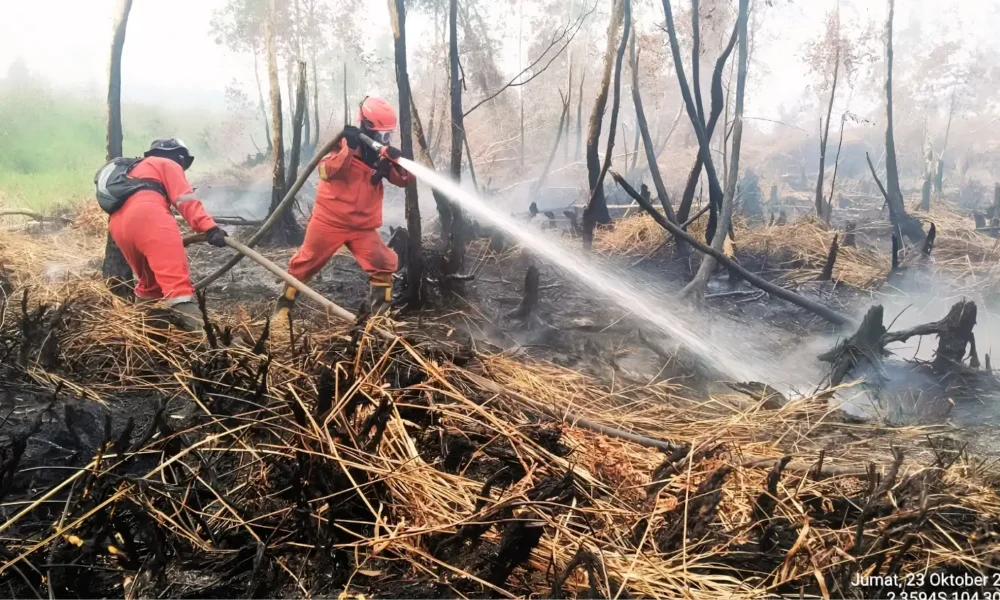
EAST LAMPUNG, thekabarnews.com—Indonesia’s disaster mitigation agency has intensified ground and aerial operations against a persistent wildfire in Way Kambas National Park, where approximately 40 hectares remained unextinguished in the latest field assessment.
National Disaster Mitigation Agency (BNPB) head Lt. Gen. Kristomei Sianturi inspected the affected area from the air on Saturday, Oct. 24. The flight allowed officials to identify active fire points, smoke-covered areas and possible access routes for ground personnel.
“After inspecting the area from the air, I saw several fire points that require attention. We have divided the ground forces in Way Kambas according to operational sectors so they can extinguish the fire more effectively,” Kristomei said in a statement published by BNPB.
The fire has burned since Sept. 22, according to BNPB’s latest report. A joint team extinguished approximately 10.2 hectares on Friday, but around 40 hectares still required treatment. BNPB said the figures remained field estimates and could change after detailed mapping.
Read also: Prabowo orders immediate action on forest and land fires
Firefighters face particular difficulties because flames and embers can survive beneath the peat surface after the visible fire disappears. Dense and dry vegetation also prevents water dropped from helicopters from reaching the ground effectively. Strong winds and difficult access create further risks.
Water sources are located about 1.5 kilometers from the fire zone. Teams have installed a hose network stretching approximately three kilometers to supply areas known as Points B and D and the affected peat swamp.
“Peatland characteristics allow fire to remain below the surface and reappear even after previous prevention efforts,” acting BNPB disaster information and communication center head Berton S.P. Panjaitan said.
Around 350 personnel are supporting the operation. They include national park officers, disaster-response teams, military (TNI) and police personnel, conservation partners and local community groups. The provincial administration previously said 200 military personnel were among the reinforcements.
Read also: BNPB deploys 39 helicopters as wildfires spread
BNPB deployed a Sikorsky Black Hawk UH-60L helicopter for two water-bombing sorties. Ground personnel were divided into four teams responsible for drone surveillance, peat-swamp firefighting, water distribution and continued suppression at priority locations.
Weather-modification operations provided additional support on Friday. A Cessna Caravan conducted two cloud-seeding sorties, each dispersing 1,000 kilograms of sodium chloride over Way Kambas and West Lampung.
Officials subsequently observed light rain in both areas. The aircraft can only operate when suitable clouds are present, making ground crews essential when atmospheric conditions prevent further seeding.
The operation protects one of Sumatra’s most important conservation areas. The Forestry Ministry records Way Kambas National Park as covering 125,621.3 hectares and providing habitat for protected wildlife, including Sumatran elephants, Sumatran rhinos and Sumatran tigers.
Read also: BNPB steps up firefighting across six provinces
Kristomei urged agencies to combine aerial observations with drone imagery, hotspot data and BMKG weather information when determining operational priorities. BNPB said crews would continue focusing on Points B and D and the peat-swamp zone while monitoring the possibility of the fire spreading.
Authorities also urged residents and businesses around fire-prone areas to avoid burning land and report smoke immediately. For Way Kambas, fully extinguishing underground embers will be as important as controlling the visible flames, because preventing reignition is crucial to protecting nearby communities and the park’s endangered wildlife.





No Comment! Be the first one.