



Rupiah falls to Rp18,000 per US Dollar, raising costs for Indonesian students overseas
Thekabarnews.com—The Indonesian rupiah’s decline to the psychological level of Rp18,000 per US dollar creates new financial challenges. This affects thousands of Indonesian families supporting...

Thekabarnews.com—The Indonesian rupiah’s decline to the psychological level of Rp18,000 per US dollar creates new financial challenges. This affects thousands of Indonesian families supporting children studying abroad.
Tuition fees, apartment rents, transportation costs, and daily expenses in other countries remain largely unchanged in local currencies.
However, the weakening rupiah means Indonesian families have to spend much more money to convert their rupiah into foreign currencies.
For many households, the effects extend far beyond the exchange-rate gyrations displayed on the screens of financial news channels.
The depreciation directly affects monthly remittances, tuition fees, accommodation costs, and daily living expenses of students pursuing higher education abroad.
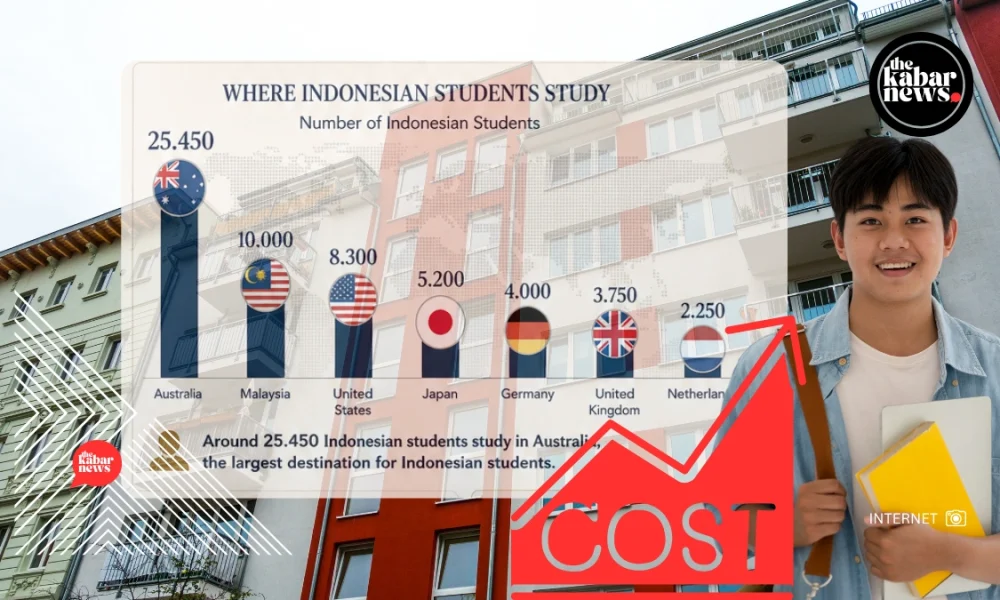
According to CNBC Indonesia’s data, it indicates that Australia is still the first choice for students in Indonesia.
There are currently some 25,450 Indonesian students studying at educational institutions in Australia, well ahead of other destinations.
The countries with the largest populations of Indonesian students are:
- Australia: 25,450 students
- Malaysia: 10,000 students
- United States: 8,300 students
- Japan: 5,200 students
- Germany: 4,000 students
- United Kingdom: 3,750 students
- Netherlands: 2,250 students
Many of these students still rely on financial support from their families in Indonesia. Consequently, they are particularly sensitive to exchange-rate movements.
The weakening of the rupiah does not necessarily mean that universities have increased tuition fees.
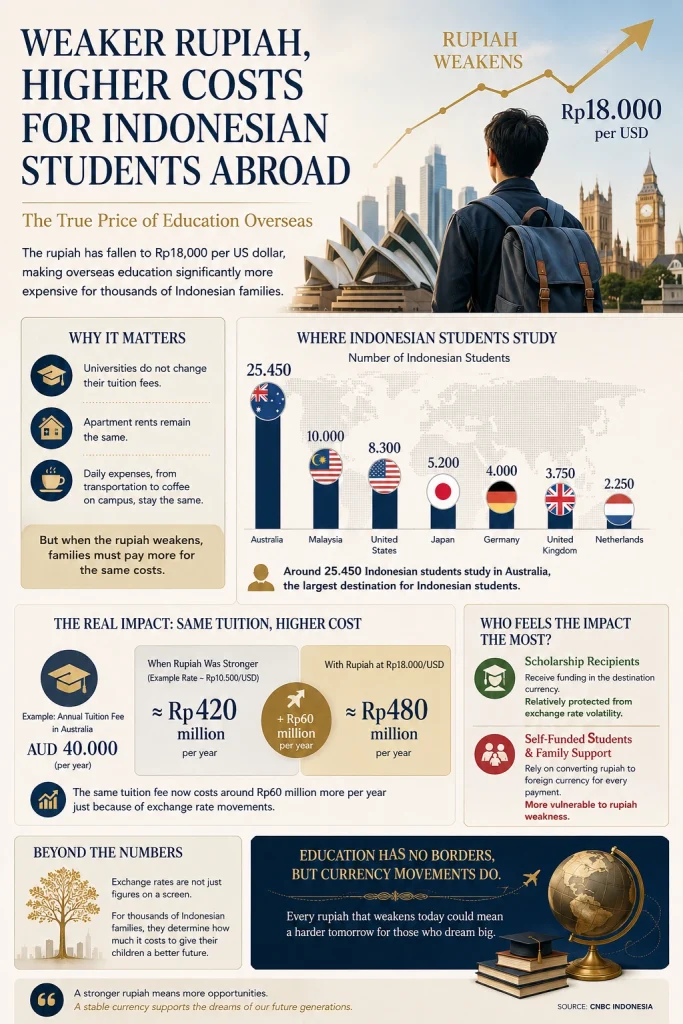
Instead, the depreciation raises the rupiah value needed to pay the same amount in foreign currency. Australia serves as a relevant example.
At that time, an annual tuition fee of AUD40,000 for an Indonesian family was around Rp420 million. This adjustment was done with a more favorable exchange rate.
The same tuition bill, as a result of the fall in the rupiah, is now about Rp480 million. This represents an increase of around Rp60 million a year just from currency fluctuations.
The same principle applies to housing, transportation, insurance, food, and other educational expenses denominated in foreign currencies.
As a result, many families face significantly larger financial burdens despite receiving the same educational services.
Currency devaluation means something different for every student.
Scholarships funded directly in foreign currencies usually insulate scholars from the volatility of exchange rates. These people’s tuition and living allowances also tend to be relatively stable, regardless of the movements of the rupiah.
In contrast, self-funded students, and those supported by family remittances, are experiencing more immediate financial pressure.
Each tuition payment or transfer of rent or monthly allowance must convert rupiah into foreign currency. This increases costs whenever the rupiah weakens.
Financial analysts say the prolonged weakness of the currency may also affect future decisions on overseas education. This is especially true among middle-income families who plan their education budgets carefully.
Exchange rates affect much more than financial markets. For thousands of Indonesian families, the movement of the currency directly impacts their access to international education. Moreover, it influences their long-term education planning.
Indonesia’s number of students studying overseas is still increasing. The rupiah’s performance remains an important factor in terms of affordability for studying abroad.
For many parents, the exchange rate is not just an economic indicator anymore. It has become a major determinant for how much they must sacrifice for their children to obtain global educational opportunities.
Ultimately the falling currency is a reminder that currency volatility can have real effects. It can turn what appears to be a fiscal statistic into a serious problem for families trying to invest in higher education overseas.






No Comment! Be the first one.