



Rupiah becomes one of Asia’s weakest currencies against US Dollar in 2026
Thekabarnews.com—New regional currency data shows Indonesia’s rupiah is one of the poorest-performing Asian currencies against the U.S. dollar in 2026. This highlights increasing economic strain...


Thekabarnews.com—New regional currency data shows Indonesia’s rupiah is one of the poorest-performing Asian currencies against the U.S. dollar in 2026. This highlights increasing economic strain across developing Asian countries.
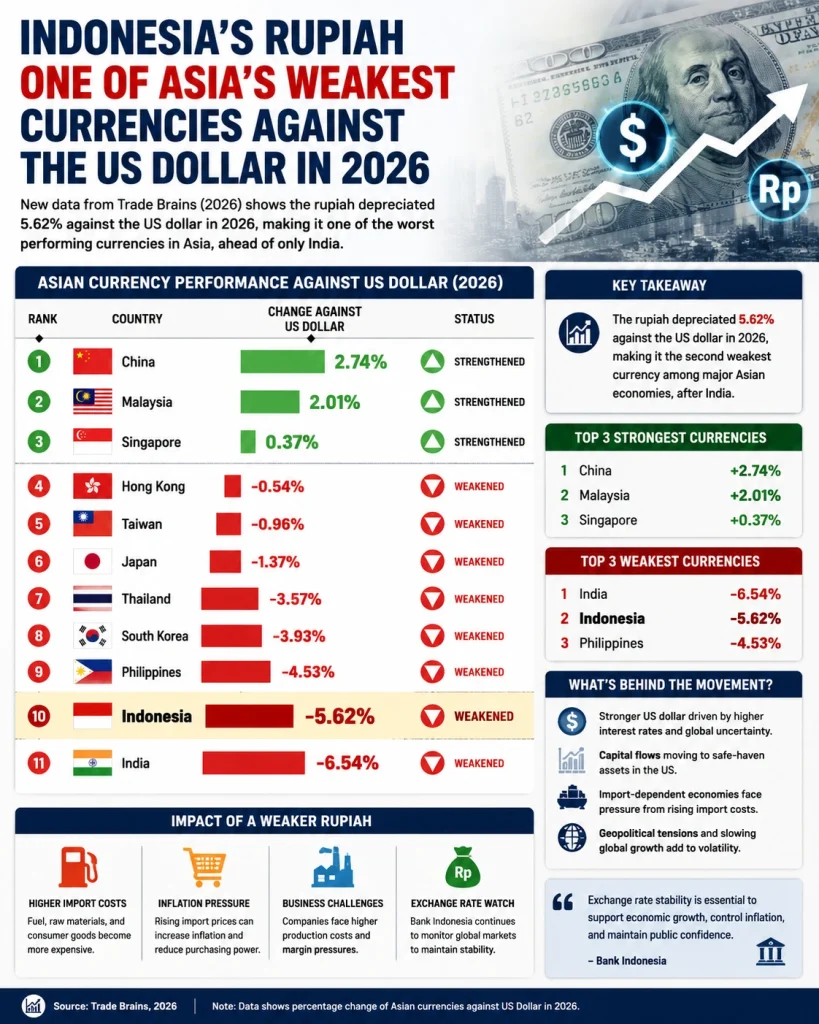
Trade Brains 2026 claimed that the rupiah has depreciated 5.62 percent against the U.S. dollar so far this year. The figure puts Indonesia toward the bottom of regional currency rankings, ahead only of India, whose currency lost 6.54 percent.
The statistics followed the performance of a range of Asian currencies versus the U.S. dollar throughout 2026. China led the list of gainers, up 2.74 percent. Malaysia followed, rising 2.01 percent, and Singapore was up 0.37 percent.
In contrast, several large Asian economies saw their currencies decline. Japanese, South Korean, Thai, and Filipino currencies declined against the dollar. However, these currencies did not fall as sharply as the rupiah and the rupee.
The U.S. dollar’s continued appreciation is squeezing emerging economies across Asia. This is particularly true for those that depend significantly on imports, external debt, and international capital flows.
Emerging-market currencies have fallen. This trend comes as many global investors pour money into dollar-denominated investments amid rising U.S. interest rates and geopolitical worries.
Indonesia: A weaker rupiah could be both an opportunity and a risk. A weakened currency could increase the export competitiveness of Indonesian goods by making them cheaper abroad.
But it also raises the price of imports of such fuel, industrial raw materials, machinery, and foodstuffs.
The danger is that if the currency stays weak for long and import costs continue to grow, inflationary pressure is likely to build. As a result, household buying power will shrink.
The performance of the rupiah is more important, as the stability of the exchange rate immediately impacts fuel prices and consumer products. Moreover, it affects general confidence in the economy.
Bank Indonesia underlined its commitment to currency stability through monetary intervention and policy coordination. The central bank is monitoring global financial conditions closely given the continued volatility in foreign markets.
Regional observers, meantime, have taken note of the stronger performance of the Chinese and Malaysian currencies. Their resilience is based on trade surpluses, high exports, and steady foreign investment flows.
The regional currency comparison also underscores broader trends in Asia’s economic landscape. As the world economy slows, geopolitical tensions rise, and trade dynamics remain unpredictable.
But for the average Indonesian, the ordinary cost of items often makes the question most acutely felt.
The depreciation of the rupiah against the dollar has led to an increase in the pricing of imported goods. This includes electronics and fuel, as well as food supplies.
Exchange rates may be abstract financial figures, but their effects eventually trickle down to the country’s homes, businesses and consumers.






No Comment! Be the first one.