



Prabowo says Indonesia will stay outside military blocs
VLADIVOSTOK, thekabarnews.com—President Prabowo Subianto said Indonesia would pursue close relations with Russia, Western countries and other major powers without joining a military alliance or...

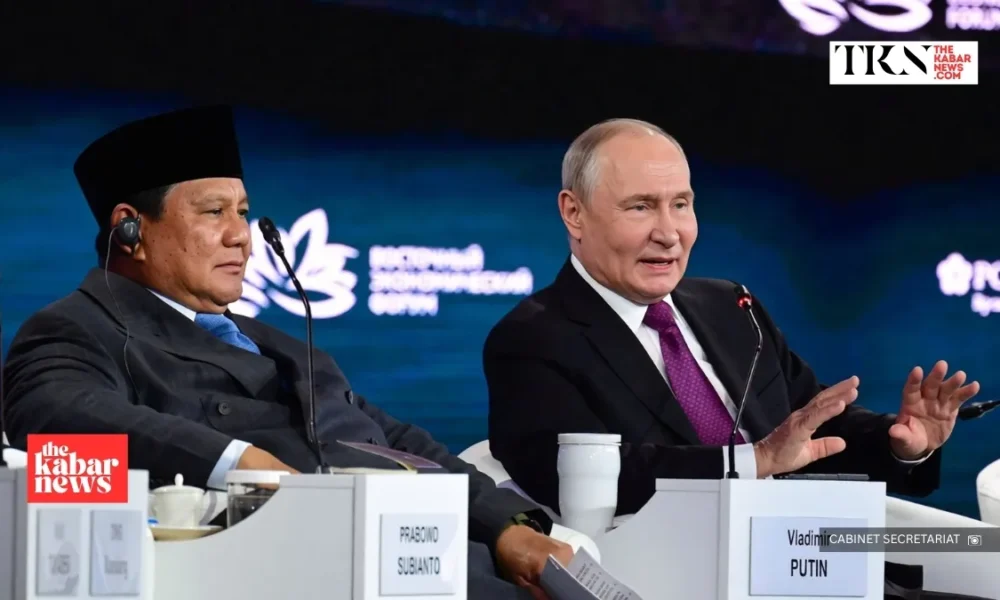
VLADIVOSTOK, thekabarnews.com—President Prabowo Subianto said Indonesia would pursue close relations with Russia, Western countries and other major powers without joining a military alliance or allowing one partnership to undermine another.
Prabowo set out Indonesia’s position during the 11th Eastern Economic Forum (EEF), at Far Eastern Federal University in Vladivostok, Russia, on Thursday, September 3.
President Prabowo attended as the principal guest of honor at Russian President Vladimir Putin’s invitation.
A moderator asked how Indonesia would balance its relations with Western partners as Jakarta expanded cooperation with Russia and the Eurasian region.
“Indonesia has been very open for decades. We are open about our policies. We have always said that we want to have the best relations with all countries, with all major powers,” Prabowo said, as a statement issued by the Cabinet Secretariat.
“By tradition, we are non-aligned. As I have said, we are not part of any military alliance. We respect all powers,” he added.
Prabowo said Indonesia would not work with one group to oppose the interests of another. Instead, Jakarta would assess cooperation based on its national interests and negotiate with prospective partners on equal terms.
“We will treat everyone who wants to come to Indonesia equally. We will give the same treatment to everyone who comes to Indonesia and we negotiate. Indonesia would rather not threaten anyone. So, that is our position,” the president said.
The position reflects Indonesia’s long-standing bebas aktif [free and active] foreign policy doctrine.
“Free” refers to Indonesia’s independence in determining its position rather than aligning itself with a major-power bloc. “Active” means the country continues to contribute to international peace and cooperation.
Foreign Minister Sugiono said in July that the doctrine did not mean Indonesia would remain passive or neutral. It allows Jakarta to expand its diplomatic room without becoming trapped in exclusive geopolitical blocs, according to the Foreign Ministry.
Remaining outside military alliances does not prevent Indonesia from conducting defense diplomacy, military exercises or equipment procurement with different countries.
It means those relationships do not constitute a collective-defense commitment requiring Indonesia to support one bloc against another.
Putin, meanwhile, described Indonesia as a major power whose policies carry international significance.
“I would like to call attention to the reality that Indonesia is not merely defined by having the world’s largest Muslim population but by its status as one of the truly major global powers,” Putin said.
“Whatever policies are pursued across the world, you simply cannot overlook them,” Putin added.
The EEF meeting also focused on economic cooperation. Prabowo said Indonesia wanted stronger links with the Russian Far East and the Eurasian Economic Union (EAEU).
Bilateral trade approached US$5 billion in 2025, rising 21.7 percent from the previous year, according to the Indonesian Presidential Secretariat.
Indonesia and the EAEU signed a free-trade agreement in December 2025 covering tariff reductions or eliminations on 11,882 product categories.
Indonesia completed its parliamentary approval and ratification process in July 2026, while all parties must complete their domestic procedures before implementing the agreement.
Prabowo said economic engagement with Eurasia is a complement—not a replacement—for Indonesia’s Western partnerships.
His message in Vladivostok placed Indonesia’s sovereignty at the center of that approach: Jakarta intends to cooperate widely while retaining the authority to determine its own strategic direction.
No Comment! Be the first one.