



Muhammadiyah demands probe as Kalbar fires escalate
PONTIANAK, thekabarnews.com—Muhammadiyah’s West Kalimantan Environmental Council [MLH-PWM Kalbar] has urged Governor Ria Norsan to take direct command of the province’s response to the 2026 forest...

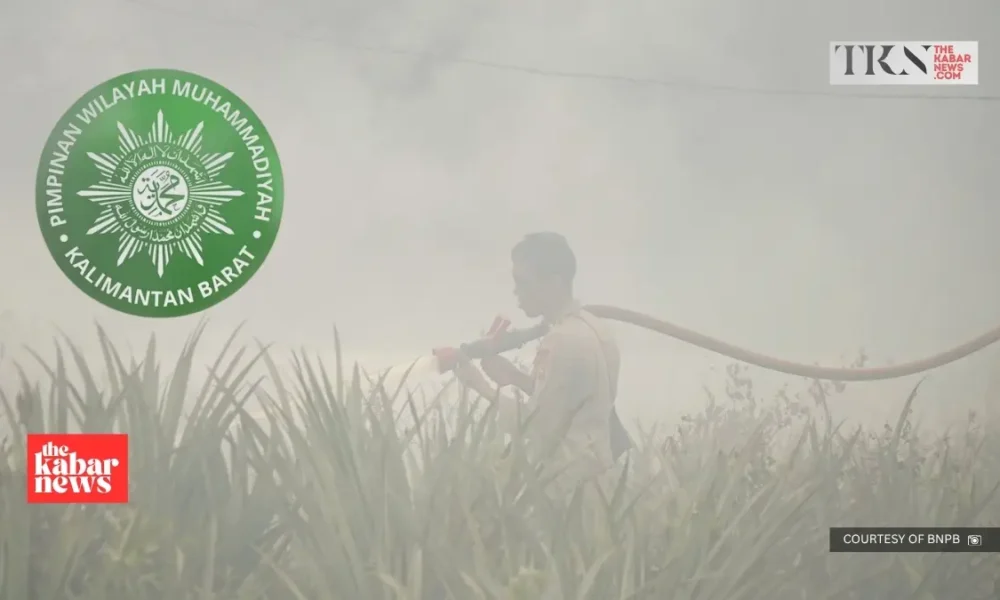
PONTIANAK, thekabarnews.com—Muhammadiyah’s West Kalimantan Environmental Council [MLH-PWM Kalbar] has urged Governor Ria Norsan to take direct command of the province’s response to the 2026 forest and land fires (karhutla). This request comes amid worsening smoke and damage to peatlands.
MLH-PWM Kalbar issued the statement in Pontianak on Sunday, August 30. It called for stronger emergency operations and independent investigations into fires detected inside corporate concessions.
“The 2026 Karhutla [forest and land fires] in West Kalimantan are an ecological disaster, not merely a natural disaster,” MLH-PWM Kalbar chair M. Hermayani Putera said.
MLH-PWM Kalbar said vulnerable peatlands and weak prevention had contributed to the crisis. It also questioned whether companies operating plantations, mines or industrial forests had fulfilled their fire-prevention responsibilities.
Those assertions represent the council’s position. Investigators and courts must establish any administrative, civil or criminal liability through the applicable legal process.
MLH-PWM Kalbar called on the West Kalimantan governor, Ria Norsan, to focus fully on controlling the fires and haze.
The council said the governor should lead coordination among district administrations, national agencies and emergency units. This is necessary during what it described as an ecological crisis.
It also argued that an official haze emergency must trigger extraordinary measures. These should include deploying available equipment, maximizing personnel and providing funding that reflects the scale of the disaster.
“The emergency status must not become merely a label without emergency-level action,” the statement said.
MLH-PWM Kalbar also requested a clearly disclosed command structure so the public can identify which agency is responsible for each part of the response. Moreover, it asked for stronger logistical support and protection for firefighters and community volunteers.
BNPB reported more than 2,610 hotspots in West Kalimantan on August 25. However, only 64 were classified separately as active fire points.
The agency identified Ketapang, Kubu Raya, Melawi and North Kayong as priority areas. More than 2,700 ground personnel were involved in the response, according to BNPB’s official update.
A hotspot indicates an unusual surface temperature detected by a satellite. However, it does not automatically confirm an active fire. Totals may vary according to the sensor, confidence threshold and monitoring period.
MLH-PWM Kalbar called for independent investigations into every burned concession.
It asked authorities to examine fires occurring within land-use rights, mining permits and forestry business permits. These permits are known, respectively, as HGU, IUP and PBPH.
MLH-PWM Kalbar also demanded operational transparency from concession holders and the application of strict liability. Strict liability is liability that does not require proof of fault when all statutory conditions are met.
It requested comprehensive enforcement against corporations if investigators establish that fires occurred within their concessions. Enforcement is also needed if the legal requirements for liability are satisfied.
Investigators should not automatically conclude that every concession holder caused the fire or committed an offense simply because they detected a blaze within their concession.
Authorities must establish the location, responsibility and supporting evidence in each case.
The Forestry Ministry has imposed administrative sanctions on six forestry permit holders over fires covering 1,511.55 hectares across three Kalimantan provinces. Notably, four permit holders operate in West Kalimantan.
One company received a permit suspension and a government compliance order, according to the Forestry Ministry. The sanctions address regulatory compliance but do not, by themselves, prove deliberate burning.
For peat areas, MLH-PWM Kalbar recommended rewetting operations and groundwater management, supported by canal blocks and bore wells.
It also urged authorities to stop further drainage during the emergency and prepare for clean-water shortages if dry conditions persist.
MLH-PWM Kalbar remarked that West Kalimantan needs clear leadership, peat-specific firefighting and evidence-based enforcement. These measures will help prevent the emergency from causing further harm.



No Comment! Be the first one.