



Indonesia’s population reaches 290 million in 2026
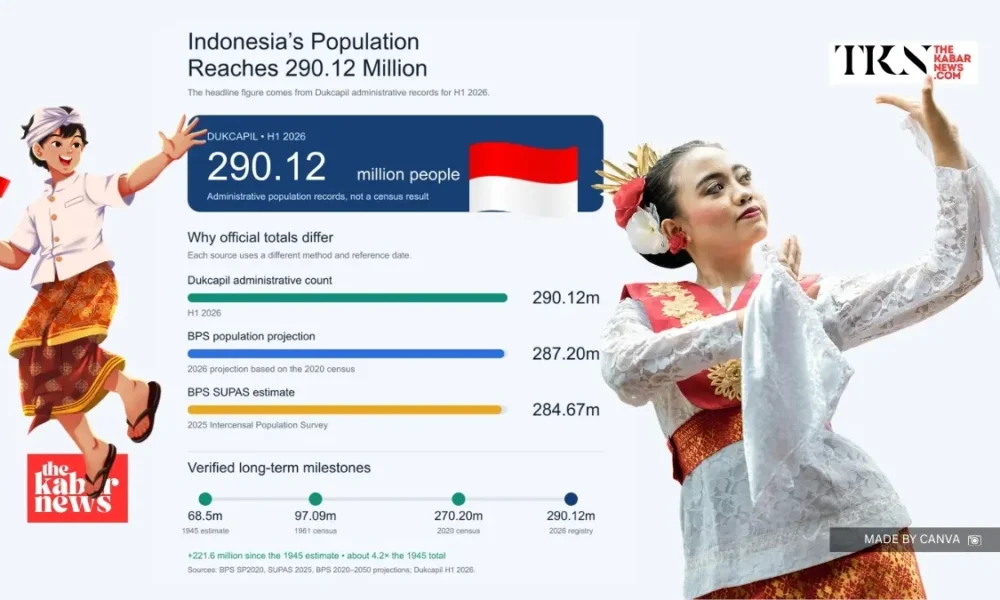
JAKARTA, thekabarnews.com—Indonesia’s population reached approximately 290.12 million in the first half of 2026. This is according to data attributed to the Home Ministry’s Directorate General of...

News Summary
- Indonesia’s population reached approximately 290.12 million in early 2026, an increase of about 1.81 million from late 2025.
- Dukcapil’s figure is based on administrative records, while BPS’s 2025 survey recorded 284.67 million people.
- The country has seen demographic growth of about 221.6 million since its independence in 1945, which is an increase of about 323 percent.
- BPS projects slower population growth at 1.08 percent per year, down from 1.25 percent between the last two censuses.
- The government must address uneven population distribution and ensure infrastructure and services keep up with this growth.
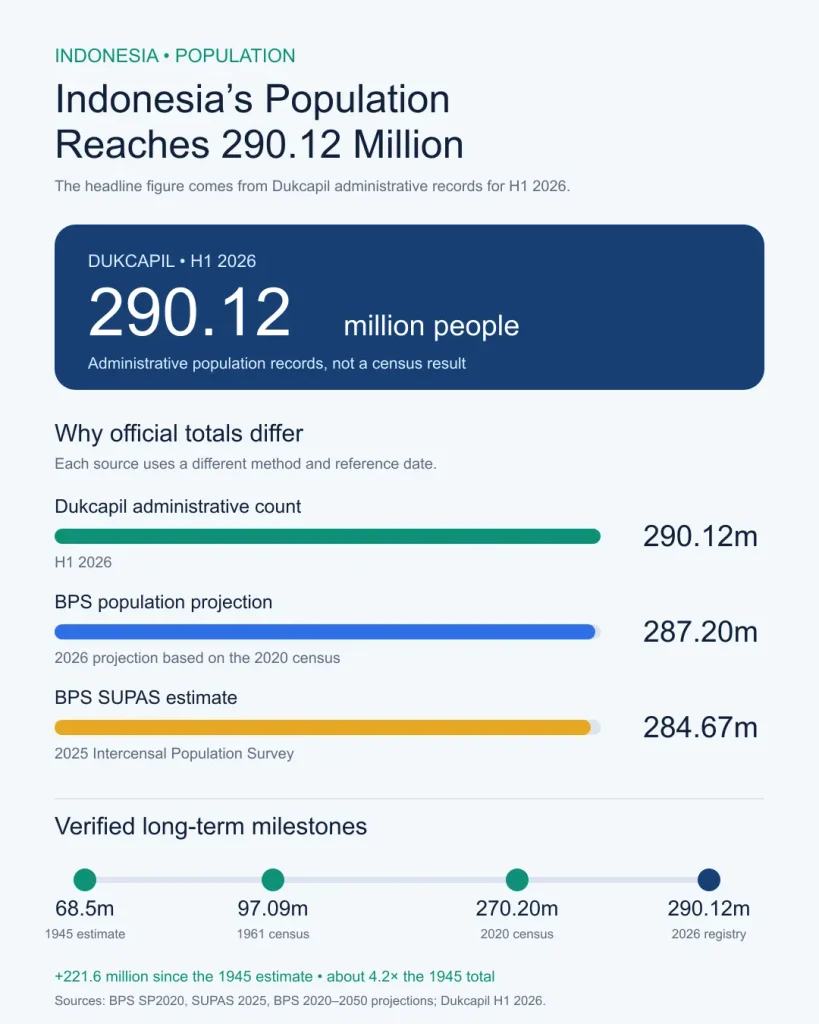
JAKARTA, thekabarnews.com—Indonesia’s population reached approximately 290.12 million in the first half of 2026. This is according to data attributed to the Home Ministry’s Directorate General of Population and Civil Registration (Dukcapil).
The administrative count represents an increase of about 1.81 million people from the second half of 2025. At that time, Dukcapil recorded approximately 288.3 million residents.
It also illustrates the scale of Indonesia’s demographic transformation during the 81 years since the country declared independence in 1945.
However, readers should not interpret the 290.12 million figure as a new census result.
Dukcapil compiles administrative records from Indonesia’s population-registration system. Meanwhile, Statistics Indonesia (BPS) produces census and projection figures using different definitions and methods.
BPS recorded 284.67 million people through the 2025 Intercensal Population Survey (SUPAS). Its population projection based on the 2020 census placed Indonesia’s 2026 population at approximately 287.20 million.
The different totals do not necessarily contradict one another because administrative records, surveys and projections measure the population differently.
Indonesia’s most recent full census counted precisely 270,203,917 residents in September 2020, according to the BPS Population Census portal.
Historical estimates place Indonesia’s population at about 68.5 million around independence.
The country’s first post-independence population census, conducted in 1961, subsequently recorded 97,085,348 people, according to the official BPS census publication.
Using the 68.5 million historical estimate and Dukcapil’s latest administrative total, Indonesia has added approximately 221.6 million residents. The country now has more than 4.2 times its estimated 1945 population.
The increase equals about 323 percent of the 1945 base—not 343 percent. Historical figures for 1945 should still be treated as estimates, as Indonesia did not conduct its first national census after independence until 1961.
The charted series shows particularly strong decadal growth from the mid-1960s through the mid-1980s. High fertility and improving survival rates contributed more directly to that expansion than political stability alone.
Since then the population has increased at a slower rate. The BPS said SUPAS 2025 is expected to grow at 1.08 percent per year. This compares to a rate of 1.25 percent between the 2010 and 2020 censuses.
The survey also recorded a total fertility rate of 2.13 births per woman. It found an infant mortality rate of 14.12 deaths per 1,000 live births.
A larger population can expand Indonesia’s workforce and domestic consumer market.
It also increases demand for affordable housing, schools, healthcare, clean water, transportation and formal employment.
The policy challenge is not just a question of national population totals. Governments also need to address uneven population distribution, rapid urbanization and regional imbalances in essential services.
The demographic scale of the country can only be an economic advantage if national and regional authorities can keep pace with population growth. They must create productive jobs, build reliable infrastructure and provide accessible public services.






No Comment! Be the first one.