



Flores quake kills 100 as BNPB expands relief
JAKARTA, thekabarnews.com—The magnitude-7.7 earthquake that struck Flores, East Nusa Tenggara, has killed 100 people, while authorities continue to deliver aid to thousands sheltering outside...


News Summary
- A magnitude-7.7 earthquake struck Flores, killing 100 people and injuring 1,603, while displacing over 180,000 residents.
- The quake damaged nearly 74,000 homes and public facilities across seven districts, complicating relief efforts due to difficult terrain.
- Authorities reported ongoing aftershocks and made efforts to deliver aid, but not everyone received sufficient assistance yet.
- Medical facilities faced challenges, with some closed and others requiring additional medical volunteers.
- BNPB plans to verify damage, establish shelters, and propose temporary solutions for severely damaged homes.
JAKARTA, thekabarnews.com—The magnitude-7.7 earthquake that struck Flores, East Nusa Tenggara, has killed 100 people, while authorities continue to deliver aid to thousands sheltering outside centralized evacuation sites.
The National Disaster Management Agency (BNPB) reported the updated figures during a press conference on Monday, August 24.
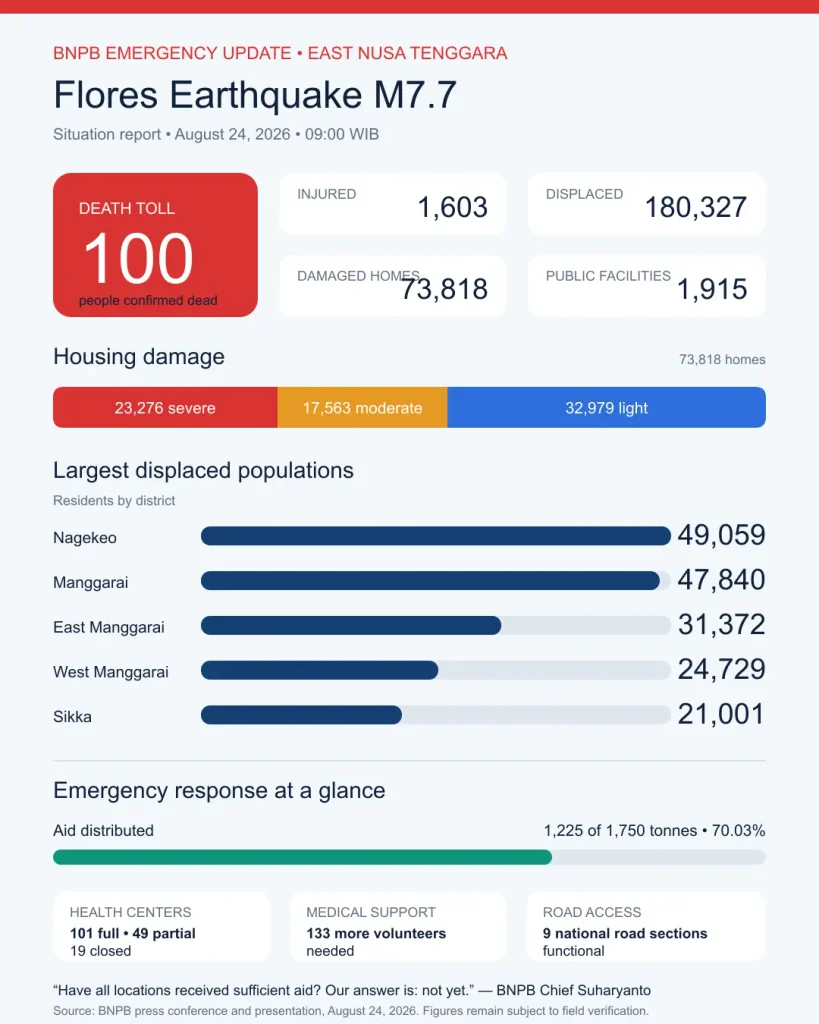
Data presented at 9 a.m. showed that the disaster had injured 1,603 people and displaced 180,327 residents across seven affected districts.
The earthquake also damaged 73,818 homes, comprising 23,276 severely damaged units, 17,563 moderately damaged units and 32,979 lightly damaged units. Authorities recorded damage to another 1,915 public facilities.
Manggarai recorded the highest death toll with 38 fatalities, followed by East Manggarai with 34 and Nagekeo with 13. Nagekeo reported the largest displaced population at 49,059, followed by Manggarai at 47,840.
BNPB head Lt. Gen. Suharyanto said difficult terrain, damaged roads and the large number of people staying in independent shelters had complicated the response.
“Have all locations been covered? Has everyone received assistance, and is it sufficient? Our answer is: not yet,” Suharyanto said, according to a recording of the press conference reviewed by TheKabarNews.
“But as time goes on, we will make every effort to ensure that independent evacuees who remain in distant locations continue to receive logistics and other basic necessities,” he added.
Some residents erected tents near their homes or moved to higher ground because repeated aftershocks generated fear and misinformation about another tsunami, he said.
BNPB encouraged residents to use centralized evacuation sites but said authorities would not force those who chose to remain elsewhere.
The main earthquake struck on August 15 at 4:58 a.m. WIB. The Meteorology, Climatology and Geophysics Agency (BMKG) located its epicenter at sea, about 30 kilometers northeast of Nagekeo, at a depth of 15 kilometers.
BMKG linked the earthquake to thrust-fault activity along the Flores Back-Arc Thrust. BMKG recorded 4,256 aftershocks through August 21, with the strongest measuring magnitude 6.2.
BNPB said relief centers received approximately 1,750 tonnes of supplies between August 15 and 23 and distributed about 1,225 tonnes, or 70.03 percent. Another 524 tonnes remained in the national logistics warehouse.
Responders have used trucks and motorcycles and, in isolated areas, carried supplies on foot. The emergency operation involved 111 BNPB personnel and 5,832 military personnel, alongside police, search-and-rescue teams, medical workers and local responders.
The Health Ministry reported damage to 169 community health centers. Of those, 101 were operating fully, 49 provided limited services and 19 remained closed. Authorities said the region had 11,106 health workers but still required 133 additional medical volunteers.
Two hospital ships, field hospitals and emergency medical teams supported local facilities. Medical posts in Reo, Waso and Wangkung treated 411 patients from August 21 to 23.
Public Works Ministry teams restored functional access along nine national road sections and handled 64 landslide locations. Although vehicles could now again use the main routes, repair work continued.
“All roads impassable due to landslides or damaged bridges are now passable,” Suharyanto said.
“They have not returned to their pre-disaster condition, but functionally they are all accessible,” he added.
BNPB plans to accelerate damage verification, establish integrated shelters and prepare in-place repairs for lightly and moderately damaged homes.
For severely damaged houses, local governments will propose temporary shelters, housing-waiting assistance or permanent reconstruction.






No Comment! Be the first one.