



Data-led strategy targets West Kalimantan fire risk
PONTIANAK, thekabarnews.com—The West Kalimantan administration is developing a science-based strategy to prevent forest and peatland fires. This comes as a strong El Niño intensifies dry conditions...

PONTIANAK, thekabarnews.com—The West Kalimantan administration is developing a science-based strategy to prevent forest and peatland fires. This comes as a strong El Niño intensifies dry conditions across parts of Indonesia.
Governor Ria Norsan led a strategic coordination meeting at the West Kalimantan Governor’s Office in Pontianak on Wednesday morning, Oct. 21. Provincial agency heads, researchers and other stakeholders attended the meeting. They aimed to align government policy with scientific findings on fire risks and peatland management.
The meeting focused on identifying the local drivers of fires, mapping high-risk areas and improving coordination before outbreaks escalate. The provincial administration said academic research would help authorities tailor preventive measures to West Kalimantan’s environmental conditions.
“Prevention efforts must be designed in an integrated manner by considering the various factors that trigger and spread fires. A data- and research-based approach should help the government set more measurable preventive steps while improving the effectiveness of operations in the field,” Norsan said at the Ruai Telabang meeting room.
Read also: West Kalimantan hotspots drop to 28, peat smoke persists
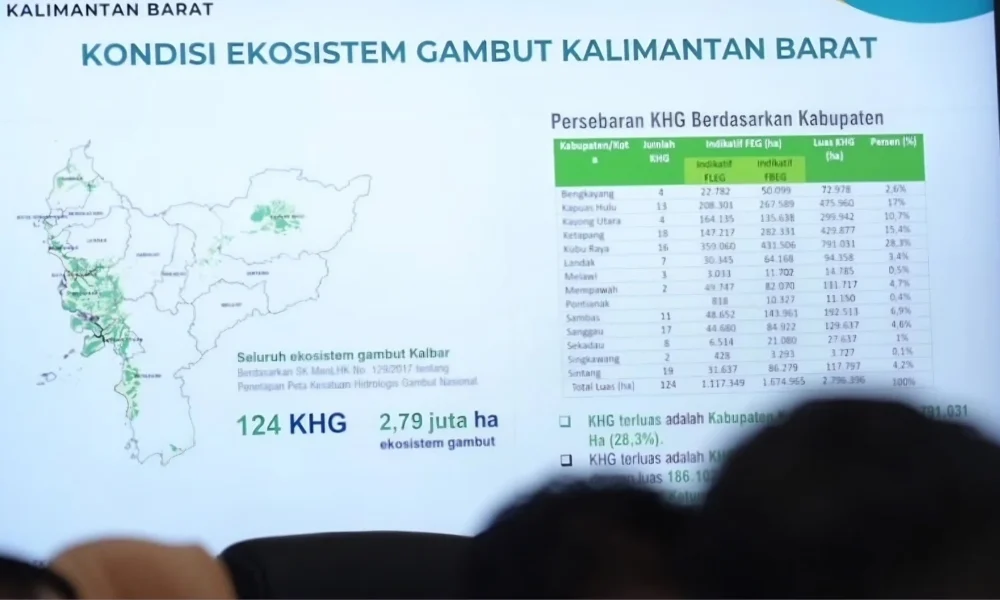
West Kalimantan contains about 2.79 million hectares of peat ecosystems divided among 124 peat hydrological units (KHGs), according to government data displayed during the meeting. The figures are also consistent with a CIFOR-ICRAF factsheet based on the national peat hydrological map.
This extensive peat area makes water management an important part of fire prevention. Drained or degraded peat can dry out during prolonged periods without rain. As a result, fires can spread below the surface and become harder to extinguish.
Norsan said the provincial administration should move beyond a response model that relies heavily on firefighting after flames appear. Authorities instead need to combine risk maps with field observations and research findings while maintaining operational readiness.
The administration expects the approach to improve early intervention and guide land management according to local ecological conditions. Its effectiveness, however, will depend on whether provincial agencies translate the research into measurable programs, clear responsibilities and sustained monitoring.
Read also: West Kalimantan steps up legal action on wildfires
The meeting took place as Indonesia faced unusually dry atmospheric conditions. The Meteorology, Climatology and Geophysics Agency (BMKG) reported a three-month ENSO index of +3.08 for August–October, indicating a very strong El Niño.
BMKG forecast low rainfall of below 50 millimeters per 10-day period across parts of West Kalimantan during the second and third parts of October.
The agency said the combination of El Niño and a positive Indian Ocean Dipole was limiting cloud formation. As a result, dry land was more vulnerable to fires.
Earlier satellite monitoring also recorded 1,088 high-confidence hotspots in West Kalimantan between Sept. 7 and 16. This placed the province behind Central Kalimantan and South Sumatra among the areas with the highest totals at the time. A hotspot indicates a thermal anomaly and does not automatically confirm a fire on the ground.
Read also: BNPB sends helicopter to Kubu Raya peat fires
Norsan also linked the provincial plan to President Prabowo Subianto’s prevention campaign. In August, Prabowo announced that the central government would prepare about 1,000 military and police officers. They would support public education on fire prevention and land clearing without burning. The initiative was initially announced during a coordination meeting in South Sumatra.
West Kalimantan’s new strategy puts research at the center of its response. However, its success will ultimately depend on field implementation, peatland protection and consistent enforcement against illegal burning.



No Comment! Be the first one.