



BGN head revises budget, recovers funds
JAKARTA, The Kabar News—The National Nutrition Agency (BGN) says it generated Rp44 trillion (US$2.6 billion) in budget savings and returned funds to the state during the first 100 days of Sudaryono’s...

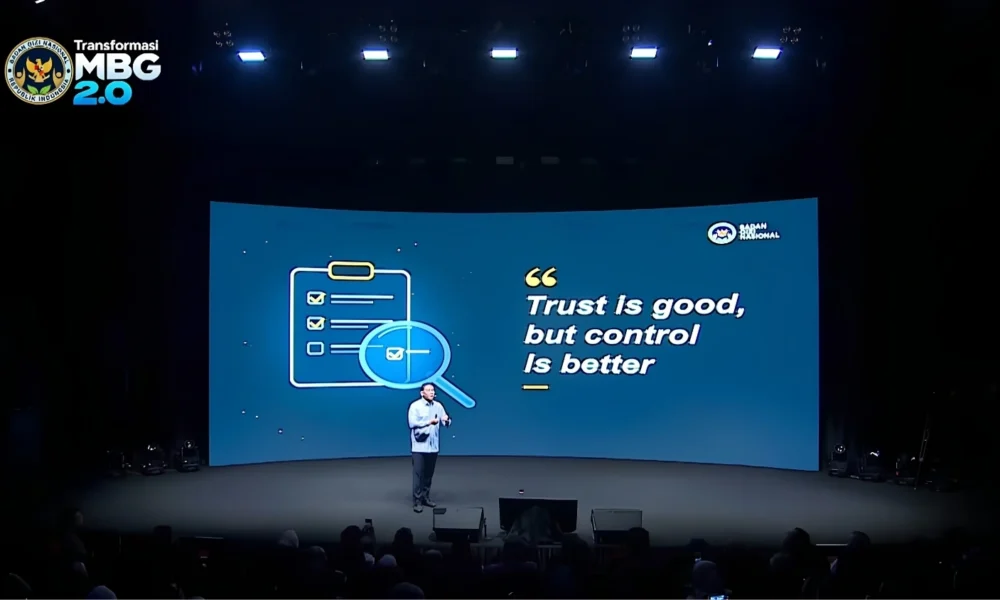
JAKARTA, The Kabar News—The National Nutrition Agency (BGN) says it generated Rp44 trillion (US$2.6 billion) in budget savings and returned funds to the state during the first 100 days of Sudaryono’s leadership as head of the agency.
Sudaryono announced the figure during a performance review in South Jakarta on Thursday, Oct. 29. The BGN presented the measures as part of an overhaul called MBG 2.0. This overhaul aims to improve the governance of President Prabowo Subianto’s Free Meals (MBG) program.
“In these 100 days, we have made the use of public money more efficient, totaling Rp44 trillion,” Sudaryono said. “Every rupiah belongs to the people and must be accountable.”
The figure largely represents changes to future spending plans rather than money recovered from proven fraud. According to BGN’s official review, the agency reduced its planned budget by Rp38 trillion after recalculating its operational needs.
Read also: BGN claims Rp44tn savings under MBG 2.0 overhaul
BGN said the remaining savings came from revising kitchen incentives by about Rp2.5 trillion. The agency also capped operational expenses to save an estimated Rp3 trillion. Moreover, it withdrew nearly Rp500 billion from virtual accounts linked to kitchens that had not begun operating.
The agency also reported returning another Rp160 billion following findings or recommendations from the Supreme Audit Agency (BPK). Furthermore, the Financial and Development Supervisory Agency (BPKP) and BGN’s internal review contributed to this outcome.
BGN has not publicly released a complete audited reconciliation. Therefore, it is unknown whether this amount sits inside or outside the Rp44 trillion total.
Sudaryono also alleged that intermediaries had controlled about 500 planned Nutrition Fulfilment Service Units (SPPGs) without investing in operational kitchens.
Read also: MBG 2.0 targets brokers, unsafe SPPGs and waste
“There were around 500 fictitious kitchens [SPPGs] controlled by broker foundations. They requested deductions of Rp500 to Rp1,500 from every meal portion,” he said.
He claimed intermediaries had previously sold the right to establish an SPPG location for between Rp300 million and Rp350 million. After obtaining a location, the foundations allegedly partnered with investors. These investors financed and operated the actual kitchens while paying the intermediaries a fee for each meal.
“Someone could sit around and make Rp1 billion a day without working or breaking a sweat, simply by collecting money,” Sudaryono said. “In this new era, we are cleaning all of that up.”
BGN has not publicly identified the individuals or foundations involved. The allegations therefore remain administrative findings and claims of the agency. They will remain so unless investigators establish criminal responsibility through a formal legal process.
Read also: BGN suspends SPPG in Kubu Raya after hundreds of students return MBG packages
BGN has replaced the flat incentive of Rp6 million per SPPG per day with a payment of Rp2,000 for each meal actually produced. Sudaryono said the previous arrangement paid the same amount to kitchens serving 500 meals and those reaching the expected capacity of 3,000 portions.
The agency also introduced a maximum operational allowance of Rp3,000 per portion after finding that some kitchens claimed between Rp4,500 and Rp5,000. Therefore, BGN expects the limit to keep more of the program’s allocation focused on ingredients and meal quality.
BGN’s review reported well over 58 million verified beneficiaries and 26,723 verified SPPGs from 27,485 registered facilities. It also listed 1.03 million active workers and 80,315 local suppliers. Of these suppliers, 82.83 percent were micro, small or medium-sized enterprises.
The agency said it would monitor kitchens through daily financial reports, CCTV and digital platforms. It is also developing Radar MBG to publish menu information and LokaMBG to record ingredient purchases.
Such reforms could help cut waste and make SPPG transactions easier to trace. However, savings must be audited by independent auditors. In addition, enforcement outcomes must be transparently published by BGN, which must show that tighter controls improve food safety without disrupting meal distribution.




No Comment! Be the first one.