



New book traces shared Dayak-Malay roots in Borneo
PONTIANAK, thekabarnews.com—West Kalimantan Deputy Governor Krisantus Kurniawan launched a multidisciplinary book examining relations between Dayak and Malay communities at Rumah Melayu in Pontianak...

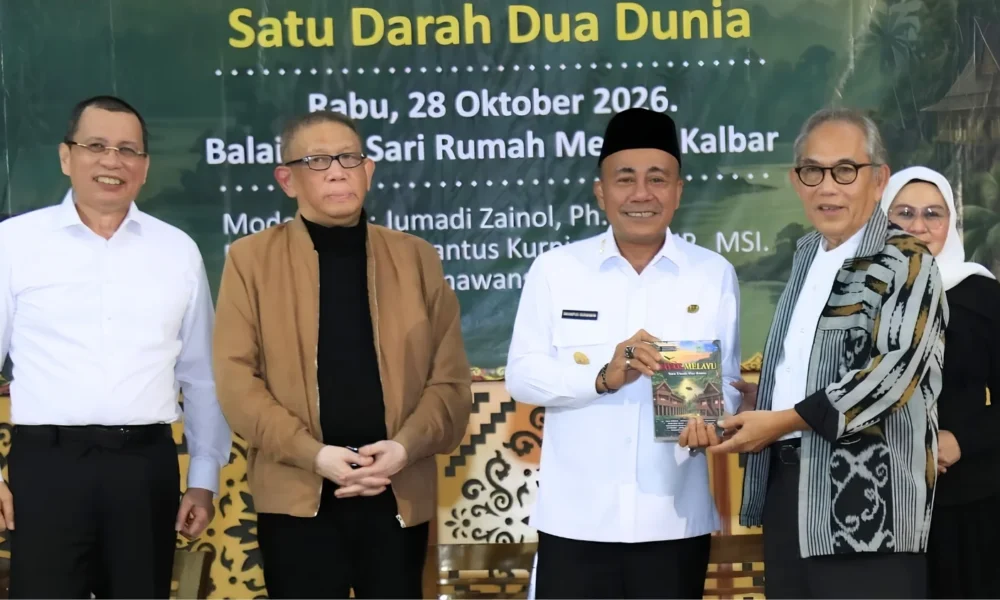
PONTIANAK, thekabarnews.com—West Kalimantan Deputy Governor Krisantus Kurniawan launched a multidisciplinary book examining relations between Dayak and Malay communities at Rumah Melayu in Pontianak on Wednesday, Oct. 28.
The launch of Dayak-Melayu: Satu Darah, Dua Dunia coincided with the 98th anniversary of Youth Pledge Day. Organizers positioned the event as an opportunity to promote cultural dialogue and reinforce social cohesion in the ethnically diverse province.
The book brings together 18 writers from a variety of educational and professional backgrounds. Its chapters approach Dayak-Malay relations through history, anthropology and linguistics. Other sections examine literature, religious studies, political life and ecology.
Krisantus said the publication could help readers understand how identities in West Kalimantan developed through long periods of interaction rather than as entirely separate historical experiences.
Read also: Krisantus’ warning on Kalbar inequality resurfaces
“I have long awaited an academic study—whether sociological, anthropological or historical—that shows the similarities in our origins,” Krisantus said.
“Some of the differences may arise from perception and from how we understand our respective identities.”
His remarks reflect the book’s central argument. They should not be read as reducing either community to a single identity, as both Dayak and Malay societies contain considerable cultural, linguistic and regional diversity.
The book discusses the ways migration, settlement patterns, religion and political change influenced community identities across Borneo. It also explores cultural meeting points through mythology, rituals, poetry, food and local environmental practices.
Krisantus said some Dayak communities historically adopted a Malay identity after embracing Islam. He argued that such experiences demonstrated close social ties, although identity formation varies across locations and historical periods.
Read also: Dayak masses hold a traditional ritual in Sanggau over a customary dispute
“If we study the history, Dayak and Malay communities have a very close relationship,” he said. “That is why the message of ‘One Blood’ remains relevant as a reminder of kinship.”
Researchers have long described Dayak and Malay communities as two of West Kalimantan’s major cultural groups. Shared public traditions also reflect their interaction.
In Kapuas Hulu, for example, Dayak Iban, Dayak Tamambaloh and Malay residents have jointly performed customary rituals connected with the Danau Sentarum Festival.
Such examples do not eliminate differences between the communities. Instead, they show how distinct traditions can coexist and interact within the same social landscape.
Krisantus described the book as more than a collection of academic essays. He said it could provide a platform for reflection and encourage younger generations to study local history without turning cultural differences into social barriers.
Read also: Krisantus urges central govt to optimize Kijing port and review spatial planning
“Dayak and Malay are not two completely separate worlds. Like leaves on the same plant, their forms may differ, but they continue to grow from connected roots,” he said.
The deputy governor also encouraged universities and researchers to expand studies of West Kalimantan’s local cultures. He said academic work should reach communities and inform public policy instead of remaining limited to classrooms.
The 18 contributors include Chairil Effendy, Hermansyah, Muriadi Arip, Paulus Ajong, Syafaruddin Usman, Alexander Mering, Albertus Imas and Ahmad Rabi’ul Muzammil. Other writers are Samsul Hidayat, Dedy Ari Asfar, Urai Muhani, M. Rustam, Sri Sukarni, Gusti Hardiansyah, Syamsul Kurniawan, Jumadi, Syahdin L. Nyarong and Stefanus Barlian Soeryamassoeka.
Former West Kalimantan governor Sutarmidji and Tanjungpura University Rector Garuda Wiko attended the launch. Malay and Dayak customary leaders were also present.
Krisantus closed the event by linking the publication’s message to the 1928 Youth Pledge, which emphasized one homeland, one nation and one unifying language. He said West Kalimantan’s communities could preserve their distinct traditions while working together as part of a shared regional future.
No Comment! Be the first one.