



BGN claims Rp44tn savings under MBG 2.0 overhaul
JAKARTA, thekabarnews.com—Indonesia’s National Nutrition Agency (BGN) has announced a wide-ranging overhaul of the Free Meals (MBG) program, combining tighter financial controls with digital...

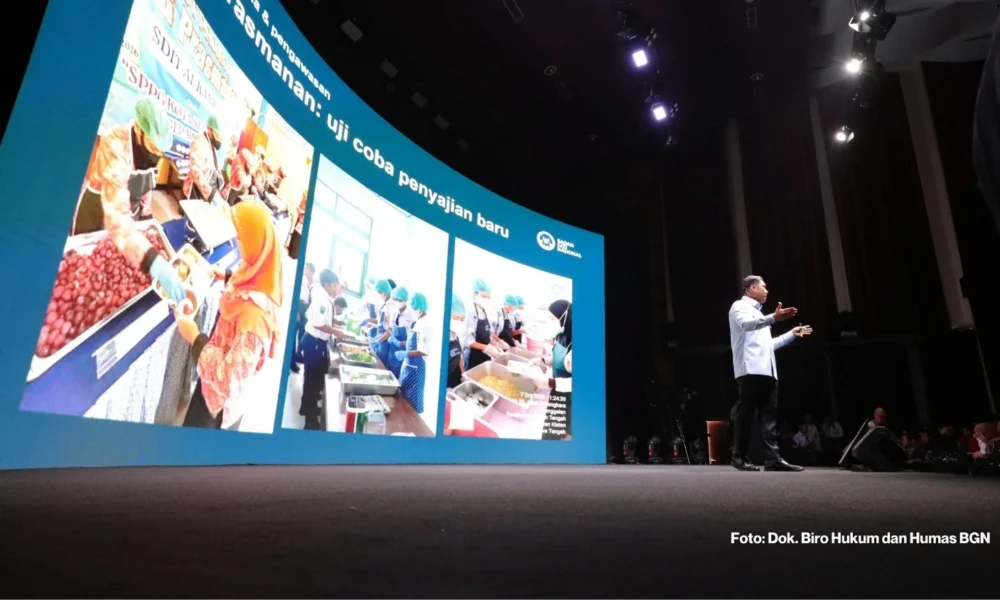
JAKARTA, thekabarnews.com—Indonesia’s National Nutrition Agency (BGN) has announced a wide-ranging overhaul of the Free Meals (MBG) program, combining tighter financial controls with digital monitoring and stronger food-safety requirements.
BGN head Sudaryono presented the reforms as MBG 2.0 during a review of his first 100 days in office in Jakarta on Thursday, Oct. 29. He said the agency had identified Rp44 trillion (US$2.6 billion) in budget reductions, projected savings and recovered funds.
“In 100 days, we have generated total efficiencies of Rp44 trillion from public funds,” Sudaryono said. “Every rupiah is public money and must be properly accounted for.”
The Rp44 trillion figure does not consist entirely of cash already recovered and returned to the Treasury. In fact, BGN said approximately Rp38 trillion came from reducing its 2026 allocation from Rp268 trillion to Rp229.75 trillion. This adjustment followed a review of the program’s spending requirements.
Read also: BGN suspends SPPG in Kubu Raya after hundreds of students return MBG packages
The agency expects another Rp2.5 trillion to Rp3 trillion in savings from changing payments to partner foundations. Specifically, BGN replaced a flat incentive of Rp6 million per kitchen per day with a payment of Rp2,000 for each meal served.
A new ceiling of Rp3,000 per meal for kitchen operating expenses could generate a further Rp3 trillion in projected savings through the end of the year, according to the agency.
BGN also reported recovering Rp311.25 billion from 414 problematic or allegedly fictitious virtual accounts. It returned another Rp160.37 billion following findings from the Supreme Audit Agency, or BPK. These recoveries total about Rp471.62 billion, according to BGN.
The full Rp44 trillion claim remains BGN’s calculation and has not yet appeared in a publicly available independent audit covering all components. Some components represent lower allocations. Others are expected future savings rather than recovered spending.
Read also: BGN fires 261 staff, closes 833 SPPGs nationwide
MBG 2.0 also seeks to strengthen food safety across the program’s Nutrition Fulfillment Service Units (SPPGs).
BGN said SPPGs must obtain sanitation and hygiene certification. The agency also plans to require experienced cooks and expand unannounced inspections. Daily staff briefings would reinforce compliance with food-handling procedures.
The agency is developing artificial intelligence-assisted monitoring through CCTV cameras connected to its central system. The technology will flag possible violations. However, BGN has not disclosed how many SPPGs already use compatible cameras or when it will complete nationwide coverage.
“Food safety is a priority. Even one affected child is one too many,” Sudaryono said.
BGN reported that it had verified well over 58 million beneficiaries and 26,723 SPPGs out of 27,485 registered facilities during the first 100 days. The agency also counted 1.03 million active workers and 80,315 local suppliers. According to its MBG 2.0 performance report, it classified 82.83 percent of those suppliers as micro, small or medium-sized businesses.
Read also: A Look Inside Indonesia’s Free Meals Program (MBG)
The reforms include two digital platforms that remain under development. Radar MBG will allow the public to view daily menus. Meanwhile, LokaMBG will record ingredient purchases and identify where the products originate.
BGN expects the platforms to reduce price manipulation and prevent individual suppliers from dominating local procurement. Their effectiveness will depend on accurate data entry, public access and prompt enforcement when irregularities emerge.
MBG 2.0 represents an attempt to correct weaknesses in a program operating across tens of thousands of SPPGs. The next test is whether BGN can translate its announced standards and projected savings into independently verifiable results. It must do so without reducing meal quality or access for intended beneficiaries.




No Comment! Be the first one.