



Three muslim women arrested in Uttar Pradesh as authorities await forensic results
Thekabarnews.com—Authorities said a normal day for a family in Uttar Pradesh’s Kaushambi district turned into a legal fight after the police raided their house over cooking beef. Forensic experts are...

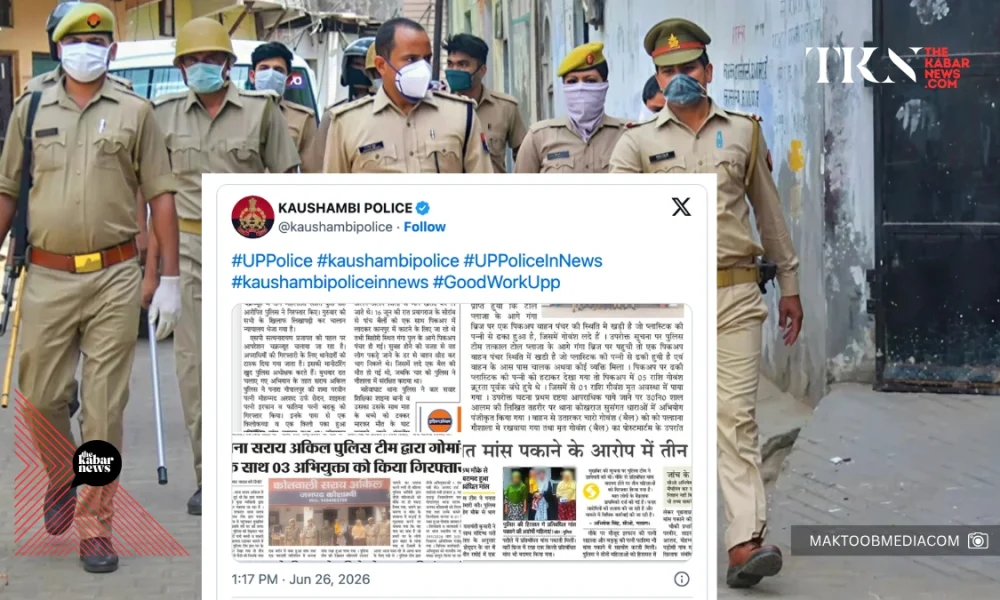
Thekabarnews.com—Authorities said a normal day for a family in Uttar Pradesh’s Kaushambi district turned into a legal fight after the police raided their house over cooking beef.
Forensic experts are yet to confirm the identity of the meat seized in the operation, which has drawn public attention.
The search ended with the arrest of three Muslim women, Shama Parveen, Shaista, and Fatima, from their residence. Officials said that the investigators received a tip-off that some family members had brought beef from outside the district. They said the meat was being cooked inside their home.
Authorities said they did a preliminary check ahead of the raid. A police team led by Deputy Superintendent of Police Abhishek Singh conducted the search. Police then took the three women into custody for questioning.
“We have arrested the three women. During questioning, they told us the meat was beef that had been brought by their family members from outside,” Singh said, as quoted by The Indian Express.
Officials said forensic experts have not yet identified the exact type of meat recovered from the residence.
But that detail has become the headline in public discourse. Many say a scientific inquiry will be key to establishing the facts of the matter.
This investigation has greatly affected the women involved in their everyday lives.
What began as a typical day at home spiraled into a criminal investigation that drew national attention. The situation spotlighted the emotional and legal challenges families face when police investigations intersect with issues of religion, food practices and local law.
The case also points to the sensitive nature of cattle-related laws in many states in India.
Uttar Pradesh has stringent laws against cow slaughter, and possession or transport of beef. From a legal and social perspective, allegations about beef are highly sensitive. Violations may incur criminal penalties.
Such investigations can often see a forensic analysis become a key part of the process. More reliable than other methods, laboratory testing can determine the identity of the seized material.
The process continues until it is finished and authorities continue to collect evidence. Criminal allegations do not imply guilt.
In India, due process is a right of the defendants. The courts will finally decide criminal liability on the evidence produced during the judicial proceedings.
The incident has also renewed debate about how to best balance effective policing and procedural fairness. This is especially important in cases involving religious and cultural sensitivities.
For many families, these questions extend beyond the courtroom. Arrests carry serious emotional, financial, and social consequences. These consequences affect not only the arrested individual but also their family members and surrounding communities.
Lawyers are reviewing the case, and investigators are awaiting results from the forensic lab.
At least for now, it’s less about conclusions than a family grappling with the uncertainty of an open investigation. The case illustrates how legal disputes can quickly affect families when authorities bring investigations into the home.
The outcome, in the end, will hinge on the evidence presented to the court. This will include the results of a pending forensic examination that authorities say will help illuminate one of the case’s central questions.



No Comment! Be the first one.