



Prabowo highlights Muhammadiyah’s role in education
PALU, The Kabar News—President Prabowo Subianto praised Muhammadiyah’s contribution to Indonesian education, healthcare and social services while calling on the country’s leaders to work together...
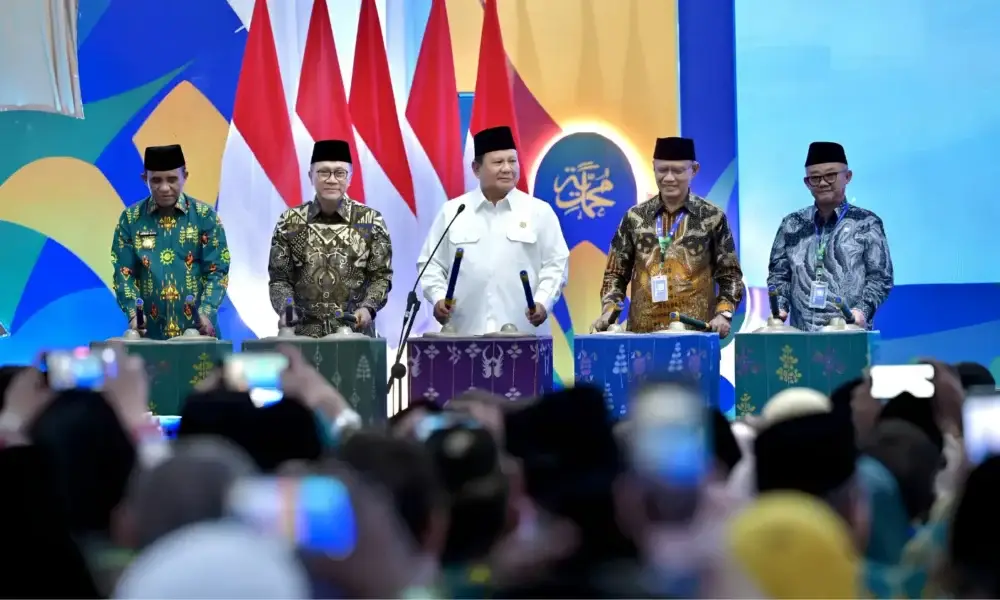
PALU, The Kabar News—President Prabowo Subianto praised Muhammadiyah’s contribution to Indonesian education, healthcare and social services while calling on the country’s leaders to work together across political and social differences.
Prabowo delivered the message as he opened the organization’s 2026 Tanwir and 114th anniversary celebration. The event was held at Muhammadiyah University of Palu in Central Sulawesi on Saturday, Nov. 14.
The three-day event, held from Nov. 13 to 15 under the theme “Together, Unifying the Nation,” brought Muhammadiyah leaders from across Indonesia to Palu. Tanwir is the organization’s second-highest deliberative forum after its national congress (Muktamar).
“By seeking the grace of Allah the Almighty, I, Prabowo Subianto, President of the Republic of Indonesia, hereby officially open the 2026 Muhammadiyah Tanwir, and happy 114th anniversary to Muhammadiyah,” the president said, according to the Presidential Secretariat.
Read also: Muhammadiyah declares smoking is haram and it invalidates fasting during Ramadan
Prabowo said Muhammadiyah had built a substantial public-service network, with education remaining one of its most visible contributions. Its schools and universities educate students in cities and regions where access to quality learning can vary widely.
Figures published by Muhammadiyah in January show that the organization and its women’s wing, Aisyiyah, operate 164 higher-education institutions. These institutions serve more than 800,000 students.
Muhammadiyah schools educate about 1.1 million pupils, while the organization reported operating 128 hospitals. These are Muhammadiyah’s institutional figures rather than independently audited national statistics.
The scale of the network, Prabowo said, reflected the organization’s ability to manage institutions. These institutions provide practical benefits to the public.
Read also: President Prabowo: global survey says Indonesians are happiest
Muhammadiyah also reported in April that its education system included 23 medical faculties. Furthermore, its university and hospital networks allow the organization to combine professional training with healthcare services. This is particularly true outside Indonesia’s largest metropolitan areas.
Prabowo used the gathering to stress that Indonesia’s diversity requires cooperation rather than competition. This is especially relevant between groups seeking to impose their interests.
“A successful nation is one whose leaders can work together,” Prabowo said.
He said Indonesia’s different social backgrounds, organizations and schools of thought should not become reasons for hostility. Instead, national leaders must find common ground when addressing poverty, education and public welfare.
The message reflected the Tanwir theme, which Muhammadiyah said drew on gotong royong [mutual cooperation]. The theme also reflects Indonesia’s national principle of unity in diversity.
Muhammadiyah chairman Haedar Nashir said holding the gathering in Palu also carried a message of recovery. Central Sulawesi has continued rebuilding after the earthquake, tsunami and soil liquefaction disaster that struck the region in 2018.
Read also: Muhammadiyah demands probe as Kalbar fires escalate
“Through this Tanwir, Mr. President, we want to share the spirit of rising and continuing to rebuild after the earthquake and tsunami,” Haedar said.
The forum is also preparing Muhammadiyah’s long-term organizational agenda and its 49th Muktamar. The Muktamar is scheduled to take place in Medan, North Sumatra, in 2027.
An accompanying exhibition in Palu features local microbusinesses and Muhammadiyah institutions working in education, healthcare and humanitarian services.
You May Also Like: Sponsored Offers
Prabowo closed his address by congratulating Muhammadiyah and encouraging it to remain a moral and social force. The organization’s future contribution, however, will depend not only on the size of its institutional network. It will also depend on the accessibility and quality of the services it provides.


No Comment! Be the first one.