



Indonesia-China MoUs target $71.8bn in projects
SHENZHEN, The Kabar News—Indonesian and Chinese entities exchanged four agreements and investment commitments with a combined headline value of US$71.8 billion, or more than Rp1.3 quadrillion, in...
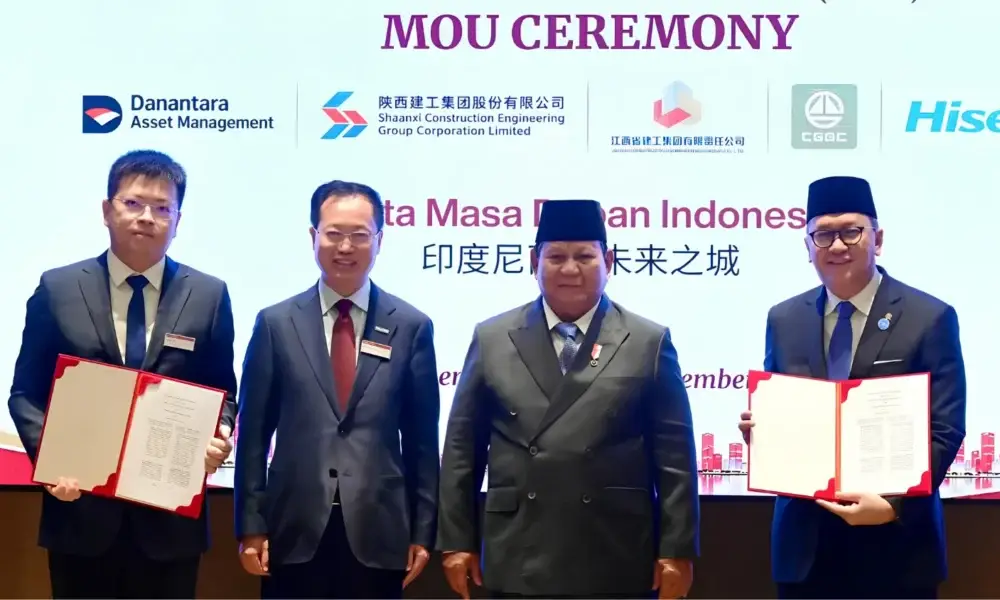
SHENZHEN, The Kabar News—Indonesian and Chinese entities exchanged four agreements and investment commitments with a combined headline value of US$71.8 billion, or more than Rp1.3 quadrillion, in Shenzhen on Wednesday, Nov. 18, 2026.
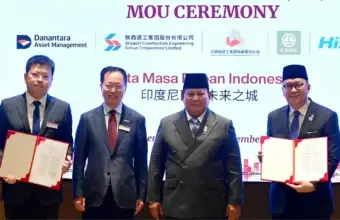
President Prabowo Subianto witnessed the exchange during his visit to China for the 2026 Asia-Pacific Economic Cooperation summit. The agreements cover future smart cities and manufacturing cooperation. They also include infrastructure financing and coal-to-ethanol technology.
Investment and Downstream Minister Rosan Roeslani, who also serves as chief executive of sovereign wealth fund Danantara Indonesia, said the projects could create jobs and expand technology transfers.
However, the $71.8 billion figure represents the stated value of memoranda of understanding, financing partnerships and corporate commitments. It does not mean that Indonesia has already received the full amount as realized investment.
The largest agreement covers plans to develop 10 initial “future smart city” sites, with a stated value of approximately $50 billion.
Read also: True wealth starts with smarter money habits, not higher income
Danantara-affiliated PT Kota Masa Depan Indonesia signed the memorandum with a consortium led by entities from China’s Shaanxi province, according to the Indonesian Presidential Secretariat.
“It will be one of the historic projects that we will commence next year,” Rosan said in Shenzhen.
The government did not immediately disclose the proposed locations, development schedule or financing structure for the cities. It also did not explain which public services would use smart-city technology.
Before construction begins, the participating entities will need to complete feasibility studies and secure financing. They will also need permits and clear data-governance rules, particularly if the projects use surveillance systems or collect residents’ personal information.
The second agreement involves Danantara, the Higher Education, Science and Technology Ministry and Chinese electronics company Hisense.
Read also: Prabowo’s commitment to integrity and anti-corruption in law enforcement reform
The parties plan to establish joint research and development laboratories, strengthen workforce training and expand home-appliance manufacturing in Indonesia. Hisense and its Indonesian partners placed the commitment’s stated value at around $10 billion.
The arrangement builds on an earlier MoU witnessed by Prabowo in Jakarta in May. The latest agreement expands the proposed collaboration, although the government has not published a detailed investment timetable or production targets.
The project’s domestic impact will depend on the number of jobs created and how much technology Indonesian institutions receive. Local supplier participation will also determine whether the investment strengthens the wider manufacturing sector.
Danantara signed the third agreement with a consortium led by China’s State Development and Investment Corporation, or SDIC. The parties valued the proposed infrastructure financing partnership at approximately $10 billion.
Read also: President Trump warns of potential global oil supply crisis without US-Iran peace agreement
The announcement did not identify a final list of projects or disclose the proportion of debt and equity financing. Those details will be important because financing terms affect project costs and the risks borne by the Indonesian government or participating companies.
The fourth agreement concerns a $1.8 billion coal-to-ethanol project. The Higher Education, Science and Technology Ministry and state energy company Pertamina signed the MoU with Beijing Petrochemical Engineering Co. Ltd.
The parties intend to develop technology that converts coal into ethanol and transfer related technical knowledge to Indonesia. The government has not yet released the project’s planned capacity or lifecycle-emissions assessment.
Coal-to-ethanol production could support domestic fuel supply, but the project will require strict environmental evaluation because its overall emissions depend on the production process and energy source.
The agreements deepen an already substantial economic relationship. China remained Indonesia’s largest trading partner during the first nine months of 2026, according to Trade Ministry data.
Bilateral trade reached $132.13 billion during that period. Indonesia exported $55.47 billion in goods to China and imported $76.67 billion, producing a $21.2 billion trade deficit.
Prabowo traveled to Shenzhen after attending the ASEAN-US Special Summit in Manila. His successive meetings with US and Chinese leaders reflected Indonesia’s effort to maintain economic partnerships with both major powers.
You May Also Like: Sponsored Offers
The Shenzhen agreements provide a large pipeline of prospective projects, but their value will depend on execution. The government and participating companies must now disclose timelines, financing terms and measurable employment targets.
Transparent procurement and credible environmental safeguards will also be key to ensuring that the commitments deliver lasting benefits. Officials should refer to the $71.8 billion as the value of agreements and commitments, not as investment completed, until the parties reach financial close and start implementation.


No Comment! Be the first one.