



Pontianak brings in 5 million liters as rivers turn salty
PONTIANAK, thekabarnews.com—The Pontianak city administration has delivered about five million liters of fresh water by barge to the water treatment plant for the Parit Mayor as saltwater intrusion...

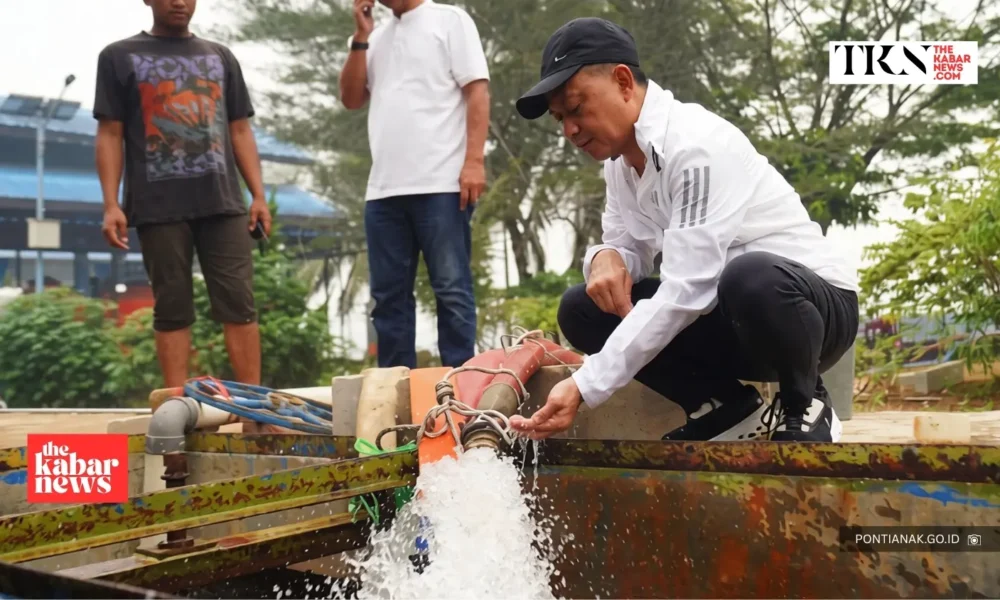
PONTIANAK, thekabarnews.com—The Pontianak city administration has delivered about five million liters of fresh water by barge to the water treatment plant for the Parit Mayor as saltwater intrusion continues to disrupt Pontianak’s raw water supply.
The shipment arrived from Radak village in Terentang district, Kubu Raya regency, on Sunday, September 20. Operators began transferring the water into a raw-water reservoir for treatment before its distribution to customers, primarily in East Pontianak.
“Today, I am at the Parit Mayor water treatment plant. The barge arrived this morning carrying around five million liters of fresh water,” Pontianak Mayor Edi Rusdi Kamtono said.
“We are now filling the raw-water reservoir so we can process it into clean water.”
The city brought in the water as seawater pushed farther into the Kapuas and Landak river systems during an extended dry period.
Higher salinity has complicated operations at facilities managed by the municipally owned Perumda Air Minum Tirta Khatulistiwa.
Edi warned East Pontianak residents that production adjustments could temporarily affect piped-water services.
“To East Pontianak residents, if you experience temporary disruptions, they are caused by the ongoing treatment and production process,” he said.
The latest delivery raised the total volume transported from the Radak-Terentang area to more than 10 million liters, according to the Pontianak city administration.
The barged water serves as an emergency supplement rather than a replacement for the city’s regular river-based supply.
An earlier shipment of 1.1 million liters reached the Nipah Kuning treatment plant on Sept. 16. Local checks found salinity below 10 milligrams per liter at the Radak source, while water at the affected Penepat reservoir exceeded 1,000 milligrams per liter.
“We will continue our efforts. The important thing is that residents continue receiving water services, although the current conditions are not yet comfortable,” Edi said.
Pontianak is also waiting for the Public Works Ministry to deliver a mobile reverse-osmosis unit. The city plans to deploy the equipment in North Pontianak to increase its capacity to process saline raw water.
“The Public Works Ministry will provide a mobile RO unit. We hope it arrives soon,” Edi said. “Once it arrives, we will use it to produce clean water in North Pontianak.”
For a longer-term solution, officials plan to examine Biyung, about seven kilometers from the Penepat reservoir.
Testing will determine whether saltwater intrusion has reached the area and whether it could support a new raw-water source.
“These are long-term measures. We are responding to today’s conditions and looking for alternatives to make our raw-water services more resilient in the future,” Edi said.
The barges may help stabilize water production in the short term. However, Pontianak’s long-term water security will depend on the results of alternative-source testing.
It will also require the arrival of the mobile treatment unit and investment in water sources that are less vulnerable to seawater intrusion.



No Comment! Be the first one.