



How West Kalimantan became a province of Indonesia
Thekabarnews.com—In the beginning, West Kalimantan was not one political territory. The province emerged from centuries of interaction among river communities, coastal sultanates, trading networks...

Facts Summary
- West Kalimantan’s history involved diverse river communities, coastal sultanates, and trading networks before establishing political boundaries.
- The Kapuas River played a crucial role in development, serving as transport and resource access.
- Sambas became a significant political center, while Pontianak emerged as a busy trading port in the late 18th century.
- Colonialism and Japanese occupation affected local governance, leading to events like the Mandor Incident, which weakened community leadership.
- West Kalimantan became an autonomous province in 1956, shaped by various cultures including Dayak, Malay, and Chinese influences.
Thekabarnews.com—In the beginning, West Kalimantan was not one political territory. The province emerged from centuries of interaction among river communities, coastal sultanates, trading networks and foreign powers in western Borneo.
The Kapuas River and its tributaries shaped much of this history. Settlements developed along waterways because rivers provided transport, food and access to inland resources.
The provincial government describes the Kapuas as Indonesia’s longest river, stretching about 1,086 kilometers through several regencies and Pontianak.
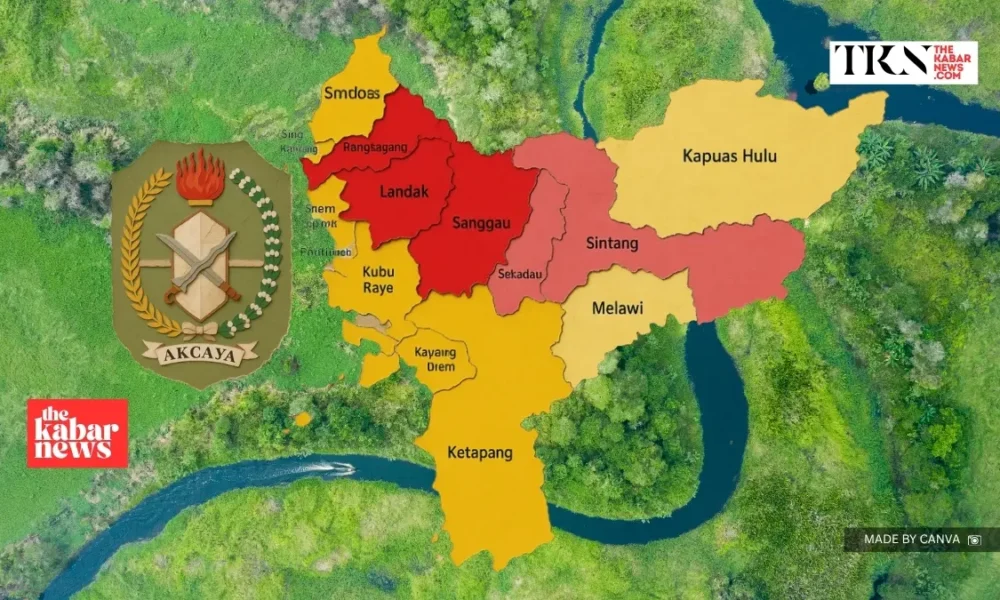
Before modern provincial boundaries existed, the region contained courts and political centers associated with Sambas, Mempawah, Landak, Tayan, Sekadau, Sintang, Matan and Pontianak.
Dayak communities across the interior also maintained their own customary institutions and systems of local authority.
Historical accounts of these polities do not always provide consistent dates or territorial boundaries. The Culture Ministry has also cautioned that archaeological evidence remains limited for some early kingdoms identified in written records and local traditions.
Sambas developed into an important political and commercial center on Borneo’s northwestern coast. An official cultural heritage account dates the establishment of its later sultanate under Sultan Muhammad Shafiuddin I to 1671, although records describe earlier centers of power in the area.
Pontianak emerged later. Syarif Abdurrahman Alkadrie and his followers established a settlement near the confluence of the Kapuas and Landak rivers on October 23, 1771, according to the Ministry of Culture. Its location enabled the settlement to grow into a busy trading port.
European intervention gradually reduced the autonomy of local rulers. Syarif Abdurrahman signed an agreement with the Dutch East India Company (VOC) in 1779.
Dutch political agreements and colonial administration subsequently reshaped authority across western Borneo during the 19th and early 20th centuries.
Japan occupied key areas of Kalimantan in 1942. Its rule produced one of the darkest episodes in West Kalimantan’s history: the mass killing of rulers, intellectuals and community leaders in 1944 and 1945.
The killings, commonly remembered as the Mandor Incident, weakened local leadership and caused long-term trauma. Historical sources report different casualty estimates, so no single figure should be presented as conclusive.
West Kalimantan officially commemorates the tragedy through Regional Regulation No. 5/2007, which established a regional day of mourning and recognized the Mandor memorial site.
Indonesia proclaimed independence on August 17, 1945, but West Kalimantan did not immediately assume its present administrative form. The region passed through political restructuring and federal arrangements before becoming an autonomous province.
Law No. 25/1956 established West Kalimantan alongside South and East Kalimantan as autonomous provinces. Current national legislation recognizes January 1, 1957, as West Kalimantan’s formation date.
The legal basis of the province today is Law No. 9/2022. It says that West Kalimantan consists of 12 regencies and two cities, with Pontianak being the provincial capital.
So, the identity of West Kalimantan is shaped not only by the history of its kings and administration. The Dayak, Malay, Chinese, Madurese, Javanese, Bugis and other communities have contributed to the province through migration, trade and cultural contact.
Telling how the inhabitants of the rivers, coastlines and interior landscapes established a varied province within contemporary Indonesia.




No Comment! Be the first one.