



DiCaprio praises Indonesia’s Papua forest policy shift
JAKARTA, The Kabar News—Hollywood actor and environmental campaigner Leonardo DiCaprio has praised Indonesia’s reported decision to avoid clearing nearly 2 million hectares of forest for food and...
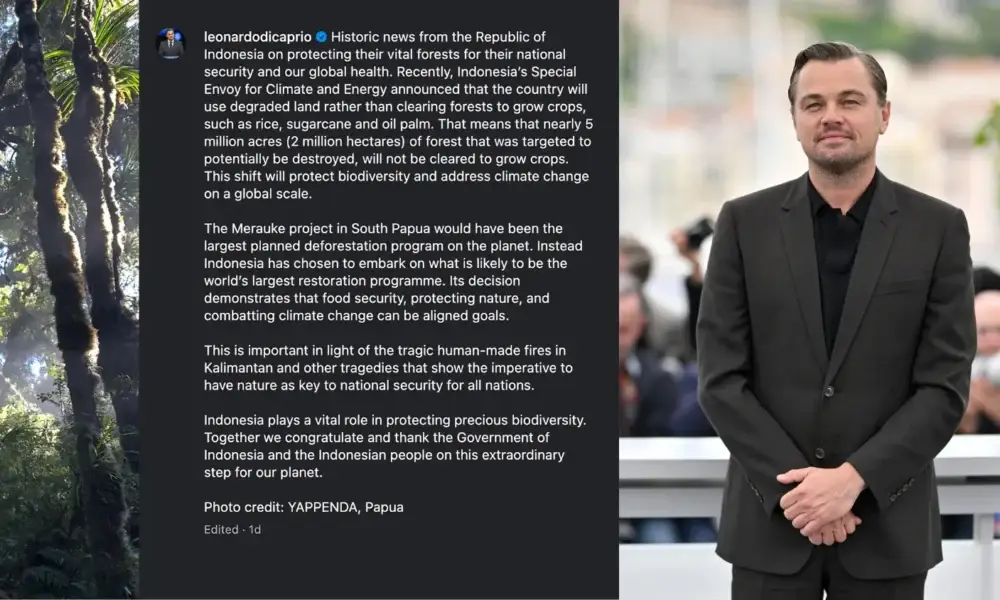
JAKARTA, The Kabar News—Hollywood actor and environmental campaigner Leonardo DiCaprio has praised Indonesia’s reported decision to avoid clearing nearly 2 million hectares of forest for food and energy crops. However, environmental groups say the government must clarify how it will implement and monitor the policy.
DiCaprio highlighted the announcement in an Instagram post on Thursday, Nov. 12. He described the development as “historic news” for Indonesia’s forests and global environmental health.
The actor said Indonesia would use degraded land instead of natural forests to grow rice, sugarcane and oil palm. Based on that announcement, he estimated that the policy could protect almost 5 million acres, or about 2 million hectares. These areas were previously considered for agricultural development.
“The Merauke project in South Papua would have been the largest planned deforestation program on the planet,” DiCaprio wrote.
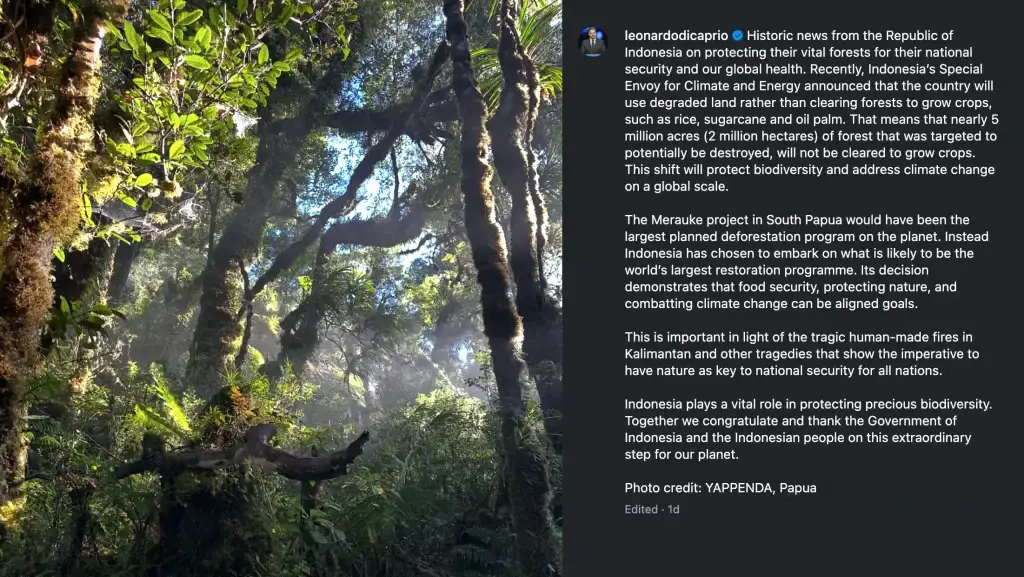
He also characterized the change as the beginning of what could become the world’s largest restoration program. However, the Indonesian government has not published a detailed restoration map, implementation schedule or legally binding protection instrument. These instruments would need to cover the entire area cited in his post.
DiCaprio’s statement followed remarks by Presidential Special Envoy for Climate and Energy Hashim Djojohadikusumo at the Indonesia International Sustainability Forum in October.
READ ALSO: Drones and cloud seeding target Merauke wildfires
Hashim said Indonesia no longer needed to convert 2 million hectares of forest into rice fields because the country had achieved its food-production targets without that expansion. He said the government would increase production on existing farmland. Furthermore, he said they would prioritize degraded land for future development, according to ANTARA.
The announcement marked a major shift in policy language. However, it remains unclear whether the government has cancelled or revised every component of the wider Merauke food and energy project. This project includes sugarcane, palm oil and supporting infrastructure.
Independent monitoring group Auriga Nusantara estimated that the Merauke estate covered about 2.2 million hectares. Its analysis found that developers cleared more than 11,000 hectares of forests and other natural ecosystems during 2024 and 2025. This clearing included 2,892 hectares of natural forest. These figures come from Auriga-linked monitoring published by Simontini.
Environmental groups have therefore called on the government to disclose the boundaries and condition of the degraded land it plans to use. WALHI said authorities had not publicly released the location of proposed sugarcane plantations or the results of a reassessment. This reassessment covered 9.7 million hectares of degraded land.
READ ALSO: The woman behind the Mona Lisa: From Florentine mother to immortal icon
The organization also warned against treating fire-damaged forests as automatically available for agricultural projects. WALHI published the concerns in November.
The policy also affects Indigenous communities whose customary territories overlap with the Merauke development area. A communication by United Nations human rights experts previously raised allegations that authorities had issued permits or begun development. They may have done this without securing the affected communities’ free, prior and informed consent.
The communication requested clarification from the Indonesian government and did not constitute a judicial finding. The UN document outlines those concerns.
DiCaprio linked the Papua announcement to recent human-caused fires in Kalimantan. He argued that governments should treat nature as part of national security. Damaged forests and peatlands can increase the risks of smoke, biodiversity loss and climate-related disasters.
His endorsement has brought international attention to Indonesia’s announcement. Still, the claimed protection of nearly 2 million hectares will require more than a policy statement.
Public maps, legal safeguards and independent monitoring will determine whether the government protects natural forests while developing food and energy production on genuinely degraded land.




No Comment! Be the first one.