



Brazilian retardant tested on Sumatra peatland
BANYUASIN, thekabarnews.com—Indonesian authorities tested a Brazilian fire-retardant product on burning peatland in Banyuasin regency, South Sumatra, on Friday, October 9. They did this as they...

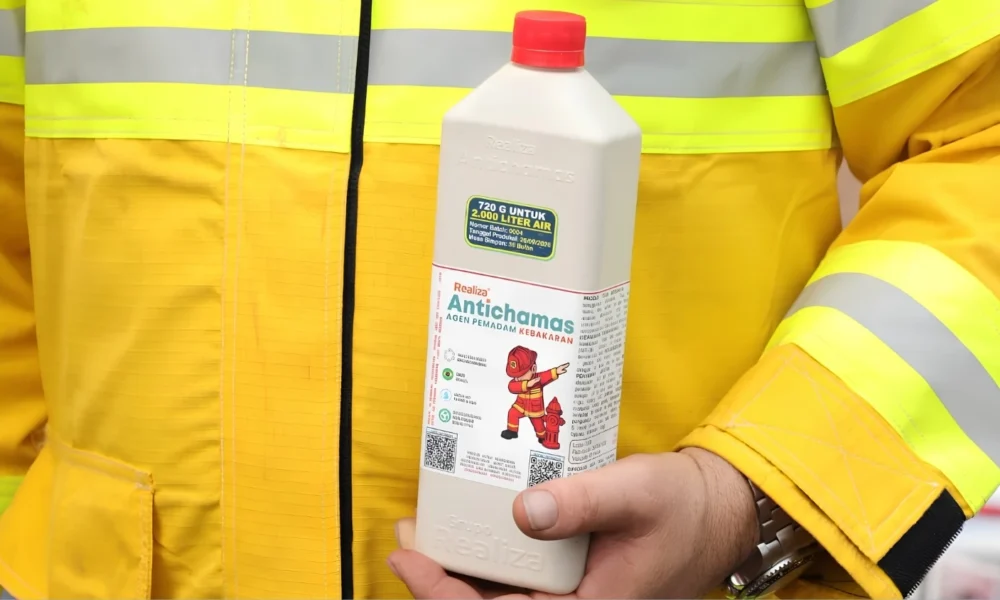
BANYUASIN, thekabarnews.com—Indonesian authorities tested a Brazilian fire-retardant product on burning peatland in Banyuasin regency, South Sumatra, on Friday, October 9. They did this as they explored a possible addition to existing forest and land fire (karhutla) operations.
The field demonstration took place in the Tanjung Lago district and involved personnel from the Regional Disaster Mitigation Agency (BPBD). It also involved the Indonesian military (TNI) and the Forestry Ministry’s Manggala Agni fire brigade.
South Sumatra Governor Herman Deru and Banyuasin Regent Askolani attended. Representatives of the coordinating politics and security ministry and the National Disaster Mitigation Agency (BNPB) were also present.
The product, known as Realiza Anti Chamas or Realiza Antichamas, comes as a powder that firefighters mix with water before spraying it on flames. The Brazilian supplier says the mixture turns into a gel that slows the spread of fire. In addition, it helps water remain on the affected surface.
Paolo Barroso, the supplier team’s coordinator, said crews could prepare the mixture in fire-engine tanks or portable reservoirs. Authorities could also examine its possible use in water-bombing operations.
“This product is a demonstration of Realiza Antichamas for forest and land fire suppression. The liquid is recommended as a more effective way to extinguish fires,” said Brig. Gen. Kresno Pratowo, an assistant deputy at the coordinating ministry.
The supplier claims the diluted material is non-corrosive and non-toxic to people, wildlife and the environment. It also says the gel decomposes within 72 hours. The supplier claims it can make firefighting up to 10 times more effective than water alone.
However, officials have not released independent laboratory findings or a detailed environmental assessment supporting those claims. The trial must therefore undergo technical evaluation before authorities consider wider deployment.
Banyuasin BPBD head Reza Agust Perdana said an earlier demonstration in another village produced a visible difference compared with conventional water spraying.
“The fire went out quickly and did not produce smoke,” Reza said. He added that water alone often leaves smoke rising from peat. This indicates that heat or embers may remain below the surface.
Peat fires present a particular challenge because they can continue burning underground after surface flames disappear. The Forestry Ministry says crews must saturate affected peat, conduct cooling operations and check for concealed embers to prevent the fire from reigniting.
For example, in one 2026 operation in Aceh, firefighters needed nine days to control a peat fire. That fire affected an estimated 132 hectares.
“We will see the results directly. If it can effectively penetrate the ground, the technique could become a solution for peatland fires in South Sumatra,” Herman said.
Banyuasin is among the areas identified in South Sumatra’s disaster plan as vulnerable to forest and land fires. The trial could provide another tool for responders.
However, authorities will still need to assess its safety, cost and performance under different pet conditions. Prevention, early detection and post-fire monitoring will remain essential even if the product passes those evaluations.



No Comment! Be the first one.