



BNPB reinforces ground and air fire crews in Jambi
JAMBI, thekabarnews.com– Indonesia’s central government has strengthened ground and aerial operations against forest and land fires (karhutla) in Jambi. This comes after the province recorded...

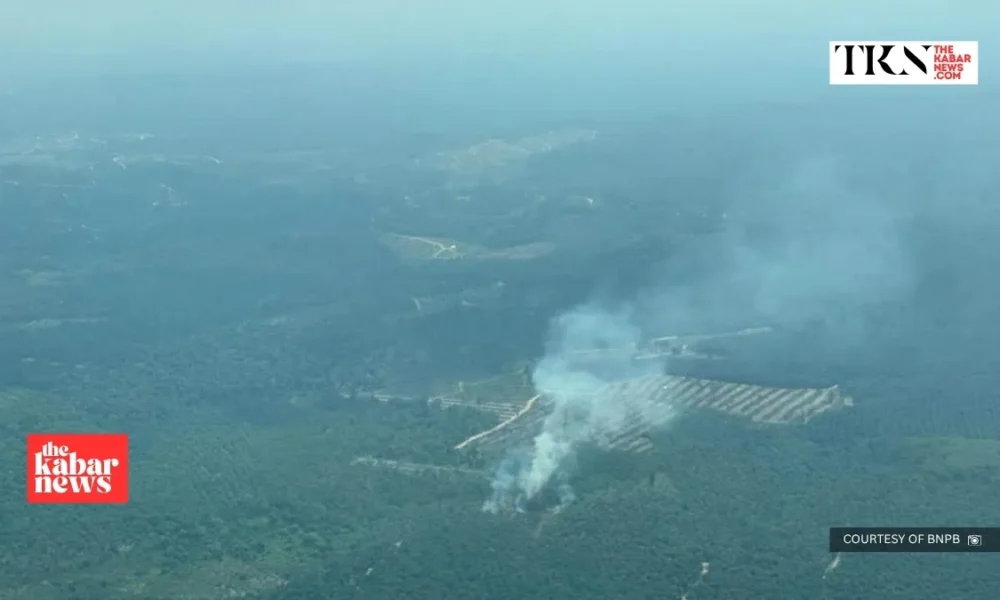
JAMBI, thekabarnews.com– Indonesia’s central government has strengthened ground and aerial operations against forest and land fires (karhutla) in Jambi. This comes after the province recorded 1,776.56 hectares of burned land by September 1.
National Disaster Management Agency (BNPB) head Lt. Gen. Suharyanto announced the additional support during a technical coordination meeting. The meeting took place at Sultan Thaha Saifuddin Airport in Jambi City on Wednesday, September 2.
Jambi is among six provinces that the government has prioritized for the 2026 fire response. The others are Riau, South Sumatra, West Kalimantan, Central Kalimantan and South Kalimantan. Authorities anticipated a heightened fire risk in these provinces during August and September.
BNPB said 5,984 personnel extinguished fires and cooled affected land in Jambi. The joint force includes members of the Indonesian Military (TNI) and National Police. It also includes regional disaster management agencies and fire departments. Volunteers and participating residents also support the operation.
The agency plans to provide financial support in the form of field incentives for personnel involved in the operation. BNPB did not disclose the amount or detailed eligibility rules in its statement.
“Our field analyses have led us to conclude that the ground task force must operate at maximum capacity. Therefore, we will prepare financial support,” Suharyanto said.
He described ground operations as the most effective component of the response. This is because crews can extinguish burning material and conduct cooling work. As a result, fires are prevented from reigniting.
“Based on our analysis of the operations conducted so far, the ground task force has provided the most effective way to extinguish the fires. We therefore need to strengthen it to support the operation,” he said in the official BNPB statement.
BNPB also distributed equipment and logistical assistance to the provincial disaster management agency and affected areas. These include Muaro Jambi, Sarolangun, Tanjung Jabung Timur and Batanghari regencies.
Aerial resources supporting the Jambi operation include two patrol helicopters and four water-bombing helicopters. BNPB has also continued a weather-modification operation despite limited potential for rain-cloud formation.
Suharyanto instructed the aerial team to maximize water bombing according to field conditions. Authorities may concentrate all available helicopters on a single location if doing so can accelerate containment.
As of September 1, teams were handling seven fire locations covering a combined 13 hectares. Crews had extinguished fires across five hectares and were still working on the remaining eight.
“Hopefully, the eight hectares being handled today will be completely extinguished and no new fire points will appear,” Suharyanto said.
Following the meeting, Suharyanto joined Forestry Minister Raja Juli Antoni, Jambi Governor Al Haris and other officials on an aerial patrol aboard a Cessna Caravan. During the patrol, the team identified a suspected new fire in Lubuk Ruso, Batanghari Regency.
Officials use data from the Forestry Ministry’s SiPongi monitoring platform to identify thermal anomalies. Before taking action, they check the anomalies through aerial patrols or ground verification.
A hotspot indicates a heat source detected by a satellite; it does not automatically confirm a forest or land fire.
“We found one location suspected of being a new fire, although it was still small,” Suharyanto said.
“We confirm SiPongi data through aerial monitoring to determine whether a hotspot represents a fire or another heat source,” he added.
The combined monitoring system allows authorities to direct personnel and aircraft more accurately. Sustained ground patrols and cooling operations will remain essential to prevent extinguished areas from burning again.




No Comment! Be the first one.