



Jakarta gets ash, Kalimantan has long lived with haze
Thekabarnews.com—Mount Anak Krakatau coughs, and Jakarta immediately panics. People scramble for masks. Eyes sting and throats itch. Flights descend into chaos, while schools face disruption. In...
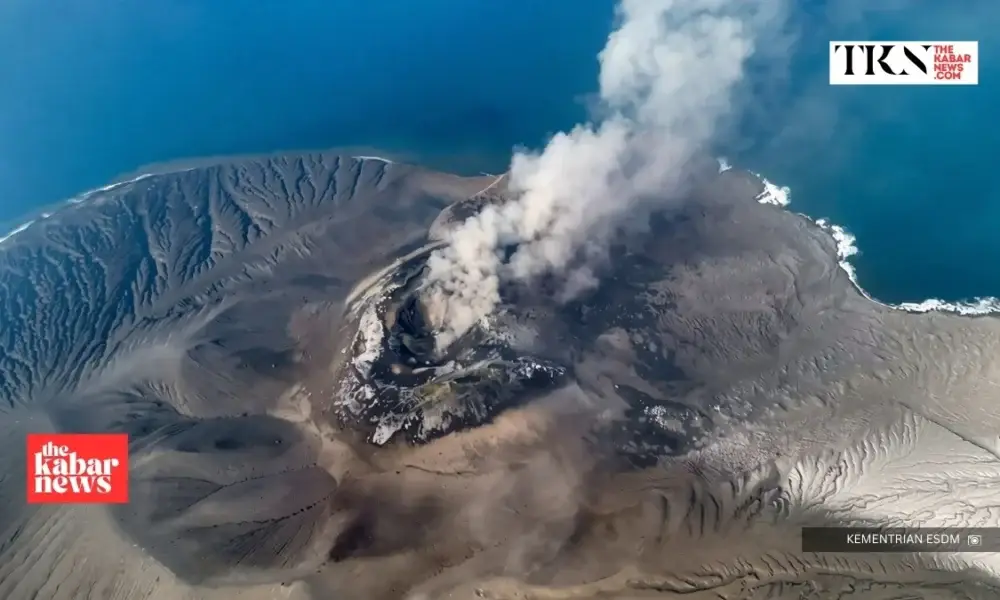
Thekabarnews.com—Mount Anak Krakatau coughs, and Jakarta immediately panics. People scramble for masks. Eyes sting and throats itch. Flights descend into chaos, while schools face disruption. In Kalimantan, residents might respond with a bitter smile: “Welcome to our club!”
The difference lies in the source. Jakarta is becoming acquainted with volcanic ash, while Kalimantan has lived with haze from forest and land fires for years. Both make breathing difficult and irritate the eyes. Both can suddenly turn masks from medical supplies into essential everyday accessories.
Anak Krakatau remained active from the evening of September 4 through September 6, 2026. Its ash reportedly spread across Banten, Jakarta and Lampung, reaching as far as Bengkulu and the Indian Ocean.
According to BMKG, the Geological Agency and the Center for Volcanology and Geological Hazard Mitigation (PVMBG), the eruption produced two main ash-dispersion clusters. Ash, reaching 20,000 feet, or about six kilometers, moved from the northeast toward the south, covering Banten, Jakarta, West Java and surrounding waters.
A higher ash cloud reached approximately 50,000 feet, or 15 kilometers. It travelled southwest to northwest across Banten, Lampung, Bengkulu, the southern Sunda Strait and parts of the Indian Ocean.
Coastal areas of Serang Regency—including Anyer, Cinangka, Ciomas, Mancak and Pabuaran—reported ashfall from the night of September 5. Baros, Padarincang, Carita and Labuan also experienced the impact.
Jakarta, Tangerang, Bogor and Depok received lighter ashfall. In Lampung, affected areas reportedly included Bandar Lampung, South Lampung, Tanggamus and Pesisir Barat.
Residents complained of stinging eyes and noses, coughing and throat irritation. Ash settled on vehicles, courtyards, clothing and household floors.
Volcanic ash can contain fine silica particles with sharp surfaces. Exposure may irritate the respiratory system and worsen conditions such as asthma or bronchitis. Children, older people, women in pregnancy and those with existing respiratory illnesses face greater risks.
Then Jakarta discovered a new enemy—and masks became hot property. Residents rushed to mask sellers beneath the Andara toll road in Pondok Labu. Some bought two boxes containing 50 masks each, while others purchased smaller packs of 10. Children’s masks and hijab-friendly designs also sold quickly. Several low-priced products ran out of stock.
Online sellers reportedly raised the price of a box of 50 four-ply duckbill masks from about Rp19,000 to Rp30,000. A box of 50 earloop masks increased from Rp17,550 to Rp25,000. Limited supplies also prompted some merchants to open pre-orders.
Kalimantan might be tempted to ask, “All this fuss over ash?” Across the island, haze from forest and land fires has repeatedly forced residents to wear masks and reduce outdoor activities. It has also turned the sky into something resembling a failed Instagram filter.
Jakarta, however, received an additional complication: flight disruption. Authorities temporarily closed Soekarno-Hatta, Halim Perdanakusuma, Radin Inten II and Budiarto Curug airports. Soekarno-Hatta reportedly began restricting operations at around 1:30 a.m. after officials detected volcanic ash. Authorities later extended the closure several times, ultimately until 5:30 p.m.
Reports estimated that the disruption affected between 209 and 301 flight movements. These included 160–233 domestic services, 39–58 international flights and 10 cargo operations. Early estimates placed the number of affected passengers at 22,798.
Masks also dominated the scene during Car Free Day at Jakarta’s Hotel Indonesia Roundabout. Jakarta and Kalimantan now share an uncomfortable reality: residents must filter the air before allowing it into their lungs.
Jakarta received its polluted air from a coughing volcano. Kalimantan receives it far too often from burning forests and peatland.
Krakatau has a long and devastating history. The eruption of August 26–27, 1883, destroyed roughly two-thirds of the island and generated tsunamis that killed more than 36,000 people. The eruption also sent ash high into the global atmosphere.
Renewed eruptions formed Anak Krakatau roughly 44 years later. A new island appeared in 1927 and became permanently established around 1930. The volcano is now active again under Level III (Siaga).
No one should underestimate the danger. Wear a KN95 or N95 mask, protect your eyes, and keep doors and windows closed. Cover food and water, avoid sweeping ash while it is dry, and remain outside the three-kilometer exclusion zone around the active crater.
Follow official updates from BMKG, PVMBG through MAGMA Indonesia, and the National Disaster Mitigation Agency (BNPB). We can no longer take clean air for granted. Jakarta is only beginning to remember its mask whenever it leaves home. In Kalimantan, a mask has become almost as essential as an identity card (KTP).
“We’re facing the same disaster, brother.”
“Stay strong and enjoy a cup of sugarless coffee (Koptagul), dude!”
By: Rosadi Jamani
……….
Do you have an opinion on the issues that are happening right now? If you would like to submit your article by email to thekabarnews@gmail.com,






No Comment! Be the first one.