



West Kalimantan ships 77.3 tons of coconut goods
PONTIANAK, The Kabar News—West Kalimantan has shipped 77.3 tonnes of processed coconut products worth approximately Rp1 billion (US$59,500) to four overseas markets, highlighting the province’s...
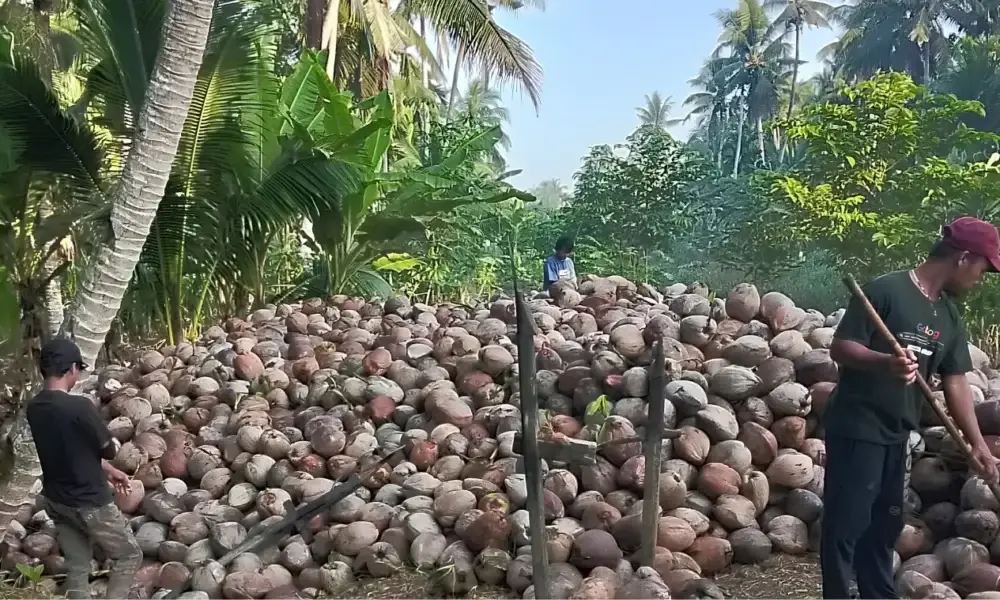
PONTIANAK, The Kabar News—West Kalimantan has shipped 77.3 tonnes of processed coconut products worth approximately Rp1 billion (US$59,500) to four overseas markets, highlighting the province’s effort to move beyond raw commodity sales.
The shipment contained coconut-shell charcoal briquettes, hexagonal briquettes and cocopeat. Exporters sent the products to Libya, Saudi Arabia, China and Malaysia, with PT Korindo Komplit Karbon supporting product development and international marketing.
Officials released the shipment during the Kalbar Sustainable Business Forum (KSBF) 2026 in Pontianak on Saturday, Nov. 21. The MSMEs Ministry organized the event to connect local businesses with financing providers, larger companies and potential buyers.
The export program seeks to help West Kalimantan’s small businesses process locally available materials into higher-value goods. Coconut shells can become fuel briquettes, while producers can turn husks into cocopeat for use as a growing medium and cocofiber for industrial applications.
“We have mostly seen coconuts as drinks, coconut milk or cake ingredients. Yet we can use many derivative products,” micro, small and medium enterprises (MSMEs) Minister Maman Abdurrahman said at the forum.
Read also: Science says coconut oil pulling is a natural way to improve oral health
Maman said West Kalimantan should develop processing capacity instead of operating only as a supplier of unprocessed commodities. Potential products include crude coconut oil, desiccated coconut and fibers made from coconut husks.
“The key question is whether we are willing. Once willing, are we serious? That is the most important thing,” he said.
According to a ministry statement reported after the event, the forum also promoted green-business trials and a cluster-based subsidized microcredit program (KUR). Organizers targeted financing for 100 small businesses that already work with buyers or other commercial partners.
Coconut processing provides an example of a circular production model because businesses can use materials that might otherwise become waste. Producers can process shells into charcoal and convert husks into growing media or fiber.
But the waste-to-export product conversion is not in itself a guaranty of environmental benefits. However, charcoal processing still consumes energy and produces emissions that producers must manage. They must also ensure that suppliers harvest raw materials legally and sustainably.
Read also: West Kalimantan sends 103 kg of bird’s nests to Singapore
The export release follows another Indonesian coconut-product shipment in April. CV Mannah Anugerah Sejahtera exported 24 tonnes of organic coconut sugar and natural liquid coconut sugar to Ghana. According to the MSMEs Ministry’s SMEsta platform, the Semarang shipment was worth US$63,400.
That transaction was a separate national export and did not originate from West Kalimantan. Nevertheless, it shows that Indonesian processors can find buyers outside traditional markets when their products meet food-safety and sustainability standards.
Indonesia produced an estimated 2.77 million tonnes of coconuts in copra equivalent in 2025, according to the Agriculture Ministry. The result reached 96.03 percent of the government’s annual target.
The ministry has identified old trees, limited access to quality seedlings and low farm productivity as persistent challenges. National productivity remains around 1.1 tonnes of copra per hectare annually, while more than 5.5 million farming households depend on the commodity.
Read also: Indonesia’s rice output hits 34.69 million tons in 2025
In 2027, the government plans to develop 51,721 hectares of coconut growing areas with a budget of around Rp154.58 billion. The plan includes replanting old trees on 9,000 hectares and expanding 42,721 hectares in several major islands.
Processing of coconut shells and husks in West Kalimantan can generate export revenue for companies here. To hold on to those gains, processors need security of supply and consistency of quality. Local farmers also need to be assured of their fair share of value added through downstream processing.
You Might Find This Interesting: Sponsored Content




No Comment! Be the first one.