



Indonesia and the EU sign trade deal after a decade of talks
JAKARTA, The Kabar News—Indonesia and the European Union (EU) signed a trade agreement in Brussels on Nov. 21, after a decade of talks, leading to duty-free access for a wide range of Indonesian...
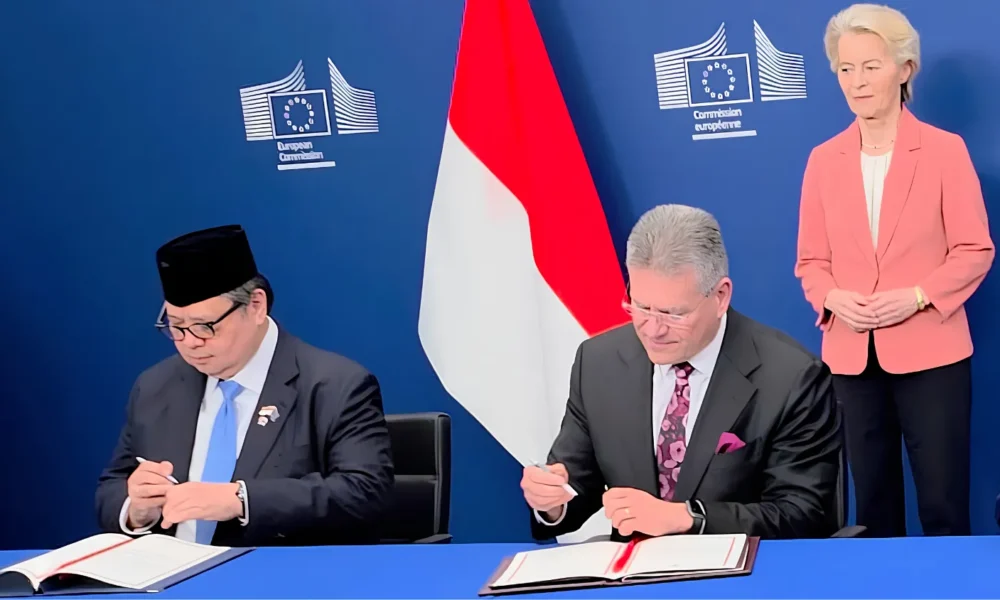
JAKARTA, The Kabar News—Indonesia and the European Union (EU) signed a trade agreement in Brussels on Nov. 21, after a decade of talks, leading to duty-free access for a wide range of Indonesian goods.
The deal, signed under President Prabowo Subianto, will eliminate duties on about 90.4 percent of EU tariff lines for qualifying Indonesian products. This change will happen when it starts to apply.
Trade Minister Budi Santoso and EU Trade Commissioner Maroš Šefčovič signed the Indonesia–EU Comprehensive Economic Partnership Agreement (IEU-CEPA) at European Commission headquarters.
The two sides also signed a separate Investment Protection Agreement. Before the ceremony, Prabowo spoke by video with European Commission President Ursula von der Leyen.
The signing capped a process that began in July 2016 and took 19 rounds of negotiations. The Cabinet Secretariat called it “a historic milestone” in its Nov. 22 announcement and pointed to Prabowo’s July 2025 visit to Brussels as part of the push to deepen ties. Negotiators finalized the texts in September 2025, more than a year before the signing.
Read also: Indonesia-EU trade pact opens door to zero tariffs
Indonesia’s Trade Ministry says qualifying footwear, textiles, rubber and certain palm oil products are among the goods that stand to benefit. In addition, the EU will phase out duties on a further 7.92 percent of tariff lines over three to 15 years. However, exporters will still need to show that their goods meet the agreement’s rules of origin. Also, they must comply with relevant EU product requirements.
The deal improves access to an existing market rather than creating a new one. Eurostat estimated that the EU’s 27 member states had 452 million residents at the start of 2026. Moreover, two-way goods trade already reached €28.9 billion in 2025.
The European Commission projects that Indonesian exports of goods and services to the EU could rise by more than 14 percent over 15 years under the agreement. Nevertheless, that is a projection, not a guarantee of export growth or new jobs.
Indonesia’s Trade Ministry is targeting Jan. 1, 2027, for implementation. The European Commission expects a provisional application in early 2027, subject to both sides completing the necessary internal procedures.
The European Parliament’s consent remains part of the EU approval process. The timing matters because Indonesia is due to lose its preferential tariffs under the EU’s Generalized Scheme of Preferences on Jan. 1.
The signing marks a diplomatic milestone for Prabowo’s administration. The next test is whether exporters can claim the preferences without delays and turn lower duties into repeat orders.
Clear customs guidance and public reporting of the number of firms using the preferences would tell us whether the deal is working for Indonesian manufacturers and workers.
You Might Find This Interesting: Sponsored Content



No Comment! Be the first one.