



Govt steps up rainy-season disaster readiness
JAKARTA, The Kabar News—President Prabowo Subianto ordered ministries, regional administrations and security agencies to strengthen early disaster preparedness as uneven rainfall patterns expose...

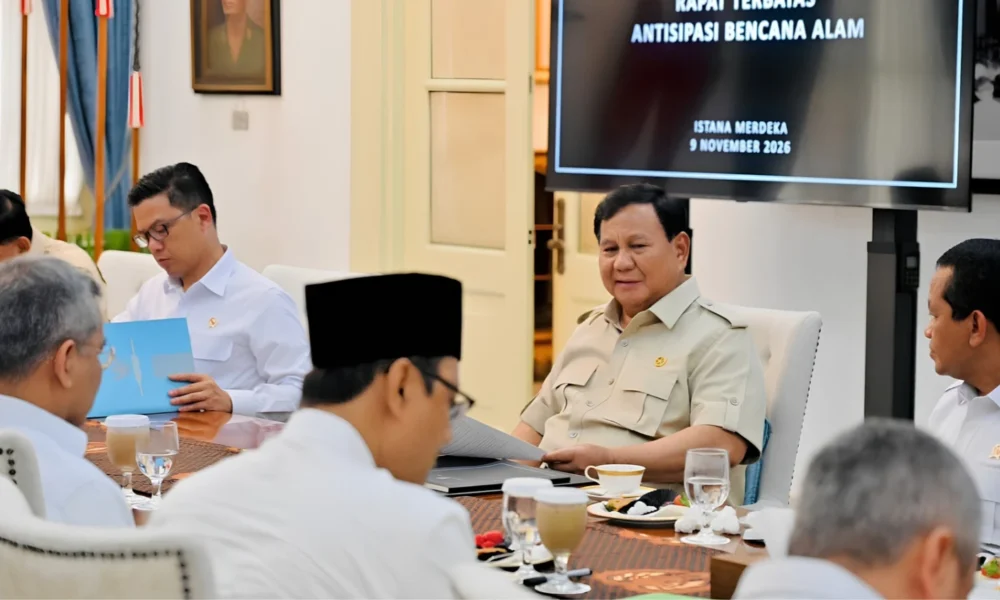
JAKARTA, The Kabar News—President Prabowo Subianto ordered ministries, regional administrations and security agencies to strengthen early disaster preparedness as uneven rainfall patterns expose parts of Indonesia to flooding while dry conditions sustain wildfire risks elsewhere.
Prabowo issued the instruction during a limited Cabinet meeting at the Merdeka Palace in Jakarta on Monday, Nov. 9. The meeting reviewed the government’s readiness for the 2026–2027 rainy season. It also assessed recovery work following major hydrometeorological disasters in Sumatra.
Meteorology, Climatology and Geophysics Agency (BMKG) head Teuku Faisal Fathani said the government would use the agency’s forecasts to coordinate preventive action. This would take place before hazardous weather developed into a larger emergency.
“I was informed that the discussion would focus on disaster anticipation and involve many ministers and agency heads,” Faisal said before the meeting.
Read also: West Kalimantan prepares for shifting rainy season
BMKG provides short-term weather updates and longer-range forecasts that government agencies can use to prepare personnel and equipment. Its near-real-time forecasts cover periods of three to six hours and can identify warning levels down to the district level.
BMKG expects the rainy season to begin later than usual across much of Indonesia. Its 2026–2027 seasonal outlook projects that 529 seasonal zones, representing about 61 percent of the country’s land area, will experience a delayed onset.
Most regions will reach the peak of the rainy season between December 2026 and February 2027. Parts of Java may face sustained high rainfall during this period. Meanwhile, heavy rain could trigger floods and landslides in vulnerable areas of Sumatra, East Kalimantan and Papua.
Read also: BNPB and BMKG strengthen data-driven disaster response
However, the delayed and uneven season also means that authorities must continue monitoring forest and land fires (karhutla). BMKG recently detected 685 high-confidence hot spots in South Papua and 167 in Southeast Sulawesi.
The agency also observed smoke over parts of Central Kalimantan and South Papua. BMKG stressed that a hot spot does not always confirm an active fire, but it provides an important warning indicator. BMKG’s weekly outlook therefore called for vigilance against both wet and dry hydrometeorological hazards.
Prabowo instructed the National Disaster Mitigation Agency (BNPB) to prepare equipment. He also asked the defense minister, Indonesian military commander, and national police chief to maintain readiness while monitoring BMKG information.
Home Minister Tito Karnavian, who leads the Sumatra Post-Disaster Rehabilitation and Reconstruction Task Force, reported progress in Aceh, North Sumatra and West Sumatra.
Read also: Higher land and forest fires risk in West Kalimantan as dry season arrives early
All 107 affected national road sections and 43 national bridges have returned to service, according to Public Works Ministry data. Learning has also resumed at all 4,922 affected education facilities, although physical rehabilitation continues at several locations. The disasters disrupted education for more than 707,000 students.
The task force reported that work to clear or process post-disaster woody debris had reached 99 percent in West Sumatra, 90 percent in North Sumatra and 70 percent in Aceh.
Nevertheless, the region remains exposed to further emergencies. Tito said authorities recorded 41 subsequent floods and landslides between April and October, including 18 incidents in Aceh.
“From April to October, I recorded 41 subsequent floods,” Tito said after the meeting.
You May Also Like: Sponsored Offers | Read also: Discover promotions available today
The government’s recovery plan runs through December 2028 and covers 11,520 activities with a projected budget of Rp100.67 trillion.
Restored roads and reopened schools show functional progress. However, continued rainfall and recurring disasters mean authorities must maintain early warnings, evacuation capacity and transparent monitoring throughout the reconstruction period.


No Comment! Be the first one.