



Ancient rock inscription linked to caliph Umar discovered in Saudi Arabia
Thekabarnews.com—The Heritage Commission of Saudi Arabia has announced the discovery of a collection of inscribed rocks from the earliest period of Islamic history. One of these rocks is inscribed...

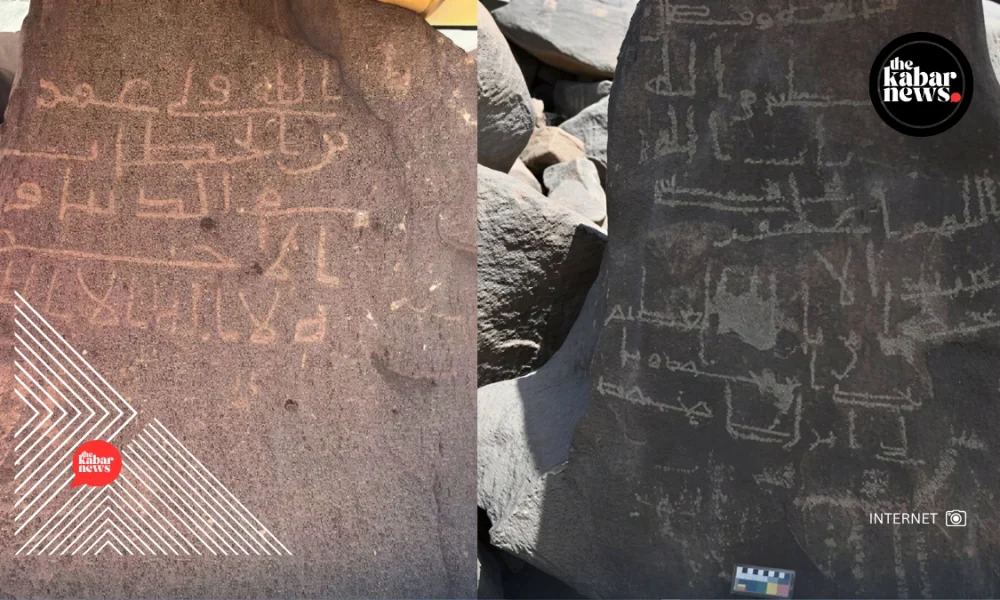
Thekabarnews.com—The Heritage Commission of Saudi Arabia has announced the discovery of a collection of inscribed rocks from the earliest period of Islamic history. One of these rocks is inscribed with the name of the second caliph, Umar ibn al-Khattab (RA).
Archeologists discovered the inscriptions in Al-Mahd Governorate in the Madinah Region. This area is of profound historical importance for its connection with the early days of Islam.
The officials called the discovery one of the most important archaeological finds of the recent past. It concerns the early Islamic period.
One of the newly discovered inscriptions is remarkable for explicitly mentioning Umar ibn al-Khattab. He was one of the closest companions of the Prophet Muhammad ﷺ and the second leader of the Muslim community after the passing of Abu Bakr al-Siddiq (RA).
The Heritage Commission states the inscription says
“Allah is the protector of Umar ibn al-Khattab in this world and the next. “There is no god but Allah.”
Officials have said the inscription reflects the religious expressions and devotional traditions of the earliest generations of Islam.
Officials said the inscription is from the earliest Islamic period, though experts are still studying exactly when it was made.
Archaeologists say rock inscriptions are valuable historical evidence. This is because they preserve the language, beliefs, and daily lives of people who lived centuries ago.
Manuscripts can deteriorate over time, but stone inscriptions can last hundreds or thousands of years. From these, historians can glean important details about early civilizations.
The recent find also helps trace the spread of Islam throughout the Arabian Peninsula in the seventh century.
Over the past few years, the Heritage Commission has ramped up archaeological surveys across the country. This is part of wider efforts to preserve the Kingdom’s cultural and historical heritage.
Researchers uncovering inscriptions, ancient settlements, trade routes, and archaeological sites are revealing new insights into pre-Islamic Arabia. In addition, they reveal much about the rise of Islamic civilization.
The latest findings emphasize the richness of Saudi Arabia’s archaeological landscape. They also highlight the importance of continuing scientific research and conservation, officials said.
The results of the first generations of Muslims are of historical and cultural significance for scholars.
Historians regard such inscriptions as primary evidence that complements historical documents. For many Muslims, they are also physical reminders of the formative period of Islamic civilization. Moreover, they remind us of the individuals who played leading roles in its formation.
The Heritage Commission said experts will continue to document, analyze, and preserve the new inscriptions. Their work will be in accordance with international archaeological standards.
Such finds, such as the Al-Mahd inscriptions, continue to add to the historical understanding of the early Islamic period. Additionally, they reinforce the kingdom’s status as the birthplace of Islam and one of the world’s richest archaeological regions with Saudi Arabia’s growing heritage preservation programs.






No Comment! Be the first one.