



Alan Greenspan dies at 100, leaving a lasting legacy on global finance
Thekabarnews.com – Alan Greenspan, the former U.S. Federal Reserve chairman and one of the most powerful men in modern economic policymaking, dies at 100. Greenspan’s wife of 29 years, veteran...

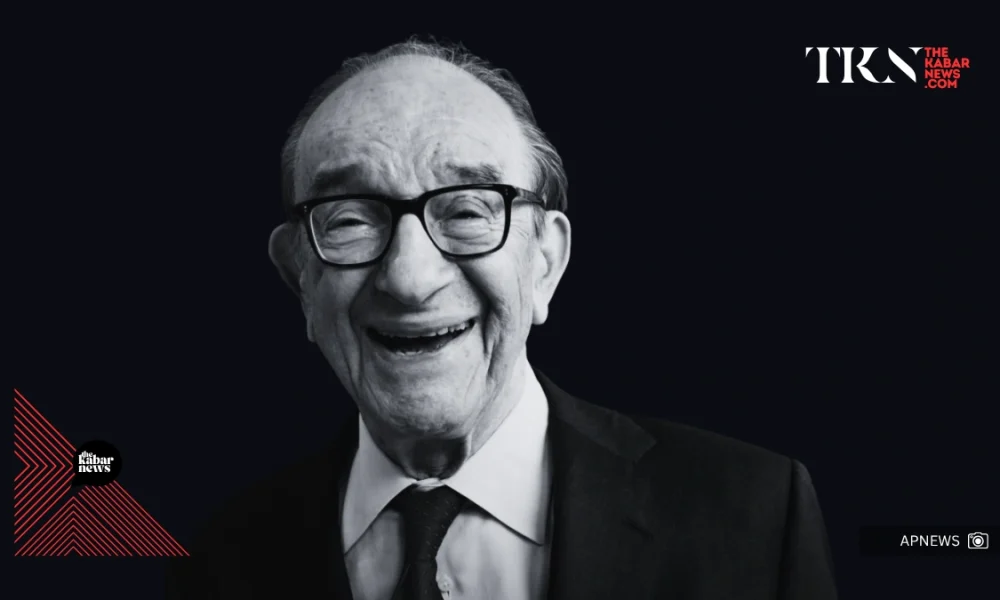
Thekabarnews.com – Alan Greenspan, the former U.S. Federal Reserve chairman and one of the most powerful men in modern economic policymaking, dies at 100.
Greenspan’s wife of 29 years, veteran NBC News correspondent Andrea Mitchell, said he died of complications from Parkinson’s disease. AP News reported the information on Tuesday, June 23.
Greenspan was at the helm of the Federal Reserve for more than 18 years, one of the longest-serving U.S. central bank chiefs. During this time, he oversaw a long period of economic growth. This helped shape the American economy through the late 1980s, the 1990s, and the early 2000s.
Economists, investors, and policymakers around the world closely followed Greenspan’s decisions. This happened because the Federal Reserve holds influence over global financial markets.
Greenspan extended his influence well beyond the United States by shaping interest rates, investment flows, and economic expectations around the world.
By the time he left the Federal Reserve in 2006, Greenspan had become so revered that people nicknamed him “The Oracle.” They also called him “The Maestro.”
Greenspan helped steer the U.S. economy through a series of major challenges, including stock market volatility, inflation worries, and times of economic uncertainty. Furthermore, he served during a period of great technological innovation and economic growth in the 1990s.
But the 2008 global financial crisis, which erupted two years after Greenspan left office, raised doubts about his legacy. Critics have targeted a number of the monetary and regulatory policies adopted during his tenure. Some argue that these policies may have created conditions that led to the build-up of financial risks in the banking and housing sectors.
Greenspan was instrumental in sustaining one of the longest periods of economic expansion in modern American history. In addition, he helped restore confidence in the U.S. financial system.
“He was widely celebrated as the “Oracle’’ and “Maestro,” Mitchell said in a statement reflecting on their life together.
“To me he was my husband, who shaped my life from our very first date in 1984,” said Mitchell.
She remembered how he had been excited about sports and music and learning all his life.
“He had ‘irrational exuberance’ for baseball, the Washington Commanders, tennis, golf, and music, especially jazz. He will be remembered for his brilliance and his kindness. Being his life partner was the joy of my life,” she said.
The term “irrational exuberance” had a particular resonance because it had famously been used by Greenspan himself in a 1996 speech to warn of over-optimism in financial markets. Importantly, it has become one of the most quoted phrases in the history of the modern economy.
Greenspan was born in 1926 and experienced and helped shape many of the most important economic changes of the last century. Moreover, he spent decades in public service, research, and policy leadership in economics.
Tributes are pouring in from political leaders, economists, and financial institutions around the world. Many are remembering Alan Greenspan as a central figure in the evolution of modern monetary policy. His decisions shaped global markets for nearly two decades.
The book concludes with a pivotal chapter in American economic history. This chapter continues to influence discussions on central banking, financial regulation and economic growth.





No Comment! Be the first one.