



Suyudi’s 100-day plan targets crime, police reform
JAKARTA, thekabarnews.com—Indonesia’s new National Police chief, Gen. Suyudi Ario Seto, has placed narcotics, digital offenses and organized criminal networks among his law enforcement priorities for...

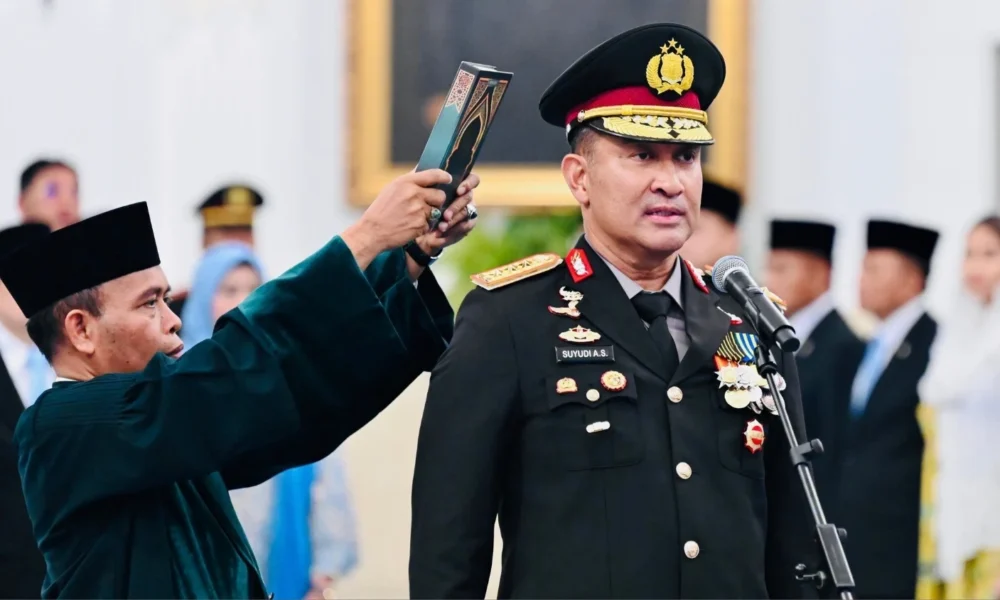
JAKARTA, thekabarnews.com—Indonesia’s new National Police chief, Gen. Suyudi Ario Seto, has placed narcotics, digital offenses and organized criminal networks among his law enforcement priorities for his first 100 days in office.
President Prabowo Subianto inaugurated Suyudi at the State Palace in Jakarta on Thursday, Oct. 1. He succeeded Gen. Listyo Sigit Prabowo under Presidential Decree No. 96/POLRI/2026, according to the Presidential Secretariat.
Before becoming police chief, Suyudi led the National Narcotics Agency (BNN) from August 2025. The 1994 Police Academy graduate has also held senior criminal-investigation positions and previously served as Banten Police chief.
Suyudi’s priority list covers narcotics trafficking, thuggery and extortion, street crime, public brawls and abusive debt collection. Police will also focus on online gambling, digital fraud and broader cybercrime.
Other targets include human trafficking, corruption, smuggling, money laundering and organized crime. Following his inauguration, Suyudi said Prabowo had specifically highlighted narcotics, smuggling, online gambling and offenses that cause public concern.
Suyudi summarized his enforcement approach with the phrase: “Firm against crime, humane toward the public.”
The policy does not treat lawful debt-collection work as a crime. It targets intimidation, violence or other illegal practices committed under the guise of collecting debts.
Suyudi divided the program into three implementation periods. During the first 30 days, police leaders will assess the institution’s condition and establish baseline measurements. They will review public reports, case backlogs, complaints and the readiness of district and subdistrict police offices.
The first stage will also map high-impact crimes and evaluate services for vulnerable groups. From days 31 to 60, Suyudi plans to test corrective measures based on the findings.
During the final phase, covering days 61 to 100, police will publish results and revise measures that fail to meet their objectives.
“The first 100 days are not a stage for announcing as many programs as possible. The first 100 days are a phase for proving the direction of change,” Suyudi said during his fit-and-proper test at the House of Representatives (DPR), according to Antara.
His quick-win targets include safer public spaces, stronger action against narcotics and improved responses through the police’s 110 emergency service. He also wants police stations to provide victim-friendly services and allow complainants to track case developments.
Suyudi’s agenda extends beyond criminal enforcement. He outlined six broader transformation areas covering institutional structure, personnel management, public services, law enforcement, internal oversight and budget accountability.
He said merit and integrity records should determine police recruitment, assignments and promotions.
“There must be no room for favoritism, transactions or sponsorship,” Suyudi said. “High-performing officers will be protected and given room to advance their careers.”
Suyudi also wants police performance assessments to measure the quality and fairness of case handling instead of relying primarily on the number of cases completed. His 100-day program therefore represents an initial benchmark for reform, while its impact will depend on measurable results and consistent implementation across police units nationwide.




No Comment! Be the first one.