



Kubu Raya air turns very unhealthy as haze thickens
KUBU RAYA, thekabarnews.com—Air quality in Kubu Raya Regency, West Kalimantan, deteriorated to the “very unhealthy” category on Saturday, August 22. This was because haze from forest and land fires...

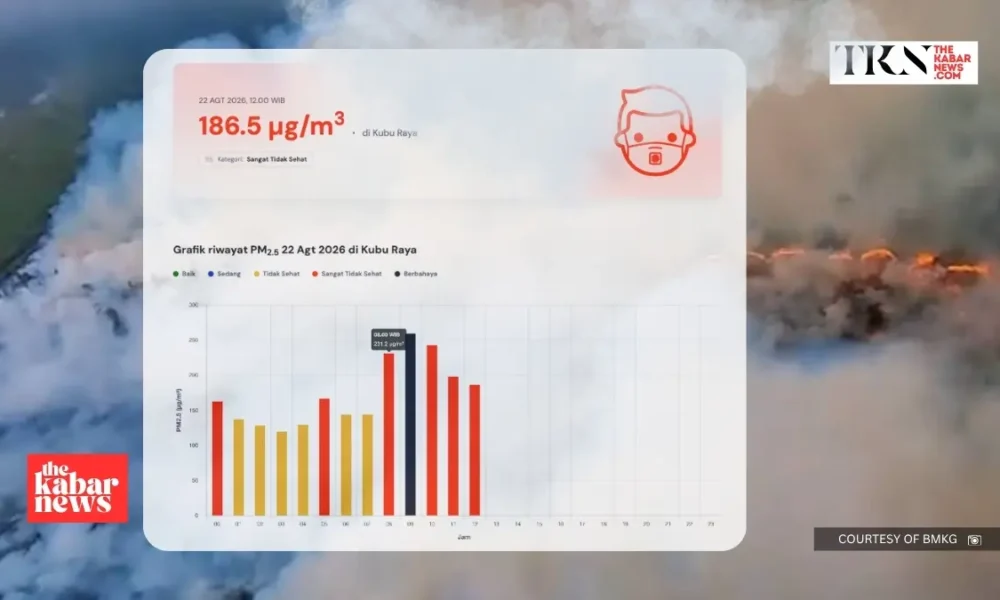
KUBU RAYA, thekabarnews.com—Air quality in Kubu Raya Regency, West Kalimantan, deteriorated to the “very unhealthy” category on Saturday, August 22. This was because haze from forest and land fires (Karhutla) continued to affect parts of Kalimantan.
The Meteorology, Climatology and Geophysics Agency (BMKG) recorded a PM2.5 concentration of 186.5 micrograms per cubic meter in Kubu Raya at noon WIB.
BMKG’s hourly chart showed consistently elevated pollution during the morning, with some readings exceeding 200 micrograms per cubic meter. The BMKG classified the noon measurement as “very unhealthy” on its official BMKG Kubu Raya.
The reading represents conditions at the monitoring station at that specific time. It may change as wind, rainfall and fire activity shift. It should not be interpreted as a daily average unless BMKG identifies it as such.
PM2.5 refers to airborne particles measuring no more than 2.5 micrometers in diameter. Sources include vehicle and industrial emissions, waste burning and smoke from forest or peatland fires.
The WHO identifies PM2.5 as one of the most significant air-pollution threats. This is because the particles can penetrate deep into the lungs and enter the bloodstream.
Exposure may increase the risk of respiratory infections, asthma, cardiovascular disease and stroke.
Children, women in pregnancy, older people, outdoor workers and people with heart or respiratory conditions are at increased risk during severe smoke episodes.
Residents should follow official health guidance, reduce strenuous outdoor activity and seek medical attention if they experience severe breathing difficulties.
Other West Kalimantan monitoring stations, including Mempawah and Sintang, have also recorded periods of poor air quality.
Because BMKG updates these measurements hourly, residents should consult the agency’s live dashboard before relying on previously published readings.
Kubu Raya contains extensive peatland areas that can dry out and burn during prolonged dry weather.
Peat fires may spread below the surface, produce dense smoke and become difficult to extinguish when canals and other water sources recede.
The regency government has mobilized BPBD, the Indonesian military, police, private firefighting units and community fire groups. They aim to strengthen prevention and suppression operations.
“I have high hopes that BPBD can coordinate all available elements, including the private sector and the TNI-Police,” Kubu Raya Regent Sujiwo said during a July coordination meeting, according to the Kubu Raya regency.
BNPB separately reported 1,487 satellite-detected hotspots across Kalimantan on August 20. It identified Central Kalimantan as having the largest concentration with 767 hotspots, followed by West Kalimantan with 560.
BNPB’s published provincial subtotals contained a discrepancy: the figures attributed to all five Kalimantan provinces added up to 1,478 rather than the stated total of 1,487. When this report was prepared, the agency had not publicly clarified the nine-hotspot difference.
Authorities also caution that a satellite hotspot indicates an abnormal surface temperature, not necessarily a separate fire. Firefighters must verify detections on the ground before determining the location, cause and extent of an actual blaze.





No Comment! Be the first one.