



Young borrowers dominate Indonesia’s online lending
JAKARTA, thekabarnews.com—Indonesians under 35 dominated the country’s licensed online lending (pinjol/pindar) market by account numbers in April 2026. Women held a larger share of outstanding...

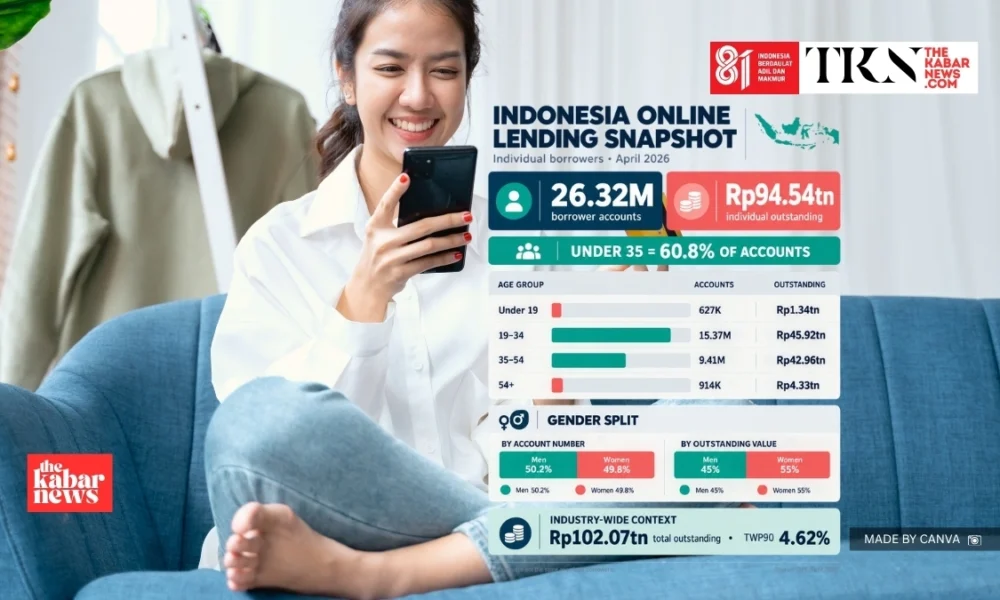
News Summary
- In April 2026, young online lending (pinjol/pindar) borrowers in Indonesia under 35 accounted for about 60.8% of all individual accounts, with 15.37 million borrowers aged 19–34.
- Women held a greater share of outstanding loans by value at 55%, while men accounted for slightly more individual accounts at 50.2%.
- Outstanding loans for borrowers aged 19–34 totaled Rp45.92 trillion, showing the significance of online lending among younger adults.
- The data from the OJK shows that total online lending rose by 26.11% year-on-year to Rp102.07 trillion in April 2026.
- Consumers should ensure their online lenders are OJK-licensed and evaluate all fees and repayment capabilities before borrowing.
JAKARTA, thekabarnews.com—Indonesians under 35 dominated the country’s licensed online lending (pinjol/pindar) market by account numbers in April 2026. Women held a larger share of outstanding personal debt, according to data attributed to the Financial Services Authority (OJK).
Borrowers aged 19–34 held 15.37 million accounts, the largest number among all age groups.
A further 627,000 accounts belonged to OJK’s under-19 category. This brought the combined share of borrowers below 35 to approximately 60.8 percent of the 26.32 million individual borrower accounts recorded in the dataset.
The under-19 category does not necessarily have to be taken as children. Because the classification includes people under 19, it may also include 18-year-old borrowers who are legally eligible.
Borrowers aged between 35 and 54 held around 9.41 million accounts, while those aged 54 or older held about 914,000.
Account totals do not necessarily equal the number of unique people. This is because one borrower may hold accounts or loans through more than one licensed provider.
Men narrowly led by account numbers, accounting for 50.2 percent of individual borrower accounts, compared with 49.8 percent for women.
The distribution reversed when measured by outstanding loan value: women accounted for 55 percent, while men held 45 percent.
The data do not explain why women carried the larger share. The data also do not show whether women borrowed primarily for household expenses, consumption or productive activities.
By age, borrowers aged 19–34 held Rp45.92 trillion in outstanding loans. The 35–54 group followed closely with Rp42.96 trillion, despite having approximately six million fewer accounts.
Borrowers aged 54 and above held Rp4.33 trillion, while the under-19 category accounted for Rp1.34 trillion.
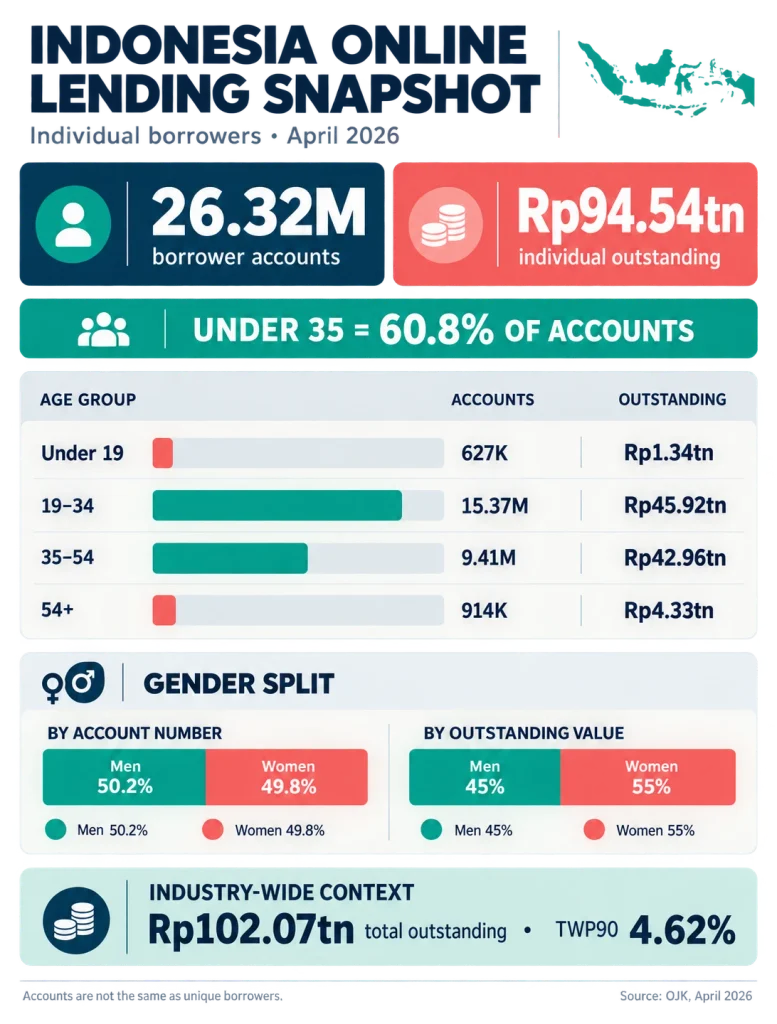
The rounded values produce a combined individual-borrower balance of approximately Rp94.54 trillion.
This figure differs from OJK’s industry-wide April total because it covers outstanding loans attributed to individual age and gender categories.
OJK reported that total online lending financing, including other borrower classifications, rose 26.11 percent year-on-year to Rp102.07 trillion in April.
OJK placed the industry’s TWP90 ratio, which measures loans overdue by more than 90 days, at 4.62 percent in April.
The figure improved to 4.42 percent in May. At the same time, industry-wide outstanding financing increased to Rp103.73 trillion, as reported by the OJK May 2026 data.
The figures illustrate how online lending has become particularly significant among younger adults.
The age and gender mix alone do not tell us if borrowers used the loans in a sustainable manner. The figures do not show whether borrowers experienced repayment difficulties.
Consumers need to verify an online lender is OJK-licensed, review all interest and service fees and assess repayment capacity prior to taking out a loan.




No Comment! Be the first one.