



Gen Z leads Indonesia’s demographic landscape with more than 64 million people
Thekabarnews.com—According to the latest Dynamic Clean Population Data (DKB) as of June 15, 2026, Gen Z officially became the largest population group in Indonesia. The results show the growing...


Thekabarnews.com—According to the latest Dynamic Clean Population Data (DKB) as of June 15, 2026, Gen Z officially became the largest population group in Indonesia. The results show the growing importance of young Indonesians for the country’s economic, technological and social development.
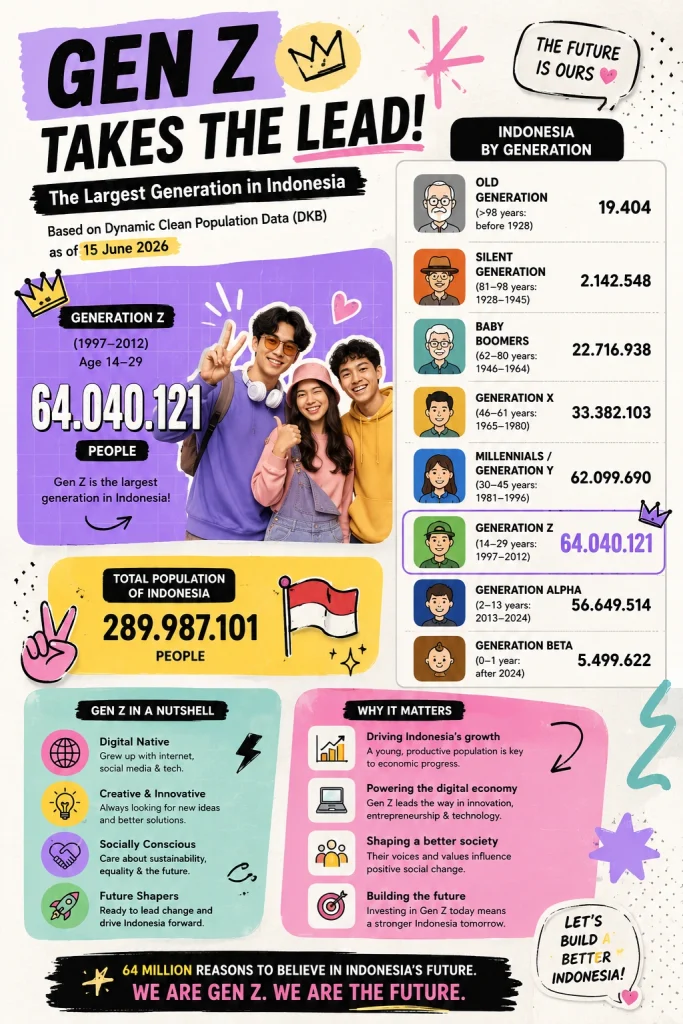
Gen Z, individuals between 14 and 29 years of age, born between 1997 and 2012, is made up of 64,040,121 people. These numbers come from the latest population estimates.
The finding gives Gen Z the edge over all other generations in Indonesia. Therefore, it makes Gen Z the greatest population segment in the country.
The data also shows that Indonesia’s total population has reached 289,987,101 people.
Millennials (Gen Y) are born between 1981 and 1996 and there are 62,099,690 people. Generation Alpha, born from 2013 to 2024, has 56,649,514 people. Then comes Gen Z.
The other demographics are Gen X (33,382,103), Baby Boomers (22,716,938), the Silent Gen (2,142,548), the Old Gen (19,404), and Gen Beta, which is the youngest generation after 2024 with 5,499,622 people.
The demographic composition reflects the ongoing demographic dividend of Indonesia. Specifically, the younger generation forms a substantial portion of the national population.
The explosion of the internet, cellphones, and social media has shaped Gen Z into a tech-savvy generation. As a result, many of this age group are early adopters of emerging technologies and active players in Indonesia’s nascent digital economy.
Gen Z will drive the country’s economic growth as they continue to influence higher education. Furthermore, they will impact the workforce, entrepreneurship, and the creative sector.
Gen Z is also expected to be a major force in shaping public policy, innovation, environmental awareness, education, and social transformation. This is in addition to their economic impact.
Their tastes, their buying behavior, and their digital smarts are already affecting business strategy and government programs. This impact stretches across a range of sectors.
The findings also emphasize the necessity of quality education, skills development, health care and career opportunities. Consequently, these are vital to prepare Indonesia’s youthful population.
For long, policymakers have called for more investment in human capital and digital capabilities. They want Indonesia to benefit from its demographic bonus.
Gen Z is Indonesia’s largest cohort, with more than 64 million people, and is one of its greatest long-term strategic assets.
Indonesia’s ability to adapt to technological change, embrace innovation and contribute to national output will probably decide its competitiveness. This will be crucial in the decades ahead.
Indonesia is making progress with the country’s long-term development goals and digital transformation agenda. In addition, the country’s largest generation is expected to be a critical factor in the shaping of the nation’s economic resilience, technological advancement, and social improvement.
The new population numbers clearly indicate that Gen Z will have a major impact on shaping Indonesia’s future. Their ideas, skills and engagement will be essential for the country’s growth in the coming years.






No Comment! Be the first one.