



Indonesia’s economy grows strongly in Q1 2026 as fiscal policy supports recovery and investment
JAKARTA, Thekabarnews.com—National economic growth in the first quarter of 2026 was at 5.61 percent year-on-year (yoy). This indicates that the Indonesian economy is still doing well. The Finance...


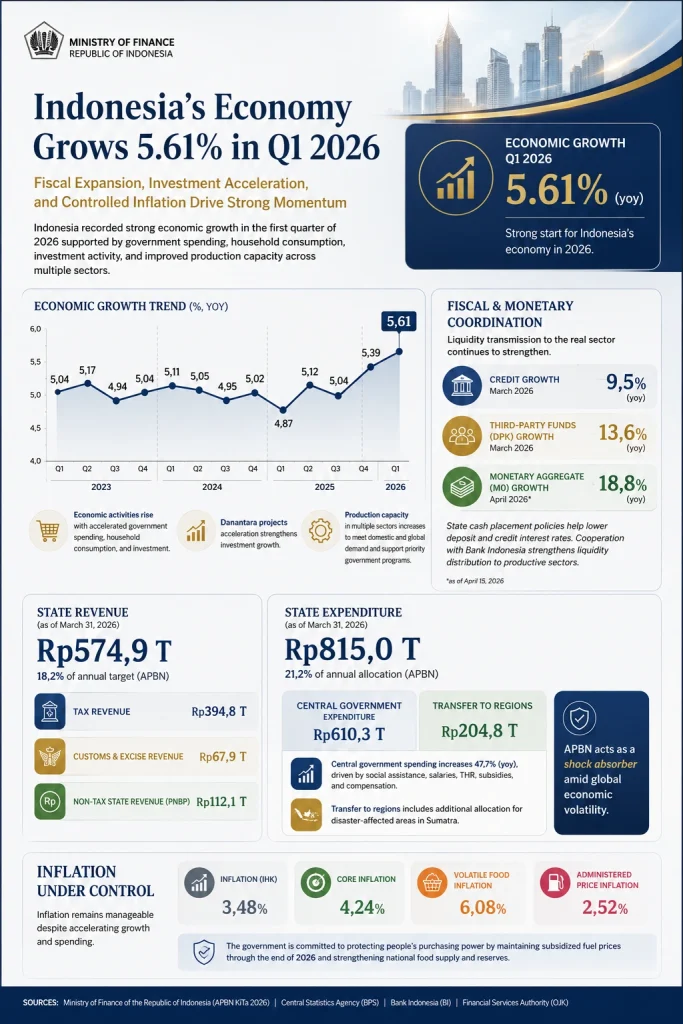
JAKARTA, Thekabarnews.com—National economic growth in the first quarter of 2026 was at 5.61 percent year-on-year (yoy). This indicates that the Indonesian economy is still doing well. The Finance Ministry of the Republic of Indonesia conveyed this information during the APBN KiTa press conference
Compared to previous quarters, this figure indicates a clear acceleration and stronger government spending, household consumption, and investment activity. Furthermore, there was also an improved production capacity in several sectors.
Data from the Statistics Indonesia (BPS) shows that Indonesia’s quarterly economic growth trend had been relatively stable recently. However, it sharply accelerated in early 2026.
Indonesia’s annual economic growth for 2023 was 5.05 percent on average, 5.03 percent in 2024, and 5.11 percent in 2025. But momentum in the first quarter of 2026 was more robust at 5.61 percent yoy. This was one of the highest recent growth performances in the country.
Indonesian government officials said the improvement was due to faster fiscal spending and stronger domestic demand.
Finance minister Purbaya Yudhi Sadewa said government expenditure increased. Growth in household consumption and investment activities also contributed to the expansion.
Other major contributors to investment growth and increased production capacity were several strategic projects under the Danantara initiative.
Indonesia was also able to increase its production capacity in various sectors to meet the needs of domestic and international markets. Meanwhile, these initiatives supported priority government programs, the report added.
The government also stressed the need for greater coordination between fiscal and monetary authorities to maintain sustainable growth.
The transmission of liquidity into the real sector continued to improve in 2026 according to data from Bank Indonesia (BI). Additionally, the Financial Services Authority (OJK) also published supporting data.
In March 2026, credit growth was recorded at 9.5 percent year-on- year. At the same time, a record was made of third-party funds (DPK) at 13.6 percent.
Meanwhile, the growth of monetary aggregates (M0) had risen to 18.8 percent by April 2026.
The Finance Ministry said that cash placement policies by the state have also helped to lower deposit and credit interest rates. As a result, these policies encouraged financing activity and supported business expansion.
Officials said cooperation with Bank Indonesia also continued to strengthen the distribution of liquidity to productive sectors of the economy.
Government revenue performance also held up well in the first quarter of 2026.
“State revenue as of March 31, 2026, has reached Rp574.9 trillion or 18.2 percent of the annual state budget target (APBN),” Purbaya said.
The revenue comprised Rp394.8 trillion in tax revenue, Rp67.9 trillion in customs and excise revenue, and Rp112.1 trillion in non-tax state revenue (PNBP). Meanwhile, government expenditure increased substantially.
Total state spending was Rp815 trillion, or 21.2 percent of the annual budget allocation. The central government spent Rp610.3 trillion and transferred Rp204.8 trillion to the regional governments.
The Finance Ministry said central government spending jumped 47.7 percent from a year earlier. Social assistance programs, civil servant salaries and holiday allowances (THR), subsidies, and compensation measures buoyed this.
It also increased regional transfer allocations, including additional support for disaster-hit areas in Sumatra.
The APBN was a “shock absorber” in the face of ongoing global economic volatility. Inflation remained pretty stable despite rapid growth and spending.
Indonesia’s inflation rate was recorded at 3.48 percent in early 2026, according to BPS data. Food inflation was volatile at 6.08 percent, while core inflation reached 4.24 percent. Inflation of administered prices was lower, at 2.52 percent.
The government reaffirmed its commitment to safeguarding the public’s purchasing power. To achieve this goal, it is sustaining subsidized fuel prices until the end of 2026.
Efforts by authorities to stabilize food prices nationally through better food reserves and improved supply management also continued.
The ability of Indonesia to maintain growth above 5 percent while keeping inflation in relative check is a sign of stronger macroeconomic resilience. In fact, this is notable compared to many emerging economies grappling with global uncertainty.
With the combination of fiscal expansion, stable inflation, faster investment, and synchronized monetary policy, Indonesia entered 2026 with better domestic confidence. In addition, there was more economic momentum.






No Comment! Be the first one.