



Karolin questions fairness of new land redistribution policy in West Kalimantan
Thekabarnews.com—Landak Regent Karolin Margret Natasa publicly challenged the legitimacy of the central government’s new land redistribution policy. She did so at the first meeting of the West...

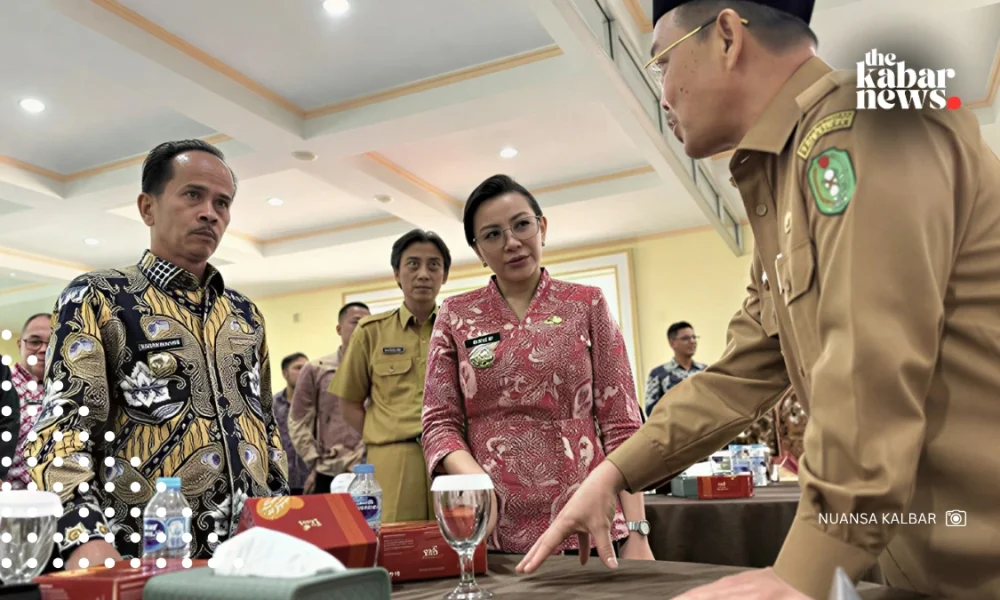
Thekabarnews.com—Landak Regent Karolin Margret Natasa publicly challenged the legitimacy of the central government’s new land redistribution policy. She did so at the first meeting of the West Kalimantan Province Agrarian Reform Task Force (GTRA) in 2026.
Officials held the meeting at Aula Khatulistiwa, the Regional Office of the National Land Agency (BPN) of West Kalimantan, on Tuesday, April 28. It became an important forum for regional leaders to channel public concerns about agrarian reform.
Karolin used the opportunity to pass on the inhabitants’ objections to the new scheme of redistribution. The new scheme no longer provides the beneficiaries with direct land ownership certificates (SHM). Now, communities have agreed to time-limited land management rights under the Land Bank Authority.
“We regret, first, the late socialization of this regulatory change. The new policy has already received a lot of rejection from people in the field, because unlike before when land redistribution gave ownership certificates, it now only offers management rights,” Karolin said.
The meeting was mainly to talk about policy change. West Kalimantan BPN regional office head Mujahidin Ma’ruf said that the central government has changed the direction of agrarian reform policy this year.
He quoted the Letter of the Agrarian Affairs and Spatial Planning Ministry/National Land Agency (ATR/BPN) Number B/LR.03.01/48/I/2026 regarding the strengthening of agrarian reform.
The new scheme is based on the concept of land redistribution by giving time-limited land rights. The land bank agency owns these management rights. The goal is to ensure sustainability and prevent land transfer or land-use conversion.
“The policy aims to protect the long-term benefits of agrarian reform and address concerns from the regions,” said Rudi Rubijaya, Director of Land Reform at the Ministry of ATR/BPN.
The objective is to promote sustainability and prevent premature transfers of land titles and changes in land uses. He said beneficiaries could upgrade their rights to full ownership after 10 years if they meet the requirements.
She accepted the explanation but stressed that justice for Indigenous communities and locals who had lived on the land for generations was the priority.
“Why is it so difficult for local people to obtain two hectares per person when companies can receive millions of hectares? People feel the situation is clearly an injustice,” she said.
West Kalimantan Governor Ria Norsan has also appealed to all stakeholders to cooperate. He wants them to find the best solution for the affected communities.
This year we have a new scheme of redistribution, based on land management rights. This initiative is a step forward, but it requires a holistic understanding from all of us,” Norsan said.
He also called for stronger coordination between BPN and other relevant regional agencies. Such cooperation ensures that agrarian reform provides legal certainty and real benefits for public welfare.
At the end of the discussion, Karolin reiterated that the Landak Regency Administration is ready to help explain the policy to the public. However, the legal guarantees and regulatory transparency must clearly provide such cooperation.
“The state can revoke the management rights it has granted to individuals at any time. The government has never given detailed rules to local governments. That’s why we can’t also explain it to the public properly,” Karolin concluded.



No Comment! Be the first one.