



Papua governor says locals feel like guests on own land
SORONG, thekabarnews.com—Southwest Papua Governor Elisa Kambu has urged Indonesia’s central government to accelerate recognition of customary land and forests. He said Indigenous Papuans increasingly...

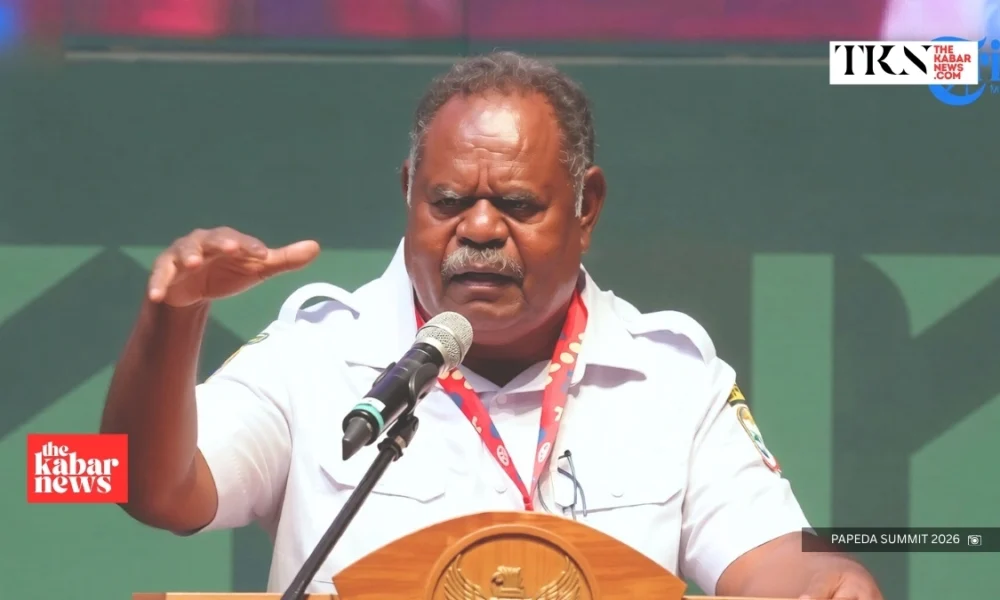
SORONG, thekabarnews.com—Southwest Papua Governor Elisa Kambu has urged Indonesia’s central government to accelerate recognition of customary land and forests. He said Indigenous Papuans increasingly feel like guests in their territory.
Elisa delivered the criticism before Coordinating Food Minister Zulkifli Hasan (Zulhas) during the opening of the PAPEDA Summit 2026 in Sorong on Wednesday, September 2.
The forum brought together government officials, Indigenous representatives and civil society groups to discuss sustainable development across Papua.
“People from Jakarta own all these forests. Generals and conglomerates own forests. Papuans own nothing; we are only guests here, sir,” Elisa said during the event.
The governor also questioned who benefits from mining and other natural-resource projects in Papua.
He argued that local communities often lack the legal recognition needed to protect their territories. This question becomes an issue when the government grants business permits or development projects proceed.
Elisa did not identify any general, company or specific concession in his speech. He also did not present documents establishing that any named party had acquired land unlawfully.
Authorities would need to examine individual permits, land boundaries and customary claims before determining whether any legal violation had occurred.
His statement should therefore be understood as criticism of unequal control over natural resources. It is not a finding that all outside investors or concession holders obtained land illegally.
Elisa asked the government to speed up administrative and legal processes covering Indigenous communities.
“Legal matters and the recognition of Indigenous land rights must be accelerated,” he said.
The provincial administration, he added, would support the mapping of customary territories to provide greater certainty for local communities.
Zulhas responded by supporting greater Indigenous participation in Papua’s development.
“Development and equitable development must involve Indigenous communities and ensure that they receive the benefits,” he said.
“Otherwise, we must question that development.” His response appeared in the PAPEDA Summit’s official account of the event.
The summit ran from September 2 to 4 and attracted about 1,030 participants.
More than 50 civil society organizations and development partners participated in preparations for the forum. The event focused partly on customary rights and environmental protection.
Indonesia’s Constitutional Court (MK) strengthened the legal standing of Indigenous forests through Decision No. 35/PUU-X/2012.
The decision did not include customary forests in the category of state forests. Communities still need to go through government processes of recognition and boundary-setting to achieve formal protection.
The Constitutional Court has acknowledged continuing challenges in implementing the decision.
The Forestry Ministry reported that Indonesia had formally established 174 customary-forest units by 2026.
Twelve units covering 14,269 hectares received recognition during the year. The government was pursuing a national target of 1.4 million hectares, according to the ministry.
Elisa’s remarks place pressure on central and regional authorities. They now must convert public commitments into verified maps, transparent permit information and legally enforceable recognition of Papua’s customary territories.


No Comment! Be the first one.