



Malaysia and Indonesia plan joint action against haze
KUALA LUMPUR, thekabarnews.com—Malaysia and Indonesia have agreed to strengthen cooperation against forest fires and transboundary haze. The agreement comes as smoke from Kalimantan affects air...

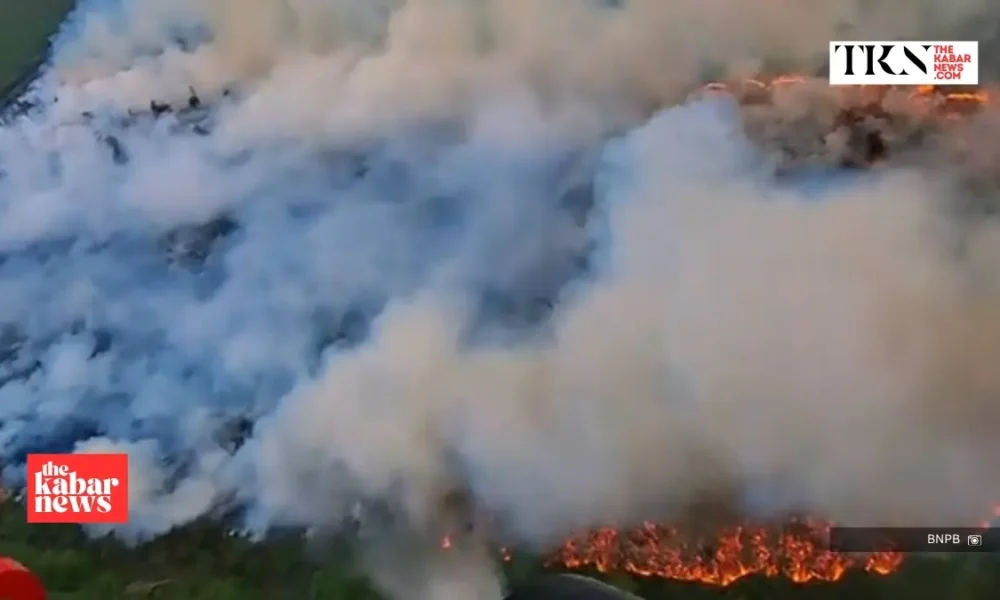
KUALA LUMPUR, thekabarnews.com—Malaysia and Indonesia have agreed to strengthen cooperation against forest fires and transboundary haze. The agreement comes as smoke from Kalimantan affects air quality across parts of Borneo and Peninsular Malaysia.
The planned cooperation includes faster hotspot-data exchanges and stronger enforcement against illegal open burning. There is also the possible sharing of airspace and equipment for cloud-seeding operations when weather conditions permit.
Malaysia’s Natural Resources and Environmental Sustainability Minister Datuk Seri Arthur Joseph Kurup discussed the measures with his Indonesian counterpart. The talks happened during recent ASEAN environmental meetings.
“Recently we had an ASEAN meeting. I met with all my counterparts, for example, the minister of environment in Indonesia, and we’ve already agreed to increase our collaboration,” Arthur said on August 18.
He said authorities could cooperate in monitoring hotspots and deploying additional enforcement agencies to prevent open burning.
“We can also share our airspace in case we need to do any cloud seeding operations; maybe share our assets too,” he added.
The statements indicate operational readiness and closer coordination. Neither government had announced a specific joint cloud-seeding mission or Malaysian deployment to Indonesia when this article was prepared.
Arthur said that one country could not manage smoke pollution because wind can transport haze across national borders.
“This is a concerted effort needed at the regional level because this is a regional problem,” he said, according to Malaysia’s Bernama news agency.
Malaysia subsequently sent an official message to ASEAN Secretary-General Kao Kim Hourn calling for collective prevention and improved firefighting preparedness.
Malaysian officials also said Arthur would write to his Indonesian counterpart through diplomatic channels.
The ASEAN Specialized Meteorological Centre activated Alert Level 2 for the southern ASEAN region on August 3. This decision followed after satellite monitoring detected rising hotspot and smoke activity.
The center recorded 185 hotspots in Kalimantan on August 1 and 371 the following day.
Its August–October seasonal outlook warned that strengthening El Niño conditions and below-normal rainfall could increase the likelihood of persistent fires and transboundary haze. Additionally, prevailing winds play a role.
The effects became increasingly visible in Sarawak. On August 21, the Air Pollutant Index at Serian reached 227, classified as very unhealthy. Nine other Sarawak monitoring stations recorded unhealthy air.
By the morning of August 22, Serian’s reading had fallen to 190 but remained unhealthy. Kuching recorded 182 and Samarahan 177, while Bukit Rambai in Melaka reached 151.
The figures can change hourly and do not prove that every pollutant measured at each station originated in Indonesia. Local fires, weather patterns and other emission sources may also affect readings.
Malaysia’s Department of Environment reported smoke movement from hotspot clusters in Kalimantan toward western Sarawak.
The cooperation falls under the legally binding ASEAN Agreement on Transboundary Haze Pollution.
It also supports the Second ASEAN Haze-Free Roadmap, which sets a regional vision of eliminating transboundary haze by 2030.
Long-term measures under that framework include peatland protection, sustainable land management, early fire detection and stronger law enforcement.
These measures are essential not only for public health but also for forests and threatened Borneo wildlife, including orangutans.
Officials have not provided a timetable for implementing the proposed joint operations.
Any cloud-seeding mission would also depend on suitable clouds, weather conditions, aviation authorization and formal coordination between the countries.



No Comment! Be the first one.