



ASEAN’s rising obesity rates reflect changing lifestyles
Thekabarnews.com—Every number in a health report represents a person. For instance, a family changing what they eat every day, a worker working long hours at a computer, and a toddler choosing...

Thekabarnews.com—Every number in a health report represents a person. For instance, a family changing what they eat every day, a worker working long hours at a computer, and a toddler choosing screens over a playground all have their own stories.
A new report from the Global Obesity Observatory at the World Obesity Federation shows how changing lifestyles are impacting public health in Southeast Asia. In particular, obesity is becoming a growing issue for several countries in the region.
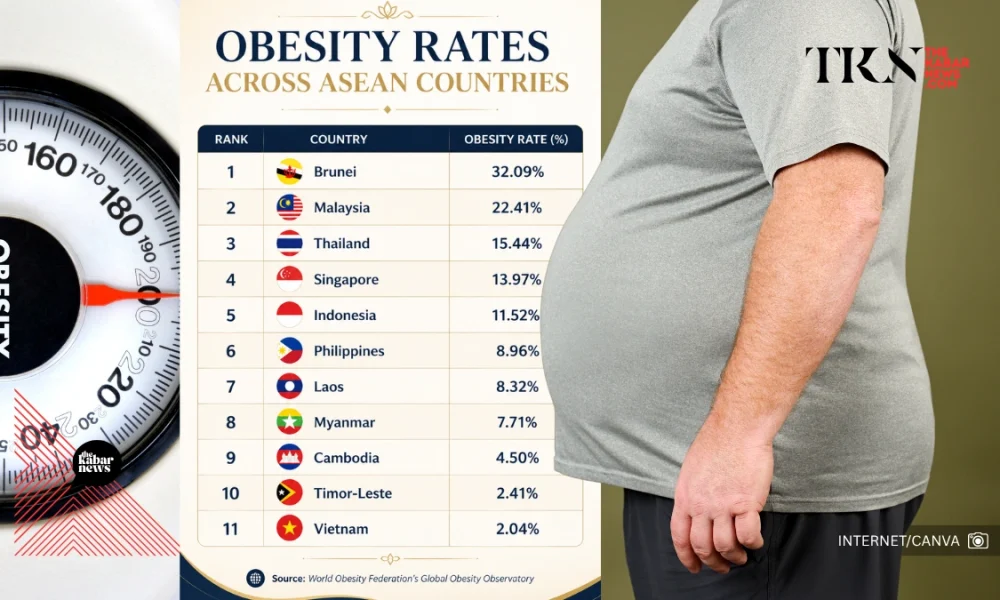
Brunei has the highest obesity rate of 32.09 percent among ASEAN member nations. The latest data shows that more than three out of every 10 adults in the country are living with obesity, making it the only country in the region to exceed that threshold.
Malaysia is second at 22.41 percent. Thailand is third with 15.44 percent, while Singapore is fourth with 13.97 percent.
Indonesia ranked fifth with 11.52 percent. The Philippines follows with 8.96 percent, Laos with 8.32 percent, and Myanmar with 7.71 percent.
The lowest recorded rates of obesity in the region are in Cambodia (4.50 percent), Timor-Leste (2.41 percent), and Vietnam (2.04 percent).
Experts attribute obesity to various factors rather than a single issue. As a result, there are significant variations in rankings.
Eating habits, physical activity, urbanization, economic development, access to nutritious food, sleep patterns, stress, and genetics all influence a person’s overall health.
Much of the rapid urbanization in Southeast Asia has changed the lives of many. Today, with so many processed foods and sugar-sweetened beverages to choose from, there are fewer reasons to be physically active.
At the same time, busy work schedules may not leave time for making a healthy dinner at home or for a regular exercise routine. For many families, it’s become more difficult than ever to maintain a healthy lifestyle.
Kids are on more digital gadgets. Adults travel longer distances, and they increasingly choose meals based on convenience rather than nutrition.
Obesity increases the risk of chronic diseases, including type 2 diabetes, heart disease, hypertension, and several types of cancer. However, experts also stress that obesity is a major medical and public health problem, not just a matter of personal willpower or aesthetics.
Instead, experts are asking governments, schools, companies, and communities to provide environments that make healthy choices easier.
Many countries are already designing projects to improve access to nutritious foods, increase public recreational spaces, and support active transportation and health education.
The ASEAN rankings shouldn’t be considered a competition. Instead, they are an opportunity to study how social and lifestyle changes are impacting millions of people.
Whether you’re living in busy cities like Kuala Lumpur, Jakarta, Bangkok, or Bandar Seri Begawan, the difficulty is becoming more and more the same. Specifically, it’s about maintaining equilibrium in a fast-moving environment.
In the end, the report is a reminder that good health is made up of everyday actions. Small decisions—walking a little farther, eating more fresh foods, getting enough sleep, and being physically active—can make a difference in healthy communities.
But the numbers only start to tell the story of obesity in ASEAN. This is a story of modern living. It shows how civilizations change and how everyday routines change. Moreover, it shows how each individual can choose to make decisions that help build a better future.






No Comment! Be the first one.