



Batak and Minangkabau lead Indonesia in university graduate rates, BPS reports
JAKARTA, Thekabarnews.com—New data from Statistics Indonesia (BPS) shows large disparities in higher education attainment among Indonesia’s ethnic groups. This highlights the influence of cultural...

JAKARTA, Thekabarnews.com—New data from Statistics Indonesia (BPS) shows large disparities in higher education attainment among Indonesia’s ethnic groups. This highlights the influence of cultural values, migration traditions, and family support systems on educational outcomes.
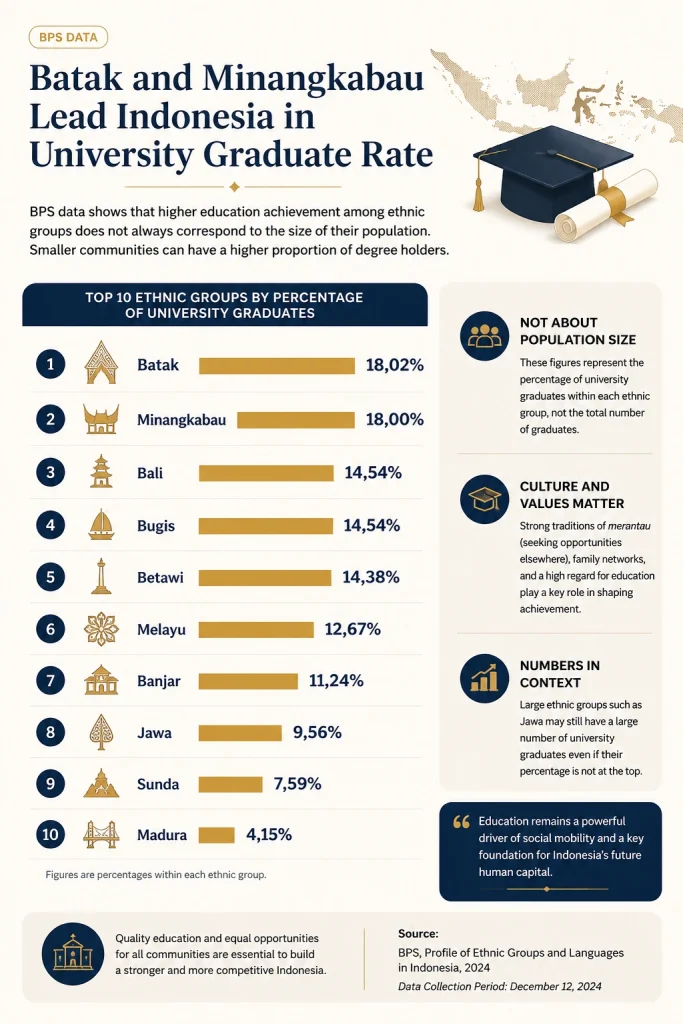
The results suggest that the share of university graduates is not always proportional to the size of the population of an ethnic group. In several cases, the smaller ethnic groups have a much larger share of degree-holders than larger populations.
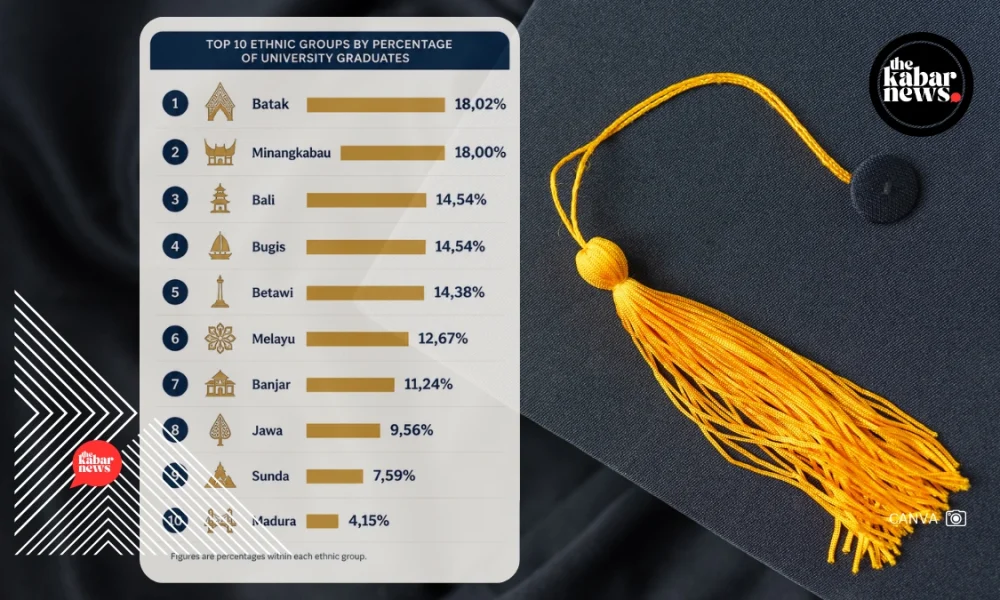
The Batak ethnic group is the first in Indonesia, with 18.02 percent of its population having a university degree, according to the BPS report on ethnic and regional language diversity. Then there is the Minangkabau community with 18.00 percent.
The line between the two groups is a fine one. This reflects long-standing traditions that have always highly valued education as a means of social mobility and economic progress.
The culture of merantau, going out to seek opportunities for education, work, or business, is often cited by researchers and social commentators. This is seen as one of the important aspects of the educational success of the Batak and Minangkabau groups.
Data also places Balinese and Bugis ethnic groups in joint third position, each with a university graduate rate of 14.54 percent. The Betawi community holds the fifth rank with 14.38 percent, followed by the Malay ethnic group at 12.67 percent.
With 11.24 percent, the Banjar community occupies the seventh position. Meanwhile, the Javanese ethnic group, at 9.56 percent, holds the eighth position.
The population of the Sundanese is 7.59 percent, while the Madurese community completes the top ten at 4.15 percent.
Top 10 Ethnic Groups by Percent of College Graduates:
1. Batak—18.02%
2. Minangkabau—18%
3. Balinese 14.54%
4. Bugis—14.54%
5. Betawi—14.38%
6. Malay—12.67%
7. Banjar—11.24%
8. Javanese—9.56%
9. Sundanese—7.59%
10. Madurese—4.15%
Do not interpret these figures as the total number of graduates produced by each ethnic group. Instead, the percentages are measuring how much education each community has attained.
Thus, one can still expect a much larger number of university graduates in absolute terms from large ethnic groups such as the Javanese. This is because of their much larger population size.
The results offer important insights into how educational outcomes are shaped by community values and cultural norms. Many of the top-ranking groups have long valued education as an investment in future generations.
While the economy is in a slump, students generally have strong family networks, community support systems and academic achievement expectations. These factors drive them to attend college.
Indonesia has made big strides in opening up university access in the past two decades. But there are still regional, income, and demographic differences in levels of education.
Latest BPS data highlight the importance of education policies that provide equal opportunities. Such policies also need to take into account the different cultural influences on academic success.
As Indonesia develops to improve its human capital and competitiveness at the global level, understanding the factors affecting educational attainment may help policymakers. This understanding can help them formulate better policies to increase participation in university education across all segments of society.






No Comment! Be the first one.