



What happens if the Rupiah hits Rp18,000 per dollar? Here’s the real impact
Thekabarnews.com—The rupiah’s fall to Rp18,000 per dollar is no longer a figure on a trading board. Many economists and market observers consider the figure a stark warning for Indonesia’s...


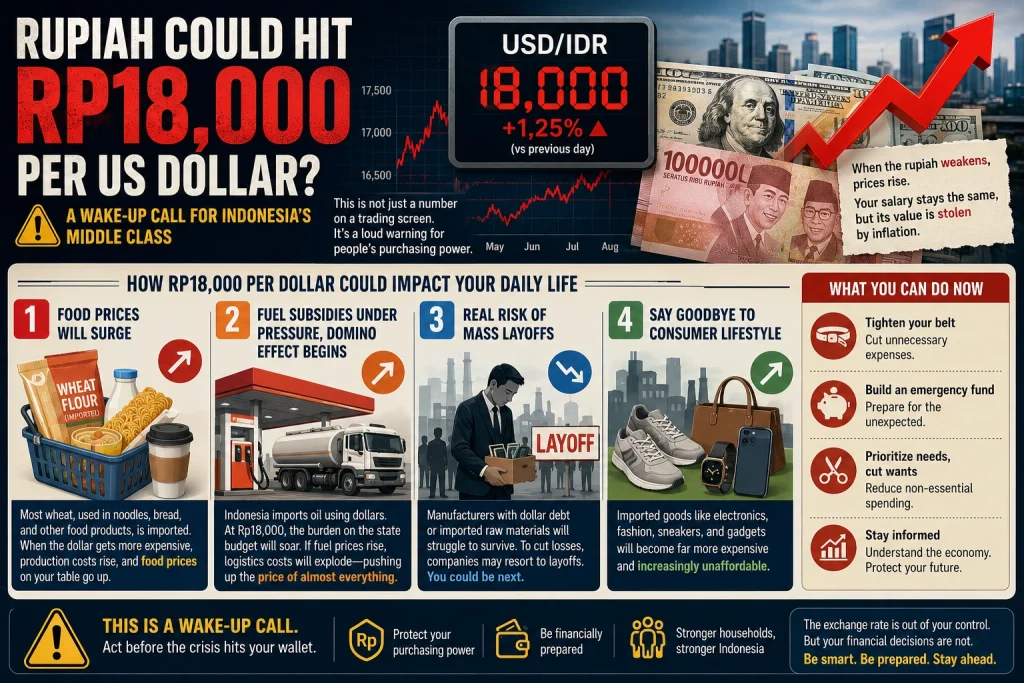
Thekabarnews.com—The rupiah’s fall to Rp18,000 per dollar is no longer a figure on a trading board. Many economists and market observers consider the figure a stark warning for Indonesia’s middle class. In particular, it is troubling for those who are struggling with rising living costs and falling purchasing power.
Should the exchange rate reach that level, the impact will extend beyond the financial market. Soon, imported inflation will start creeping into our daily lives. The effect is an increase in local prices due to the depreciation of the local currency against foreign currencies.
When the rupiah depreciates, Indonesia must pay more to buy imported goods priced in US dollars.
This includes fuel, wheat, soy, industrial raw materials, medicines, electronics, and many consumer products.
It’s common for companies to pass on production costs to consumers as they increase. The first direct effect is usually the price of food.
Indonesia imports many raw materials, such as wheat and dairy ingredients, to produce popular daily products. These include noodles, bread, milk, and processed foods.
And as the dollar becomes pricier, it costs producers more. As a result, prices on supermarket shelves and restaurant menus start to go up.
There’s pressure on fuel subsidies, too. Indonesia still relies heavily on imported oil and refined fuel products, which it pays for in U.S. dollars.
If the rupiah reaches Rp18,000, the impact on the state budget for fuel subsidies will be very severe. If the government cuts subsidies or fuel prices fluctuate, transportation and logistics costs will increase immediately.
It causes a chain reaction that pushes up the price of almost every product on the market. Perhaps the manufacturing sector faces even bigger problems. Companies importing raw materials or with dollar debt may find it difficult to survive as costs go up.
Occasionally the corporate response is to cut costs, to slow growth, or even to cut the workforce. Layoffs are more likely, especially in sectors that are under significant foreign exchange pressure.
Consumers may have to change their habits. Imported electronics, fashion, smartphones, and luxury goods will be much pricier.
Middle-class households that have purchased nonessential items with stable exchange rates may need to cut back on those purchases. They may also need to focus more on emergency savings.
Financial analysts warn that many people still underestimate how quickly exchange-rate shocks can hit personal finances.
In theory, the salary might not change, but if inflation outpaces your earnings, that salary can silently erode its purchasing power.
Economists argue that it is time to implement stricter fiscal measures.
If currencies are bouncing around, it becomes even more critical to cut waste, build up emergency funds, and educate oneself about macroeconomic risks.
The depreciation of the rupiah is not a problem of the market but of the house.
If the exchange rate does in fact reach Rp18,000 to the US dollar, perhaps the most significant problem is not the figure itself. Instead, it is what it means for the day-to-day financial lives of millions of Indonesians.






No Comment! Be the first one.