

The World Bank says Indonesia’s big dream of becoming a developed country is not possible
Thekabarnews.com—Imagine this: you work hard every day, and then a friend walks by and says, “Why bother? You will never make it, no matter how hard you try.” He is annoying, right? That is...

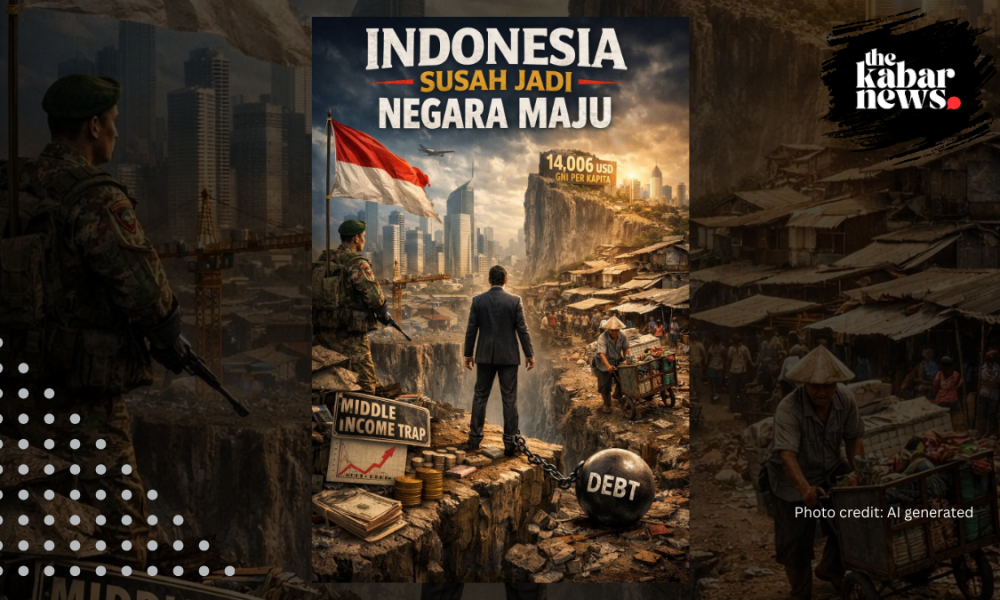
Thekabarnews.com—Imagine this: you work hard every day, and then a friend walks by and says, “Why bother? You will never make it, no matter how hard you try.” He is annoying, right? That is about how we feel when the World Bank talks about Indonesia. Let’s read the narration carefully while drinking a cup of sugarless coffee (Koptagul), Wak!
Nowadays, Indonesia is going through a wave of nationalism. Indonesia is getting ready for 2045, and President Prabowo Subianto is in charge. The government is pushing downstreaming, the free meals program (MBG) is like a daily prayer, and palm oil is recognized as the country’s backbone. The mood is heroic, like a war movie with dramatic music from an orchestra.
Suddenly, the World Bank apologizes, stating, “Unfortunately, Indonesia is still struggling to achieve the status of a developed country.” That is not counsel. That is like throwing a bottle on stage at the finale.
The World Bank does not talk about feelings. It talks in figures, tables, and calculations that make people frown. A developed country is one with a “high-income status,” according to the dictionary. The rule is harsh but simple: the gross national income per person must be more than $14,006 a year. If you miss it by one dollar, you lose. You cannot pay for national pride in installments. Optimism is not a good thing for economic success.
The World Bank seems like a strict lecturer and says, “You work hard, but you are not smart enough.” Yes, Indonesia is rising, but not in a way that will last. Growth needs to stay over 6% all the time, not just when prices go up or exports do well. The economy needs to be based on productivity and new ideas—not on digging up resources, selling them, and hoping that global markets stay nice.
The World Bank says that Indonesia’s productivity engine is what really makes the country sick. There are big companies, and a lot of them are enormous, but productivity goes down as they get older and bigger. In theory, as companies grow, they should become more efficient and competitive. The opposite is true in Indonesia. The bigger they are, the slower they move—these are like “economic dinosaurs.” Despite their size and strength, they struggle to adapt to changes.
The Bank asserts that institutions and business practices pose the primary issue. The rules are always shifting. The playing field is not fair. Bureaucracy is like layers of a traditional dessert. Because of this, the formal sector is slow to grow. Around 83% of workers end up in the informal economy. Even though it is in the G20, it still feels like a pop-up market for jobs.
This affects the finances of the state. Tax collection gets weaker. The state’s income goes down. The deficit is getting closer to the sacrosanct 3% mark. The debt goes up. Interest payments take up about 20% of the state’s income. This is a massive warning sign. It is a siren. As development needs grow louder, there is less room in the budget for productive investment.
At the end, there is irony. The World Bank says that if Indonesia really follows through on structural reform—making the business climate better, increasing productivity, and cutting down on red tape—growth may go up a lot. The growth could potentially increase by an additional 2% annually for a period of five years. The message is clear: Indonesia can go forward. It is just too often half-hearted.
So the debate turns into a global Warkop statement. Indonesia yells optimism. The World Bank responds with graphs. One side talks about bravery and the past. The other one talks about GNI per capita and budgetary discipline. Nowadays, Indonesia finds itself torn between national pride and economic reality, caught between lofty dreams and cold numbers.
“Bang, this is insolent to the World Bank. It should give optimism to the president; his statement is even honest. The World Bank doesn’t look at MBG; it is already a sector of one million workers. Especially mine.”
“Yes, that is harsh. We hope the president doesn’t call it a foreign agent.”
By: Rosadi Jamani, Chairman of Satupena West Kalimantan.





No Comment! Be the first one.