

The U.S. sends the nuclear-powered USS Abraham Lincoln to the South China Sea, which raises tensions
Thekabarnews.com—Tensions in the South China Sea have risen anew after the United States Navy’s nuclear-powered aircraft carrier, the USS Abraham Lincoln, went on a normal cruise. The move...

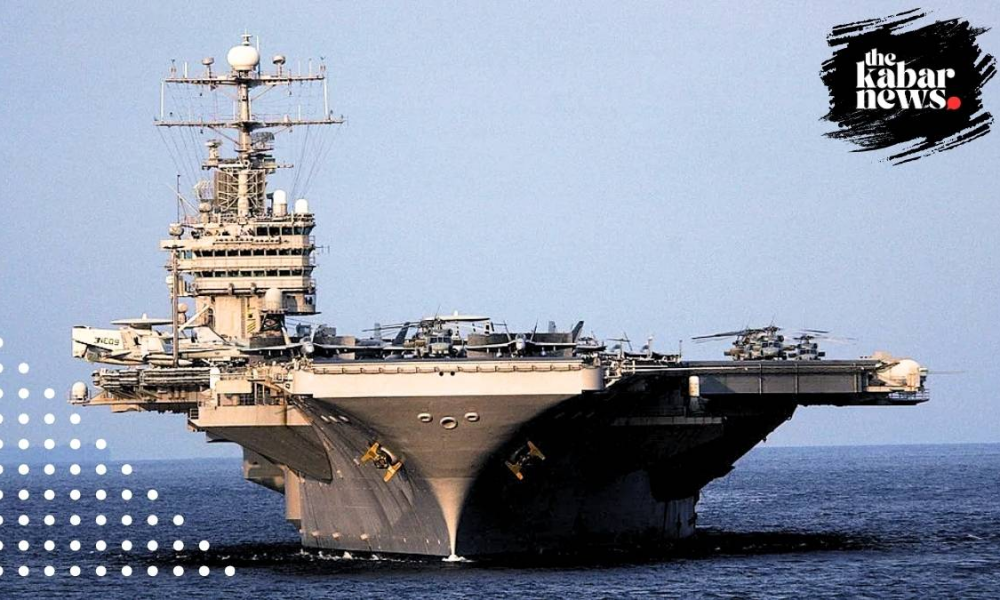
Thekabarnews.com—Tensions in the South China Sea have risen anew after the United States Navy’s nuclear-powered aircraft carrier, the USS Abraham Lincoln, went on a normal cruise.
The move comes at a time when the strategic rivalry between Washington and Beijing is getting worse. This shows how important the Indo-Pacific is becoming as a center of global security competition.
The USS Abraham Lincoln has a strong air wing. It includes fifth-generation F-35C Lightning II stealth fighter jets, F/A-18E/F Super Hornet multirole combat aircraft, and EA-18G Growler electronic warfare planes.
These assets give the carrier strike group advanced powers. They can control the air, carry out precision strikes, and attack and disable opponent air defenses.
Military experts say that having such a large and technologically advanced force is a clear sign. It indicates that the U.S. military is ready and able to stop aggression.
Table Of Content
U.S. Navy cites routine operations and deterrence
The United States Navy stated that the deployment is a component of its regular operations. It aims to halt aggression, foster alliances, and maintain peace through a robust and conspicuous military presence.
The U.S. officials have said many times that moving naval assets forward is necessary. This system protects freedom of navigation and overflight in international waters, especially where competing territorial claims could lead to instability.
The USS Abraham Lincoln is working with three guided-missile destroyers to protect against threats from the air, surface, and subsurface.
This escort configuration makes the strike group more likely to survive. It gives it more options for how to do its job. Thus, it can respond quickly to a wide range of situations.
Many people saw the deployment as a powerful message to China about its growing territorial claims in the South China Sea, which is also claimed by certain Southeast Asian countries.
Strategic importance of the South China sea
Washington has long said that if one country had too much power in the South China Sea, it would be a big danger to stability in the area and trade around the world.
Every year, more than one-third of the world’s maritime traffic travels through these seas. This makes the area important not only to Asia’s economies but also to global supply chains. Officials in the U.S. have said that trying to control or limit access to these sea lanes may have big effects on the economy and strategy.
China, on the other hand, says it has historical rights over giant parts of the South China Sea and has always been against what it perceives as outside intrusion.
Beijing often calls U.S. Navy actions in the area provocative and harmful to stability. The Ministry of Foreign Affairs of China has not yet made an official announcement about the current deployment. But prior responses show that China sees these kinds of steps as part of a bigger plan by the US to stop its ascent.
Growing risks of miscalculation
International relations experts say that sending the USS Abraham Lincoln to the Indo-Pacific is part of a long-term U.S. plan to keep its might and reassure its allies.
While China modernizes its military and expands its naval presence, the United States seeks to demonstrate its commitment to regional security.
Analysts caution that the proximity of hostile military troops often increases the likelihood of errors or uncontrollable situations.
The lack of strong ways to develop trust between the two powers has made the South China Sea one of the most dangerous places on the globe right now.
Both Washington and Beijing say they do not want to fight, but their different geopolitical goals keep them in close and sometimes tense contact.
The deployment of the USS Abraham Lincoln shows how the balance of power is changing in the Indo-Pacific and how precarious peace is in one of the world’s most important maritime areas.




No Comment! Be the first one.