

The moment minister Sakti fell down during the farewell ceremony for three coffins
Thekabarnews.com—There were three coffins at the front of the hall. Someone in the family was reading a goodbye note. His body gave up and collapsed to the ground at that precise instant. He passed...

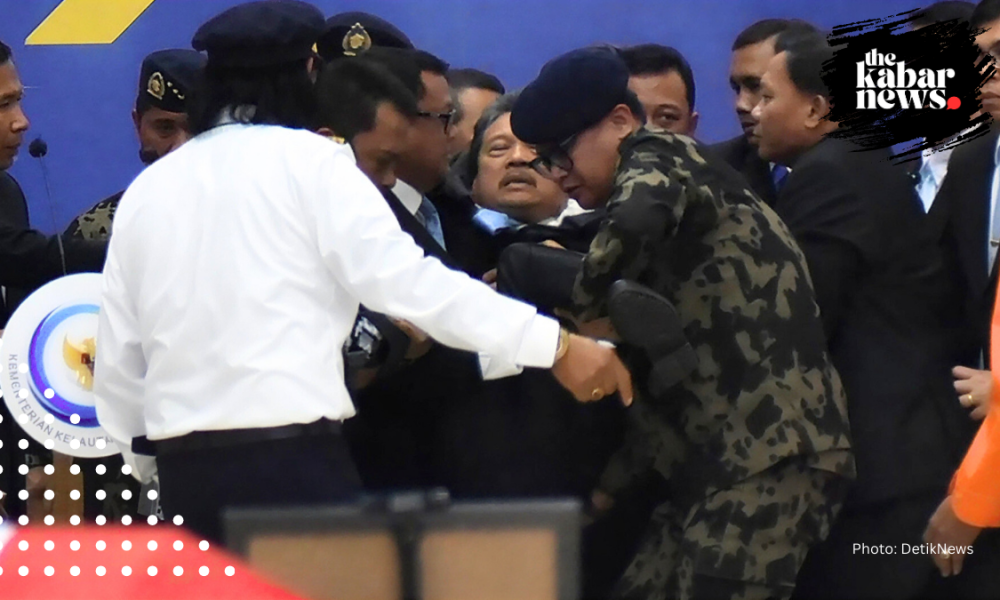
Thekabarnews.com—There were three coffins at the front of the hall. Someone in the family was reading a goodbye note. His body gave up and collapsed to the ground at that precise instant. He passed out. Indonesia’s Maritime Affairs and Fisheries Minister (KKP), Sakti Wahyu Trenggono, went through it. Please read the narration carefully while you drink a cup of sugarless coffee (Koptagul).
The event took place on Sunday, January 25, 2026, at 9:20 a.m. The clock on the wall of the Fisheries Business Academy’s Madidihang Auditorium in Pasar Minggu, South Jakarta, remained ticking without stopping. Three coffins were lined up neatly in front of the room. The arrangement was too neat to be appropriate for a tragedy. The bodies of Ferry Irawan, Yoga Naufal, and Captain Andy Dahananto were wrapped in red and white flags.
They worked for the Maritime Affairs and Fisheries Ministry (KKP) and left for work on an ATR 42-500 jet. When the plane crashed into Mount Bulusaraung in Maros, their names were carved into headstones.
Solemn did not do the mood justice. This quiet was so thick that it made people hesitant to breathe too loudly and pushed against their temples. The victims’ families were in the first row. People who may have hoped for miracles the night before formally forfeited the right to hope that morning.
A mother looked at her child’s casket without blinking, as if closing her eyes would make reality a nightmare she might yet wake up from.
Minister Sakti was at the podium. His suit was neat and his posture was strong, but there was something heavy on his face that no state procedure manual had ever written about. There were three coffins in front of him. The state was behind him. The pain all around him was overwhelming.
Words about duty, service, and loss came out of the microphone like slow gunshots, ripping into the hearts of everyone who heard them.
Then the body gave up. Minister Sakti immediately fell to the ground in front of the coffins, without any warning or showy spectacle. He did not fall. He did not make a mistake. Minister Sakti fell because his body could not handle the weight of the situation.
In that moment, the symbol of the state crumbled before death itself. The sadness he had been pushing back with official calm eventually got what it wanted in the quietest way possible: it made his body cease standing.
Families started yelling “Allahu Akbar.” It was not a triumphant song of faith but a terrible cry of surrender, emanating from chests that had already been opened. What had been serious became tense. Panic spread over the rows of chairs.
Doctors ran in and took the minister to an ambulance that was waiting outside. The state went back to work since the timetable had to go on even if someone died while they were grieving.
The ceremony stopped for a few minutes, which felt like hours to the families. Retired Admiral Didit Herdiawan Ashaf took over as Vice Minister of Maritime Affairs and Fisheries Ministry after that. The ceremony went on. They sent off the three coffins. The state continued talking. The flags in red and white kept flying.
Everything seemed normal, except for the hearts that had stopped beating for good.
There has been no official word about the minister’s health since the event. We do know that he was taken for a test right away. But that morning, people saw something much more essential than the health of a government figure.
We saw how sadness can bring down anyone, even those who are in charge of the state.
Interestingly, the three coffins remained motionless as the minister fell. Captain Andy, Ferry, and Yoga had made their peace with the world. The living are the ones who have to shoulder the weight: women coming home to empty arms, children growing up with framed pictures on the walls, and a country that has to learn again—too late—that service often ends in quiet, sorrow, and ceremonies that must nonetheless finish on time.
That morning, Madidihang Auditorium was more than just a place to say goodbye. It showed that sadness does not care about rank. Death usually comes in the most painful way, making us mourn in quiet even when we have to rise up.
By: Rosadi Jamani, Chairman of Satupena West Kalimantan







No Comment! Be the first one.