

It’s quite heartless of the govt to pay PPPK teachers only Rp200,000 a month
Pontianak, Thekabarnews.com– Many PPPK workers have told me about their problems through direct messages. They are upset about how their salary is going down. Weird, they already have an NIP,...

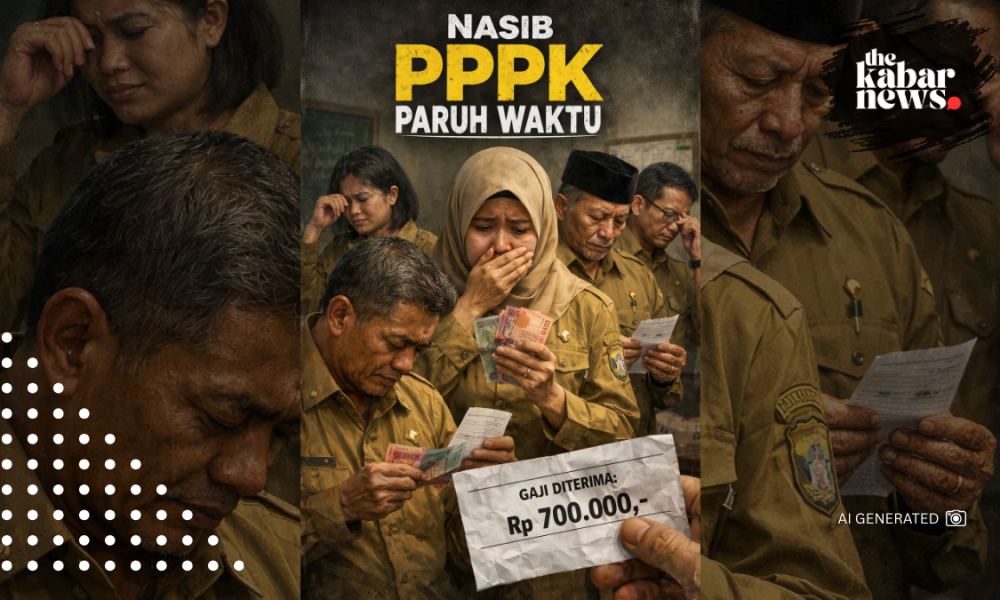
Pontianak, Thekabarnews.com– Many PPPK workers have told me about their problems through direct messages. They are upset about how their salary is going down. Weird, they already have an NIP, yet their salary is less than the UMR, and there are even worse examples. Let us keep speaking up for the PPPK, whom the government seems to be ignoring.
Read the narration carefully while drinking a cup of sugarless coffee (Koptagul), Wak!
A country proudly says, “Education is the future of the nation,” but when it comes to the “teachers’ kitchen,” the future is just requested to boil water. This is the next episode of the most ridiculous reality show in the bureaucracy. Part-time State civil servants (ASN) positions have great names, but salaries are decreasing, life is becoming more difficult, and they are being told to be thankful.
The opening was big. The teachers’s faces were proud and strong, like they had just won a war for freedom. But when the camera moved to the bank account, all that showed up were tiny, single-line figures that looked like the heart rate of a patient in an ICU. Still alive, but not for long.
Let us start with the numbers so that the suffering is real. In North Aceh, there were 8,094 part-time PPPK in 2026. Out of that figure, about 5,000 persons get paid Rp 200,000 a month. You should understand the word “paid” here, because before they were getting zero rupiah, Wak. Zero is the holy number that people often utilize for test results or ATM balances following Eid.
The other 3,000 people are a little “luckier”: they get Rp 350,000 for service honor and Rp 750,000 for regional honor, for a total of Rp 1.1 million. Why? It is because of limited money. What’s funny! For meetings, banners, and celebrations, money can be released, but for teachers, the regional budget suddenly embarks on a spending flurry.
Move the camera to Cianjur. The drama is more like a cinematic movie here. Thousands of part-time PPPK teachers wouldn’t sign contracts because the salary is barely Rp300,000. It isn’t a status raise—it is a cut. There are honorary workers who become ASNs, but their salary is actually cut. They are mad, and they have every right to be. This event is not about money; it is about respect.
Almost 4,000 teachers and other school workers marched in Sukabumi. The lowest salary is Rp250,000, and the highest is Rp650,000. There was a plan to “black out the pavilion,” but it was called off when a strange banner that was against the protests showed up. The spiritual group involved could be “What Matters is Sincerity, Wak.”
How about Sumedang? This has already become a horror-comedy. Part-time PPPK teachers make Rp55,000 gross. After taking out BPJS, the total is Rp15,000. Fifteen thousand, my brother. That isn’t a salary; it is the money a kid in elementary school has left over after not buying a toy. What is enough? If the vendor is feeling kind, you can get a glass of iced tea and some fried food.
THL used to be Rp1.5 million in Kuningan, but today it is only Rp1 million gross and Rp950,000 net. In other areas, the differences are much more shocking, going from zero rupiah for a short time to Rp160,000, Rp250,000, and Rp350,000. The Indonesian Part-Time PPPK Alliance even made their voices heard. What are teachers expected to survive on if they only get Rp500,000 and BPJS deductions? Is it photosynthesis?
Then came the twist plot that made our necks stiffen. The free meals program (MBG) quickly made thousands of SPPG workers full-time PPPK workers as of February 2026. The pay stays the same. The coordinator makes Rp5–8 million, the nutritionist makes Rp3.5–6 million, and the field personnel makes Rp2.5–4.5 million. The state revenues and expenditures budget (APBN) pays for everything, and it is all secure, comfortable, and successful.
Are there teachers in this country who have been teaching children for decades? Teachers still work part-time, teaching 20 to 30 hours a week, and their compensation reflects the long-standing honor associated with their profession.
The members of the House of Representatives’ Commission X shook their heads in disapproval. A driver can make more money than a teacher. P2G says it hurts. It isn’t jealousy—it’s rationality that hurts.
Even if the regulations are clear, well-written, and smell like fresh ink. It is obvious from paragraphs 19–21 of KepmenPANRB Number 16 of 2025 that the pay of part-time PPPK cannot be less than the prior honorarium—no lowering. If the region is financially capable, this could even equate to the UMP/UMK.
BKN stated that local governments can allocate funds from their expenditures on goods and services. The final answer is to switch to full-time PPPK before the contract ends in September 2026. But what about in the field? Many places still don’t care.
The central government advises protection, the regional administration cites budget constraints, and the population expresses gratitude. And the teachers? They were told to remain patient when they’re hungry.
At this point, being shocked isn’t enough. Now is the time to speak up. Part-time PPPK are not a burden; they are the backbone of the classrooms that spark the future every day. They are already ASN, have an official NIP, and have been working for decades.
The only thing the state needs is the guts to be fair. Come together, speak up about your worries, put pressure on the regional and national parliament (DPRD, DPR RI), and ask for full-time PPPK. Don’t allow PPPK to be just a pretty name with no meaning.
If we don’t speak up today, teachers’ salary and dignity will drop tomorrow. A country that lets its professors survive on Rp15,000 a month is a country that is laughing at its future.
By: Rosadi Jamani, Chairman of Satupena West Kalimantan.





No Comment! Be the first one.