

KPA End-of-Year Report 2025: Agrarian conflicts are on the rise all over Indonesia in 2025
Jakarta, Thekabarnews.com—In its first year, Indonesia’s Prabowo–Gibran administration’s agrarian policies have revealed a fundamental contradiction. The government has promised many...

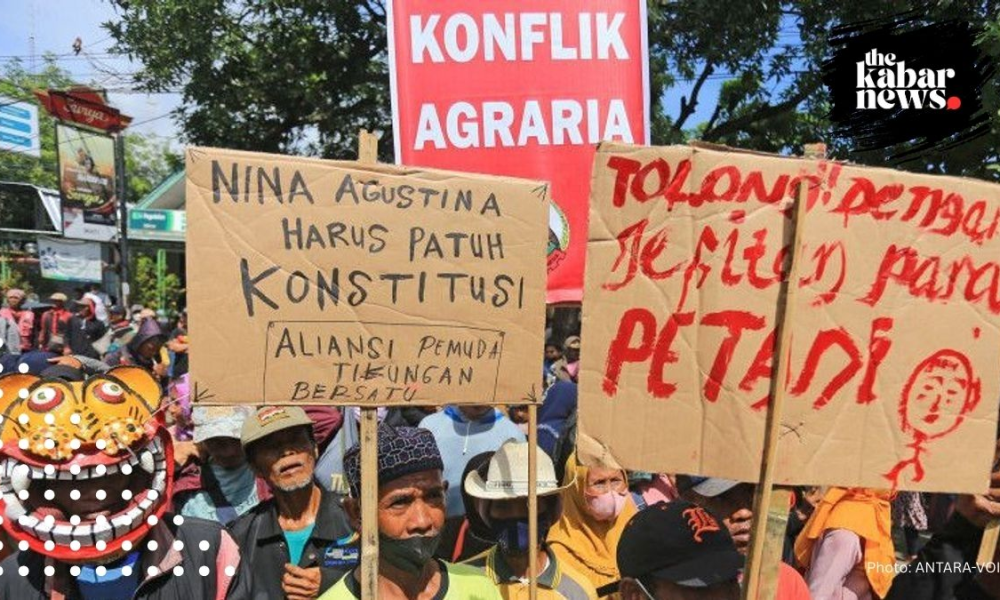
Jakarta, Thekabarnews.com—In its first year, Indonesia’s Prabowo–Gibran administration’s agrarian policies have revealed a fundamental contradiction. The government has promised many times to make the country self-sufficient in food, energy, and water, cut poverty, and boost development in villages.
Table Of Content
However, its actions on the ground have mostly brought back old policy patterns. For example, the government has given away large amounts of land, cleared forests for palm oil and food estate projects, and made it easier to get licenses in the name of investment.
The Agrarian Reform Consortium (KPA) released the 2025 End-of-Year Agrarian Report. This report shows that agrarian conflicts are rising quickly across the country. It also shows that land control is becoming more centralized and militaristic.
The study by KPA identifies three primary policy options for 2025. First, the government has centralized power by using command-style practices. Second, it has run the economy like a state-capitalist, putting big projects and business interests first. Third, it has depended increasingly on military and security services, especially the TNI and National Police, to keep the political situation stable and carry out development plans.
KPA says that this combination has made land disputes worse instead of alleviating long-standing challenges in agriculture.
Agrarian conflicts are on the rise all over Indonesia
KPA reported at least 341 agrarian conflicts in 33 provinces in 2025. These conflicts took place over a total area of 914,547 hectares. These fights affected 123,612 families in 428 localities. This is 15% more than last year.
West Java had the most conflicts (39), followed by North Sumatra (36), South Papua (23), Jakarta (21), South Sulawesi (20), and East Kalimantan (19). The conflicts also affected Central Java, Riau, Jambi, and the Riau Islands.
Agrarian tensions have led to an increase in violence and crime. At least 404 people were charged with crimes in 2025. 312 were physically abused, 19 were shot, and one person died in a land-related dispute.
According to the people who did the crimes, corporate security personnel were responsible for the most violent events (233), followed by the police (114), the military (70), and municipal police units (36).
The KPA says that this rise is mostly due to the military’s bigger engagement in agricultural matters. This is especially true in efforts to make food and energy self-sufficient and to enforce rules in forest areas.
The plantation sector is still the key driver
In 2025, the plantation sector was still the leading cause of agrarian conflict, with 135 incidents encompassing 352,156 hectares and affecting 8,734 households. This was a 21 percent rise from the year before.
There were 74 cases of palm oil plantations, 25 cases of sugarcane plantations, and six cases of food estate projects. These results indicate that the state’s goal of food and energy sovereignty often gets in the way of local communities’ land rights and spatial sovereignty.
KPA also said that the Agrarian Affairs and Spatial Planning Ministry/National Land Agency (ATR/BPN)’s moratorium policies on land-use permits did not do much to stop conflicts. This demonstrates the need for real conflict resolution, not just licensing freezes.
There were also a lot more agrarian conflicts in the mining sector. In 2025, there were 46 cases involving 58,904 hectares and 11,020 families. There were 16 incidents of nickel mining and 12 cases of coal mining.
From 2022 to 2025, KPA saw a steady rise in disputes related to mining. This raised severe worries regarding Indonesia’s energy transition strategy. Nickel is often touted as a key part of developing renewable energy. However, KPA asserts that the extraction of nickel remains closely associated with land grabbing, environmental damage, and social conflict.
The military’s involvement in land disputes
In 2025, military presence became more and more obvious in fights over land. KPA found several reasons for this trend.
First, the government made the defense minister a key player in enforcing rules in forest areas. This led to a militaristic posture that often ignored talking to local residents. The Task Force for the Restoration of Forest Areas (Satgas PKH) forced 21 people to leave their homes in North Sumatra, Riau, Jambi, and West Kalimantan. There was violence during these operations.
Second, the TNI’s territorial expansion, which included the regional military command (Kodam) and territorial development battalions, made it harder to get land for food and energy projects. In 2025, KPA reported 24 land disputes connected to military bases. The figure was a 300% increase from the previous year.
Third, direct orders from the president to protect palm oil farms and national key projects led to the large-scale deployment of military forces. In agrarian conflict areas, there were 70 reported incidences of conflict involving the TNI. This number is an 89 percent increase from the year before.
Business networks behind farm conflicts
KPA’s research also talks about how big national and international business groupings are behind many of the fights for land.
In the plantation sector, 64 percent of companies that are in dispute are linked to big companies like Royal Golden Eagle, Wilmar, Sinar Mas, Salim Group, Jardine Matheson, and state-owned businesses like PTPN.
In mining, 72% of corporations that cause conflict are connected to groups like Bakrie Group, Harita Group, and Indika Energy, and some state-owned companies, such as PT Timah, Pertamina, and PT Antam.
Furthermore, 80% of conflicts in forestry include companies that are part of RGE, Sinar Mas, Parna Raya, and Perum Perhutani.
KPA says that agrarian strife is not a side consequence but a way for companies to have cheap access to land, natural resources, and labor with the help of the government.
KPA also stated that decades of concession-driven land monopolization caused the recent flash floods and landslides in Aceh, North Sumatra, and West Sumatra. A data study reveals that 673 companies engaged in plantations, mining, and forestry control over two million hectares in the three provinces.
Seven of the eight corporations that the Environment and Forestry Ministry fined for breaking disaster-related rules also have records of fighting with local communities for land.
KPA welcomed the government’s efforts to investigate corporate accountability but warned against short-term, reactionary enforcement. Instead, KPA recommended the government do regular evaluations and revocations of permits to stop tragedies from happening again.
About the KPA
The Agrarian Reform Consortium (KPA) is a group of people that is open and free to join. KPA aims to fight for a fair agrarian system that guarantees the right to govern, own, use, and produce agrarian resources for farmers, agricultural workers, fishermen, indigenous communities, women, and the urban poor. It also wants to guarantee welfare for all Indonesian people. www.kpa.or.id







No Comment! Be the first one.